
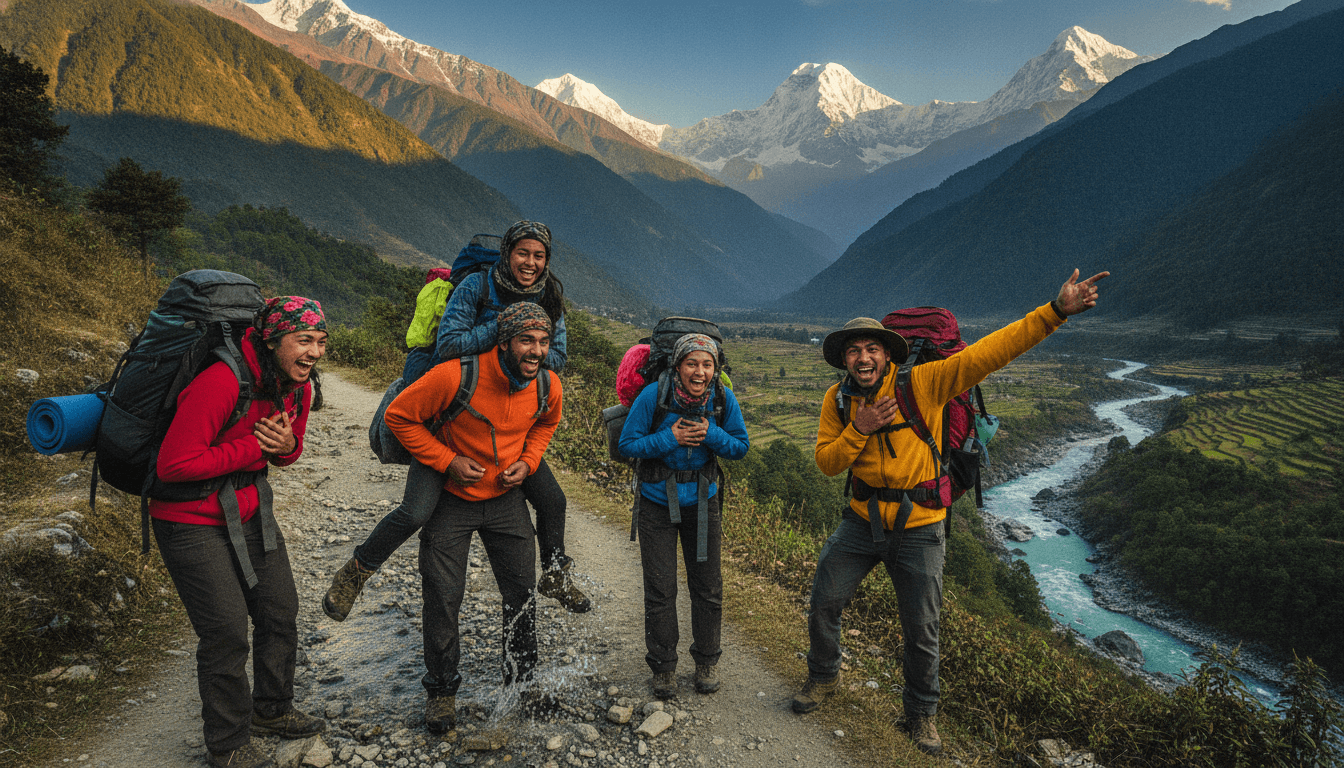
Self-Launched Annapurna Circuit Trek
13 days · Annapurna Circuit, Nepal
Peregrine Treks and Expedition charges £1,620
No-markup version: ~£690 per person
Estimate only, not a guaranteed price. Always verify costs independently before booking.
A self-launched independent version of the classic 13-day Annapurna Circuit trek. You'll arrange your own TIMS card and ACAP permit, catch local buses and shared jeeps along the trail, sleep in teahouses that are already the standard on this route, and walk the same trails — from Besisahar through Pisang and Manang, over the 5,416m Thorong La Pass to Muktinath, then down to Tatopani, Ghorepani and the Poon Hill sunrise before finishing in Pokhara and Kathmandu. No guide required (Nepal permits independent trekking on the Annapurna Circuit with a valid TIMS card). Costs are approximate and based on budget teahouse rates for a solo trekker; hiring a licensed guide (~£20-25/day) or porter is optional and will raise the total.
Day-by-day
Arrival in Kathmandu
Kathmandu
Land at Tribhuvan International Airport (KTM) and make your own way to a hostel or guesthouse in Thamel or Paknajang — the two most trekkable budget hubs. Use a metered taxi or the airport pre-paid counter (approx NPR 700-900, ~£4-5). In the afternoon head to the Nepal Tourism Board office on Bhrikutimandap Marg to sort your TIMS card (NPR 2,000, ~£12) and, if not already done, your ACAP permit (NPR 3,000, ~£18). Buy a local SIM (Ncell or NTC, ~£2-4) and a Nabil/Ace debit card if you need one. Nepal gets a 15-day visa on arrival (US$30, ~£24) — or 30 days for US$50 (~£40) — payable at the airport. Evening: street momos and a wander round Thamel.
🚌Airport taxi ~£4-5
🛏Budget guesthouse in Thamel/Paknajang (dorm or basic double, £6-10)
- →Arrange TIMS card at Nepal Tourism Board
- →Purchase ACAP permit
- →Buy local SIM card
- →Explore Thamel district
Kathmandu to Besisahar
Besisahar
Travel by local bus from Gongabu (New Bus Park) to Besisahar — the classic Annapurna Circuit trailhead. Buses leave early (from ~06:30) and take 6-8 hours on winding mountain roads. Tickets cost roughly NPR 500-700 (~£3-4). Alternatively, a share jeep from Kalanki can be faster but pricier. Overnight in a Besisahar guesthouse; check your permits are in order as the ACAP checkpoint is here. Stock up on snacks and any gear you still need.
🚌Local bus Kathmandu-Besisahar £3-4
🛏Besisahar teahouse/guesthouse (£5-8)
- →Local bus to Besisahar
- →ACAP permit check point
- →Gear and snack shopping
Besisahar to Pisang (by shared jeep)
Pisang
The rough road from Besisahar to Pisang is now the standard starting leg — most independent trekkers take a shared local jeep (approx NPR 2,500-3,500, ~£15-22) or a series of local buses via Chame. It's a long, bumpy, spectacular day through forests and waterfalls and past villages like Ngadi, Jagat and Chame. Arrive in Pisang (3,200m) for the night and start the gradual altitude adjustment. Teahouses in upper and lower Pisang are cheap and plentiful.
🚌Shared jeep Besisahar-Pisang £15-22
🛏Teahouse in Pisang (£4-6)
- →Shared jeep drive to Pisang
- →Forests and waterfall views
- →Pass through local villages
- →First high-altitude night
Pisang to Manang
Manang
A proper trekking day: choose the southern route via Hongde or the higher northern route via Ghyaru and Ngawal — the northern one is harder but gives the best views of Annapurna II and III. Start early (07:00-07:30) with a light pack. Pass through Hongde and the village of Bryanga before dropping into Manang (3,540m). Take it slow, drink water. The teahouse you pick in Manang will be your home for two nights — good time to settle, get a hot shower and order dal bhat.
🚌On foot
🛏Teahouse in Manang (£5-7)
- →Trek via southern or northern route
- →Pass through Hongde and Bryanga
- →Arrive in Manang with Annapurna range views
Manang Acclimatisation Day
Manang
A rest and acclimatisation day at 3,540m — essential before pushing higher. Spend the morning exploring Manang village and its gompa, then walk up to the Gangapurna glacier viewpoint or the small lake above Gangapurna for a short altitude-walk (back down by early afternoon). Optional side trip to the Manang Bojo gompa or a yak-head viewpoint. Evening talk on altitude sickness at the Himalayan Rescue Association in Manang (Oct-Apr), free but donations welcome.
🚌On foot
🛏Teahouse in Manang (£5-7)
- →Explore Manang village and gompa
- →Walk to Gangapurna glacier viewpoint
- →Visit the Himalayan Rescue Association for an altitude briefing
Manang to Yak Kharka
Yak Kharka
Short but altitude-heavy day. Walk out of Manang through the Jarsang Khola valley, passing the villages of Tengi and Gunsang. The landscape turns dry and barren as you climb. Many trekkers overnight at Ledar (4,250m), but the classic itinerary pushes on to Yak Kharka (4,090m) — note the trail can dip slightly after a high point. Keep the pace gentle, hydrate constantly and watch for headaches.
🚌On foot
🛏Teahouse in Yak Kharka (£6-8)
- →Trek through Jarsang Khola valley
- →Steady ascent through changing landscape
- →Reach Yak Kharka at 4,090m
Yak Kharka to Thorong Phedi
Thorong Phedi
A shorter half-day to Thorong Phedi (4,450m), crossing a small river bridge around 4,310m and climbing steadily up toward the base of Thorong La. There are two possible sleeps: lower Thorong Phedi (4,540m) or the higher Thorong High Camp (4,925m) a further hour up — High Camp cuts the pass day but is cold and rough. Most choose Phedi. Eat early, sleep early: tomorrow is the big one, and you'll be walking in the dark.
🚌On foot
🛏Teahouse at Thorong Phedi (£7-9)
- →Cross river bridge at 4,310m
- →Ascent towards Thorong Phedi
- →Prep for Thorong La Pass
Thorong La Pass to Muktinath
Muktinath
An early 04:00-05:00 start with a headtorch to climb the final 600m to Thorong La Pass (5,416m) — stone markers, prayer flags and the most famous panorama of the trek. Don't linger if cold; descend steadily to Muktinath (3,800m), where the pagoda-style Muktinath temple and its 108 water spouts are a welcome reward. Eat a proper meal, sleep well below your previous altitude.
🚌On foot
🛏Teahouse/guesthouse in Muktinath (£6-8)
- →Night trek to Thorong La Pass (5,416m)
- →Prayer flags and chortens at the pass
- →Descend to Muktinath
- →Visit Muktinath temple and its 108 water spouts
Muktinath to Tatopani
Tatopani
A rest day from walking — take a shared local jeep from Muktinath via Jomsom south to Tatopani (approx NPR 2,000-3,000, ~£12-18). The road winds along the Kali Gandaki, the deepest gorge in the world, and passes Marpha, Tukuche and Dana. Arrive in Tatopani (1,200m) in the afternoon, sleep in a simple teahouse and soak in the famous Tatopani hot springs in the evening (small entry fee, ~NPR 100-200, ~£1). It's the perfect recovery after the pass.
🚌Shared jeep Muktinath-Tatopani £12-18
🛏Teahouse in Tatopani (£5-7)
- →Scenic shared jeep drive to Tatopani
- →Evening soak in Tatopani hot springs
Tatopani to Ghorepani
Ghorepani
A demanding climbing day out of the Kali Gandaki and up into the rhododendron and oak forests of the Annapurna foothills. From Tatopani at 1,200m you climb steadily via Shikha and Chitre toward Ghorepani (2,860m) — around 1,600m of ascent, so pace yourself. Ghorepani is a nice high village with a real trekkers' atmosphere; get an early night ahead of the Poon Hill sunrise.
🚌On foot
🛏Teahouse in Ghorepani (£5-7)
- →Trek through rhododendron and oak forests
- →Explore Ghorepani village
- →Experience local Gurung culture and hospitality
Poon Hill Sunrise and Trek to Pokhara
Pokhara
Up at 04:15 to climb to Poon Hill (3,210m) for the classic Annapurna and Dhaulagiri sunrise — one of the great views in Nepal. Back for breakfast, then descend via Deurali and Tikhedhunga, cross the Birethanti suspension bridge and exit the ACAP checkpoint. From Birethanti or Nayapul catch a local bus or shared jeep to Pokhara (approx NPR 200-400, ~£1.5-3; 2 hours). Arrive in Pokhara and treat yourself — Lakeside has cheap guesthouses and a great backpacker scene.
🚌On foot + local bus/jeep to Pokhara £2-4
🛏Budget guesthouse in Pokhara, Lakeside (£6-10)
- →Sunrise from Poon Hill (3,210m)
- →Views of Dhaulagiri, Annapurna South, Machhapuchhare
- →Descend via Tikhedhunga to Birethanti
- →Local bus/jeep to Pokhara
Pokhara to Kathmandu
Kathmandu
Travel back to Kathmandu by one of the deluxe tourist buses (approx NPR 1,500-2,500, ~£10-16; 7-8 hours, book in advance the day before) or fly (Buddha Air/Yeti, ~£75-110) if you're short on time. Arrive in Kathmandu, drop your bag at a Thamel guesthouse and spend the evening exploring the old markets around Asan Tole and Kathmandu Durbar Square, or just eat and recover.
🚌Tourist bus Pokhara-Kathmandu £10-16 (or flight £75-110)
🛏Budget guesthouse in Thamel (£6-10)
- →Scenic drive to Kathmandu
- →Explore Thamel district
- →Visit Asan Tole and Kathmandu Durbar Square
- →Browse traditional artifacts and handicrafts
Departure from Kathmandu
Kathmandu
Last morning in Kathmandu. If your flight is late, squeeze in Boudhanath Stupa or Swayambhunath (monkey temple) — both easy from Thamel and cheap to enter. Allow plenty of time for the airport and pay any outstanding local bills. Airport taxi ~£4-5. Say goodbye to Nepal — and start thinking about the EBC trek.
🚌Airport taxi £4-5
🛏None (checkout)
- →Optional Boudhanath or Swayambhunath visit
- →Airport transfer
- →Departure
Self-launched vs. Peregrine Treks and Expedition
| This itinerary (self-launched) | Peregrine Treks and Expedition | |
|---|---|---|
| Price per person | ~£690 | £1,620 |
| Duration | 13 days | 13 days |
| Who books it | You and your group, direct | Tour operator, guided group |
| Savings | £930 per person (57%) | |
Estimate only, not a guaranteed price. Always verify costs independently before booking.
Want to see more Peregrine Treks and Expedition-style trips? Check them out here.~£690
estimated per person
You never pay Travel Crew for this — you pay hostels, transport, and activity providers directly, the same as if you'd booked it all yourself.
This publishes your dates so other travellers can find and join you — no tour operator needed.
Customise with Tour BusterCreated by

Travel Crew
0 trips
Frequently asked questions
How much does Self-Launched Annapurna Circuit Trek cost?+
Doing it yourself with this self-launched itinerary costs an estimated £690 per person for 13 days in Annapurna Circuit, Nepal. This is an AI-generated estimate based on typical budget-traveller prices — actual costs will vary by season and how you book.
Is this cheaper than booking with Peregrine Treks and Expedition?+
Yes — Peregrine Treks and Expedition charges around £1,620 per person for a similar tour. Doing the same route independently, using the same standard of accommodation and activities, costs an estimated £690 — a saving of roughly £930 (57%) per person.
How long is the Annapurna Circuit, Nepal trip?+
This itinerary runs 13 days, covering 13 day-by-day stops through Annapurna Circuit, Nepal.
How do I join this trip?+
You can join an existing open departure using this itinerary if one is scheduled, or launch your own departure with your own dates and invite other travellers to join you — no tour operator required.
Isn't it easier to just use a tour operator?+
Well, yes, a tour operator will book all the individual parts of your travel for you and provide a guide. That's obvious, but doing this has the potential to save the group thousands, which can in turn improve your itinerary substantially or save you huge amounts of money. Also, when you launch a departure, Travel Crew has tools in place to help you book the individual sections of the trip or make it easier for you to do this as a group. Really, you do not need a middle man. If you are more comfortable paying more and using a middle man, then you should certainly do this.
Is it safer to book through a tour operator?+
Arguably, there isn't much difference. A self-launched trip runs on the same principle as a group travel crew: collective responsibility, everyone looking out for each other, the same way it would if a group of friends organised the trip themselves — because that's exactly what's happening. You should always take out travel insurance before you go, self-launched or not; that doesn't change either way. Every open departure is published publicly with real dates and a real trip organiser, so it's never an anonymous arrangement, and our support team is reachable any time you need help, including in an emergency while you're away. Longer-term, we're building direct relationships with ground DMCs in popular destinations, offered as an optional paid add-on for extra on-the-ground support. Ultimately, though, the group is responsible for its own conduct and safety on a self-launched trip, same as on any trip you plan yourself.
What kind of trip is this?+
This is a adventure, hiking, culture trip through Annapurna Circuit, Nepal, self-launched rather than run by a tour operator — you organise it with a group you find or bring yourself.
Would you like to name the operator, name the trip, or have any suggestions about how to improve this itinerary?
Drop your comment below — if you've done a similar route, tell us what worked, what you'd add, or what you'd skip.
No comments yet — be the first to share your take.
Sign in to leave a comment.