
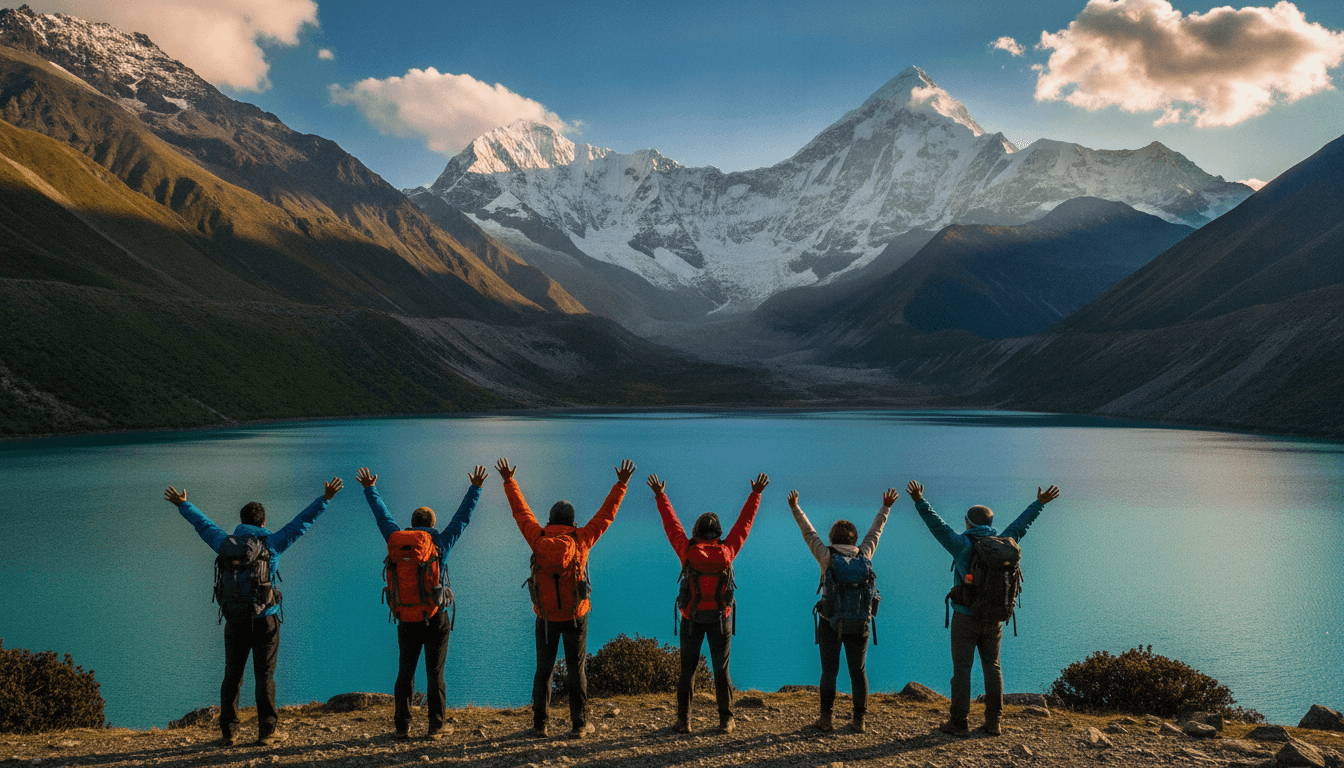
Short Annapurna Circuit Trek: Self-Launched 10-Day Version
10 days · Annapurna Circuit, Nepal
Himalayan Recreation Treks & Expedition charges £780
No-markup version: ~£355 per person
Estimate only, not a guaranteed price. Always verify costs independently before booking.
An independent, self-launched take on the classic 10-day short Annapurna Circuit — Kathmandu to Chame by local bus, then trekking the Marsyangdi valley through Pisang, Ngawal, Manang, Yak Kharka and Thorong La (5,416m) down to Muktinath, finishing with a jeep to Pokhara and a tourist bus back to Kathmandu. You organise your own TIMS card and ACAP permit, walk without a guide (or hire a local porter-guide in Kathmandu for ~£20-25/day if you prefer), and sleep in teahouses along the trail. Costs are approximate backpacker rates in GBP and assume shared teahouse rooms and dal bhat-style meals; add a buffer for hot showers, Wi-Fi, charging and weather delays.
Day-by-day
Kathmandu to Chame by local bus and shared jeep
Kathmandu → Besisahar → Chame
Pick up your ACAP permit and TIMS card at the Nepal Tourism Board office in Kathmandu (bring passport photos; ~£30 total) — do this the day before if you can. Early start: take a local bus or shared microbus from Kathmandu's Gongabu (New Bus Park) to Besisahar (~6-7 hours, ~£4-5), following the Trishuli River with views of Manaslu and Lamjung Himal. From Besisahar, continue on a shared jeep or local bus up the rough road to Chame (~4-5 hours, ~£8-10) — the road is bumpy but the scenery through the Marsyangdi gorge is superb. Check into a teahouse in Chame, eat dal bhat and get an early night at 2,710m.
🚌Local bus Kathmandu–Besisahar (~£4-5, 6-7h) + shared jeep Besisahar–Chame (~£8-10, 4-5h)
🛏Teahouse in Chame (shared twin, basic, ~£5-7)
- →Nepal Tourism Board permit office (ACAP + TIMS)
- →Scenic drive along the Trishuli River
- →Shared jeep up the Marsyangdi gorge to Chame
Chame to Pisang along the Marsyangdi
Chame → Pisang
First proper trekking day: follow the Marsyangdi River bank through dense pine forest, crossing suspension bridges including the one near Swarga Dwari. The trail is gentle-to-moderate and takes roughly 5-6 hours to Pisang (3,300m). Walk the lower route via Hongde if you want an easier day, or the higher route via Ghyaru later on. Teahouse in Upper or Lower Pisang — Upper Pisang has the better mountain views for sunrise.
🚌On foot, ~5-6 hours
🛏Teahouse in Pisang (shared twin, ~£5-6)
- →Trek along the Marsyangdi River
- →Pine forest walking and suspension bridges
- →Optional side trip to Upper Pisang monastery
Pisang to Ngawal via Ghyaru viewpoint
Pisang → Ghyaru → Ngawal
Take the high route: climb steadily through pine and juniper forest, cross the suspension bridge over Khumi Khola and push up to the Ghyaru viewpoint where Annapurna II, Lamjung Himal, Tilicho Peak and Pisang Peak line up in front of you. Continue through the Tibetan-styled village of Ghyaru and on to Ngawal (3,660m) — about 5-6 hours of walking. Ngawal is a quieter, traditional village and a great acclimatisation stop.
🚌On foot, ~5-6 hours
🛏Teahouse or homestay in Ngawal (shared twin, ~£5-6)
- →High route via Ghyaru viewpoint
- →Annapurna II and Pisang Peak panoramas
- →Tibetan-style village walk
Ngawal to Manang through juniper forest
Ngawal → Manang
A shorter, easier day (3-4 hours) descending gently through pine and juniper forest, past a monastery and scattered ethnic settlements, into Manang village (3,540m). Take it slow — this is an acclimatisation day. Manang has bakeries, a small hospital/clinic, gear shops and the best selection of teahouses on this section, so it's a good place to restock cash and snacks (there are no ATMs beyond Besisahar/Chame).
🚌On foot, ~3-4 hours
🛏Teahouse in Manang (shared twin, ~£6-8)
- →Forest and monastery walk
- →Manang village exploration
- →Bakery stop and gear/cash top-up
Manang acclimatisation: Gangapurna Lake hike
Manang
Rest and acclimatise. Morning hike up to Gangapurna Lake (about 1 hour up, 3,840m) for close views of Gangapurna glacier and the Annapurna range — go early for the calmest water and fewest people. Spend the afternoon exploring Manang, chatting with locals, visiting the Gompa and maybe taking the short walk to Chongkor viewpoint for sunset. Hydrate, eat well and check your sleep quality before heading higher.
🚌On foot (acclimatisation hike only)
🛏Teahouse in Manang (shared twin, ~£6-8)
- →Gangapurna Lake acclimatisation hike
- →Chongkor viewpoint sunset walk
- →Manang village and gompa visit
Manang to Yak Kharka
Manang → Gunsang → Yak Kharka
A short, steady climb of 3-4 hours: ascend to Gunsang, walk through open meadows with yaks grazing, cross the suspension bridge over the Thorung Khola and reach Yak Kharka (4,050m). The altitude is noticeable now — keep the pace slow and drink plenty. Teahouses here are simple but cosy; expect a wood stove and an early dinner.
🚌On foot, ~3-4 hours
🛏Teahouse in Yak Kharka (shared twin, basic, ~£5-6)
- →Meadow walking towards Gunsang
- →Thorung Khola suspension bridge
- →Yak spotting around Yak Kharka
Yak Kharka to Thorong Phedi
Yak Kharka → Thorong Phedi
Follow the Jarang Khola upstream for 3-4 hours through cliff-surrounded meadows to Thorong Phedi (4,450m). Consider pushing on 45 minutes further to High Camp (4,925m) if you're feeling strong and acclimatised — it shaves an hour off tomorrow's pass day — but only if you've slept well. Otherwise settle into Thorong Phedi, eat early and set your alarm for a pre-dawn start.
🚌On foot, ~3-4 hours
🛏Teahouse at Thorong Phedi or High Camp (shared, basic, ~£5-7)
- →Jarang Khola valley walk
- →Cliffside meadow trail
- →Optional move up to High Camp
Thorong La Pass (5,416m) to Muktinath
Thorong Phedi → Thorong La → Muktinath
The big day — start at 4-5am with a headtorch and climb steadily for 3-4 hours to Thorong La (5,416m), the high point of the circuit. It's cold, windy and slow going; keep moving, watch for altitude symptoms and turn back if you feel unwell. From the pass it's a long 4-5 hour descent to Muktinath (3,800m), where you can visit the temple complex with its 108 water spouts and eternal flame. A hot shower and a proper meal are well earned.
🚌On foot, ~8-9 hours
🛏Guesthouse in Ranipauwa/Muktinath (shared twin, ~£6-8)
- →Sunrise ascent to Thorong La Pass (5,416m)
- →Descent to Muktinath
- →Muktinath temple complex visit
Muktinath to Pokhara by shared jeep
Muktinath → Jomsom → Pokhara
Early morning visit to Muktinath temple before the crowds arrive, then take a shared jeep or local bus down the Kali Gandaki valley via Jomsom and Beni to Pokhara (~7-9 hours, ~£10-14). The jeep ride is long and dusty but the gorge scenery between the Annapurna and Dhaulagiri ranges is spectacular. Arrive in Pokhara, check into a Lakeside guesthouse and treat yourself to a lakeside dinner.
🚌Shared jeep/bus Muktinath–Pokhara (~£10-14, 7-9h)
🛏Guesthouse in Pokhara Lakeside (private twin, ~£10-14)
- →Sunrise at Muktinath temple
- →Kali Gandaki gorge drive
- →Lakeside evening in Pokhara
Pokhara to Kathmandu
Pokhara → Kathmandu
Take a tourist bus from Pokhara's tourist bus park to Kathmandu (~7-8 hours, ~£8-10), or a 25-minute flight (~£70-90) if you're short on time. Buses usually leave around 7am and stop for lunch. Arrive in Kathmandu in the afternoon/evening with time for last-minute souvenir shopping in Thamel before your onward flight.
🚌Tourist bus Pokhara–Kathmandu (~£8-10, 7-8h)
🛏Not included — book a Thamel guesthouse (~£10-15) if staying the night
- →Scenic highway drive back to Kathmandu
- →Thamel souvenir shopping
Self-launched vs. Himalayan Recreation Treks & Expedition
| This itinerary (self-launched) | Himalayan Recreation Treks & Expedition | |
|---|---|---|
| Price per person | ~£355 | £780 |
| Duration | 10 days | 10 days |
| Who books it | You and your group, direct | Tour operator, guided group |
| Savings | £425 per person (54%) | |
Estimate only, not a guaranteed price. Always verify costs independently before booking.
Want to see more Himalayan Recreation Treks & Expedition-style trips? Check them out here.~£355
estimated per person
You never pay Travel Crew for this — you pay hostels, transport, and activity providers directly, the same as if you'd booked it all yourself.
This publishes your dates so other travellers can find and join you — no tour operator needed.
Customise with Tour BusterCreated by

Travel Crew
0 trips
Frequently asked questions
How much does Short Annapurna Circuit Trek: Self-Launched 10-Day Version cost?+
Doing it yourself with this self-launched itinerary costs an estimated £355 per person for 10 days in Annapurna Circuit, Nepal. This is an AI-generated estimate based on typical budget-traveller prices — actual costs will vary by season and how you book.
Is this cheaper than booking with Himalayan Recreation Treks & Expedition?+
Yes — Himalayan Recreation Treks & Expedition charges around £780 per person for a similar tour. Doing the same route independently, using the same standard of accommodation and activities, costs an estimated £355 — a saving of roughly £425 (54%) per person.
How long is the Annapurna Circuit, Nepal trip?+
This itinerary runs 10 days, covering 10 day-by-day stops through Annapurna Circuit, Nepal.
How do I join this trip?+
You can join an existing open departure using this itinerary if one is scheduled, or launch your own departure with your own dates and invite other travellers to join you — no tour operator required.
Isn't it easier to just use a tour operator?+
Well, yes, a tour operator will book all the individual parts of your travel for you and provide a guide. That's obvious, but doing this has the potential to save the group thousands, which can in turn improve your itinerary substantially or save you huge amounts of money. Also, when you launch a departure, Travel Crew has tools in place to help you book the individual sections of the trip or make it easier for you to do this as a group. Really, you do not need a middle man. If you are more comfortable paying more and using a middle man, then you should certainly do this.
Is it safer to book through a tour operator?+
Arguably, there isn't much difference. A self-launched trip runs on the same principle as a group travel crew: collective responsibility, everyone looking out for each other, the same way it would if a group of friends organised the trip themselves — because that's exactly what's happening. You should always take out travel insurance before you go, self-launched or not; that doesn't change either way. Every open departure is published publicly with real dates and a real trip organiser, so it's never an anonymous arrangement, and our support team is reachable any time you need help, including in an emergency while you're away. Longer-term, we're building direct relationships with ground DMCs in popular destinations, offered as an optional paid add-on for extra on-the-ground support. Ultimately, though, the group is responsible for its own conduct and safety on a self-launched trip, same as on any trip you plan yourself.
What kind of trip is this?+
This is a adventure, hiking, budget trip through Annapurna Circuit, Nepal, self-launched rather than run by a tour operator — you organise it with a group you find or bring yourself.
Would you like to name the operator, name the trip, or have any suggestions about how to improve this itinerary?
Drop your comment below — if you've done a similar route, tell us what worked, what you'd add, or what you'd skip.
No comments yet — be the first to share your take.
Sign in to leave a comment.