
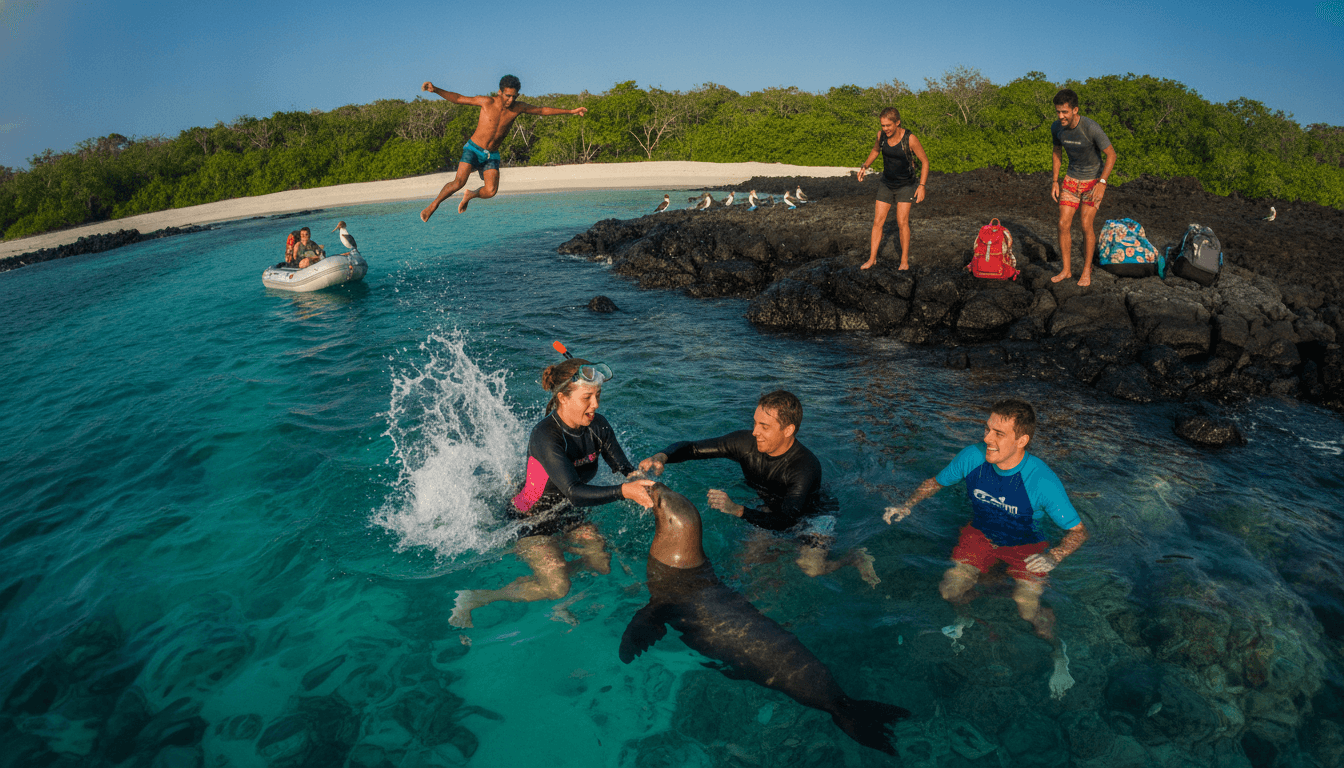
Self-Launched Galápagos Island Hopper: San Cristóbal to Santa Cruz
7 days · Galápagos Islands, Ecuador
G Adventures charges £2,200
No-markup version: ~£950 per person
Estimate only, not a guaranteed price. Always verify costs independently before booking.
A self-launched island-hopping version of G Adventures' Upgraded Land Galápagos (trip code SEGU) — same three islands, same wildlife highlights, booked independently. Fly into San Cristóbal, snorkel Kicker Rock, cross to Floreana for sea lions and highland birdlife, then on to Isabela for Tintoreras sharks and the tortoise breeding centre, finishing in Puerto Ayora on Santa Cruz. Instead of private speedboats and a naturalist CEO, you use the scheduled public inter-island ferries (lanchas rápidas), take locally run snorkel trips, and stay in guesthouses and small budget hotels. Bear in mind you must organise your own Galápagos National Park permit and TCT transit card, and that a certified naturalist guide is required for some park sites (arranged through local operators). Costs are approximate per-person estimates in GBP; park fees, flights from the mainland and the $20 TCT card are shown separately.
Day-by-day
Arrive San Cristóbal — Puerto Baquerizo Moreno
San Cristóbal Island
Fly from Quito or Guayaquil to San Cristóbal (Isla Baltra/Seymour is the usual mainland gateway — check LATAM/Avianca for ~£180-260 return if booked early; internal one-way sectors aren't possible, so most travellers fly into San Cristóbal and out of Baltra or vice versa). Buy your $20 TCT transit control card at the Quito/Guayaquil airport counter before boarding, and pay the $200 Galápagos National Park entry fee in cash on arrival. Take a $2 taxi or the 20-minute walk to your guesthouse in Puerto Baquerizo Moreno. Spend the afternoon walking to Playa Mann for your first sea lion and marine iguana encounters, and pick up snorkel gear rental (~£8/day) if you don't have your own. Book your Kicker Rock trip for tomorrow at any of the dive shops on the malecón (roughly £100-120 including wetsuit, mask, lunch and guide).
🚌Flight Quito/Guayaquil to San Cristóbal; $2 taxi from airport; walk around town
🛏Guesthouse or small budget hotel in Puerto Baquerizo Moreno (twin/double, ~£25-35/night)
- →Playa Mann sea lion colony
- →Book Kicker Rock snorkel trip
- →Malecón evening and sea lion spotting
Kicker Rock (León Dormido) snorkel day
San Cristóbal Island
Full-day boat trip to Kicker Rock, the volcanic tuff cone the G Adventures group visits on Day 2 — you'll do the same site with a local operator. Most trips run roughly 7.30am-3pm with two snorkel stops (Kicker Rock plus a beach or bay), lunch and a naturalist guide included. Expect sharks, turtles, rays, and if you're lucky hammerheads in the channel. Seas can be choppy — bring motion-sickness tablets. Evenings back in town are cheap: a set almuerzo lunch or dinner of fish, rice and plantain runs about £6-8.
🚌Local tour boat to Kicker Rock (included in trip cost); walking in town
🛏Guesthouse or small budget hotel in Puerto Baquerizo Moreno
- →Kicker Rock snorkelling excursion
- →Beach stop and wildlife spotting en route
- →Optional: La Lobería beach walk (~$8 taxi)
Ferry to Floreana — black-sand beaches and sea lions
Floreana Island
Take the morning public speedboat (lancha rápida) from San Cristóbal to Floreana — around 1.5-2 hours, usually $50-60 one way, book a day ahead through your guesthouse or at the pier. Floreana is tiny and quiet; accommodation is limited to a handful of family-run hospedajes, so book in advance. Walk the black-sand beach south of Puerto Velasco Ibarra to La Lobería, where a resident sea lion colony lounges on the rocks and snorkelling is excellent. Eat at one of the local family restaurants — this is the same community-tourism model the G Adventures group supports, just booked directly. Cash only on the island; there are no ATMs.
🚌Public inter-island speedboat San Cristóbal to Floreana (~$50-60, ~£45); walking
🛏Family-run hospedaje on Floreana (~£25-35/night)
- →La Lobería black-sand beach and sea lion colony
- →Snorkelling at La Lobería
- →Lunch at a local family restaurant
Floreana highlands, then ferry to Isabela
Isabela Island
Hire a local guide early for a walk up into the Floreana highlands (~£25-35 for a half-day, arrange the night before) to see the pirate caves, freshwater springs and birdlife including finches and frigatebirds. Catch the midday/early-afternoon speedboat to Isabela (roughly 2 hours, ~$60-70). Settle into Puerto Villamil, then take an afternoon boat excursion to Islote Tintoreras — a short 15-minute panga ride — where white-tip reef sharks rest in the channel, marine iguanas pile on the rocks, and penguins and blue-footed boobies patrol. Trips go for around $40-50 and last about 2.5 hours.
🚌Local guide for highlands walk; public speedboat Floreana to Isabela (~$60-70, ~£55); panga to Tintoreras
🛏Guesthouse or small hotel in Puerto Villamil, Isabela (~£25-35/night)
- →Floreana highlands guided nature walk
- →Islote Tintoreras boat excursion and snorkel
- →White-tip reef shark, penguin and marine iguana spotting
Isabela — Sierra Negra or Los Túneles, plus tortoise centre
Isabela Island
Choose your big Isabela day. Hikers can join a Sierra Negra volcano walk to the vast crater rim (roughly £50-70 with transport and guide, ~5-6 hours). Snorkellers should head to Los Túneles, a lava-tunnel snorkel site about 40 minutes by boat known for sea turtles, seahorses and white-tip sharks (~£110-130 including guide, wetsuit and lunch). Budget travellers can instead rent a bike (~£8) and ride the flat sandy track to the Wall of Tears. In the afternoon, walk out to the Giant Tortoise Breeding Centre just outside town — entry is a couple of dollars and it's an easy, worthwhile hour among captive-bred tortoises.
🚌Local tour transport for Sierra Negra or Los Túneles; bike or walk to breeding centre
🛏Guesthouse or small hotel in Puerto Villamil, Isabela
- →Sierra Negra volcano crater hike OR Los Túneles snorkelling
- →Giant Tortoise Breeding Centre visit
- →Optional: Wall of Tears bike ride
Ferry to Santa Cruz — Puerto Ayora and Darwin Research Station
Santa Cruz Island
Morning public speedboat from Isabela to Puerto Ayora on Santa Cruz (about 2-2.5 hours, ~$35-45). Check into a guesthouse near the waterfront and spend the afternoon at the Fausto Llerena Breeding Centre and Charles Darwin Research Station — entry is free or a nominal donation, and it's the same site on the G itinerary (admission to the station is free). Then head to Tortuga Bay: a 20-minute walk plus a 2.5km sandy trail leads to a white-sand beach with marine iguanas and pelicans; you can rent a kayak there for about £12-15. Evening on Avenida Charles Darwin for cheap seafood and ceviche.
🚌Public inter-island speedboat Isabela to Santa Cruz (~$35-45, ~£32); walking to Tortuga Bay
🛏Guesthouse or budget hotel in Puerto Ayora (~£30-40/night)
- →Fausto Llerena Breeding Centre and Charles Darwin Research Station
- →Tortuga Bay beach walk
- →Optional: kayaking or snorkelling at Tortuga Bay
- →Waterfront dinner in Puerto Ayora
Depart Santa Cruz (or extra Highlands day)
Santa Cruz Island / Baltra
If your flight allows, take an early morning highlands tour (~£45-55 with a local operator) to see giant tortoises in the wild at El Chato reserve, plus the lava tunnels — a great last stop. Then take the public bus to the Baltra ferry channel ($5 ferry + $5 bus, about an hour total) and fly out from Baltra to Guayaquil or Quito. If you're flying from San Cristóbal instead, allow a full half-day for the ferry back and onward flight. Budget a little leftover cash for airport departure formalities and any last-minute souvenirs.
🚌Public bus and ferry to Baltra airport (~$10-15 total); flight to mainland (~£150-220 if not already included in return fare)
🛏None — overnight flight or onward travel
- →Optional: Santa Cruz highlands giant tortoise reserve and lava tunnels
- →Baltra ferry crossing
Self-launched vs. G Adventures
| This itinerary (self-launched) | G Adventures | |
|---|---|---|
| Price per person | ~£950 | £2,200 |
| Duration | 7 days | 7 days |
| Who books it | You and your group, direct | Tour operator, guided group |
| Savings | £1,250 per person (57%) | |
Estimate only, not a guaranteed price. Always verify costs independently before booking.
Want to see more G Adventures-style trips? Check them out here.~£950
estimated per person
You never pay Travel Crew for this — you pay hostels, transport, and activity providers directly, the same as if you'd booked it all yourself.
This publishes your dates so other travellers can find and join you — no tour operator needed.
Customise with Tour BusterCreated by

Travel Crew
0 trips
Frequently asked questions
How much does Self-Launched Galápagos Island Hopper: San Cristóbal to Santa Cruz cost?+
Doing it yourself with this self-launched itinerary costs an estimated £950 per person for 7 days in Galápagos Islands, Ecuador. This is an AI-generated estimate based on typical budget-traveller prices — actual costs will vary by season and how you book.
Is this cheaper than booking with G Adventures?+
Yes — G Adventures charges around £2,200 per person for a similar tour. Doing the same route independently, using the same standard of accommodation and activities, costs an estimated £950 — a saving of roughly £1,250 (57%) per person.
How long is the Galápagos Islands, Ecuador trip?+
This itinerary runs 7 days, covering 7 day-by-day stops through Galápagos Islands, Ecuador.
How do I join this trip?+
You can join an existing open departure using this itinerary if one is scheduled, or launch your own departure with your own dates and invite other travellers to join you — no tour operator required.
Isn't it easier to just use a tour operator?+
Well, yes, a tour operator will book all the individual parts of your travel for you and provide a guide. That's obvious, but doing this has the potential to save the group thousands, which can in turn improve your itinerary substantially or save you huge amounts of money. Also, when you launch a departure, Travel Crew has tools in place to help you book the individual sections of the trip or make it easier for you to do this as a group. Really, you do not need a middle man. If you are more comfortable paying more and using a middle man, then you should certainly do this.
Is it safer to book through a tour operator?+
Arguably, there isn't much difference. A self-launched trip runs on the same principle as a group travel crew: collective responsibility, everyone looking out for each other, the same way it would if a group of friends organised the trip themselves — because that's exactly what's happening. You should always take out travel insurance before you go, self-launched or not; that doesn't change either way. Every open departure is published publicly with real dates and a real trip organiser, so it's never an anonymous arrangement, and our support team is reachable any time you need help, including in an emergency while you're away. Longer-term, we're building direct relationships with ground DMCs in popular destinations, offered as an optional paid add-on for extra on-the-ground support. Ultimately, though, the group is responsible for its own conduct and safety on a self-launched trip, same as on any trip you plan yourself.
What kind of trip is this?+
This is a adventure, wildlife, backpacker trip through Galápagos Islands, Ecuador, self-launched rather than run by a tour operator — you organise it with a group you find or bring yourself.
Would you like to name the operator, name the trip, or have any suggestions about how to improve this itinerary?
Drop your comment below — if you've done a similar route, tell us what worked, what you'd add, or what you'd skip.
No comments yet — be the first to share your take.
Sign in to leave a comment.