
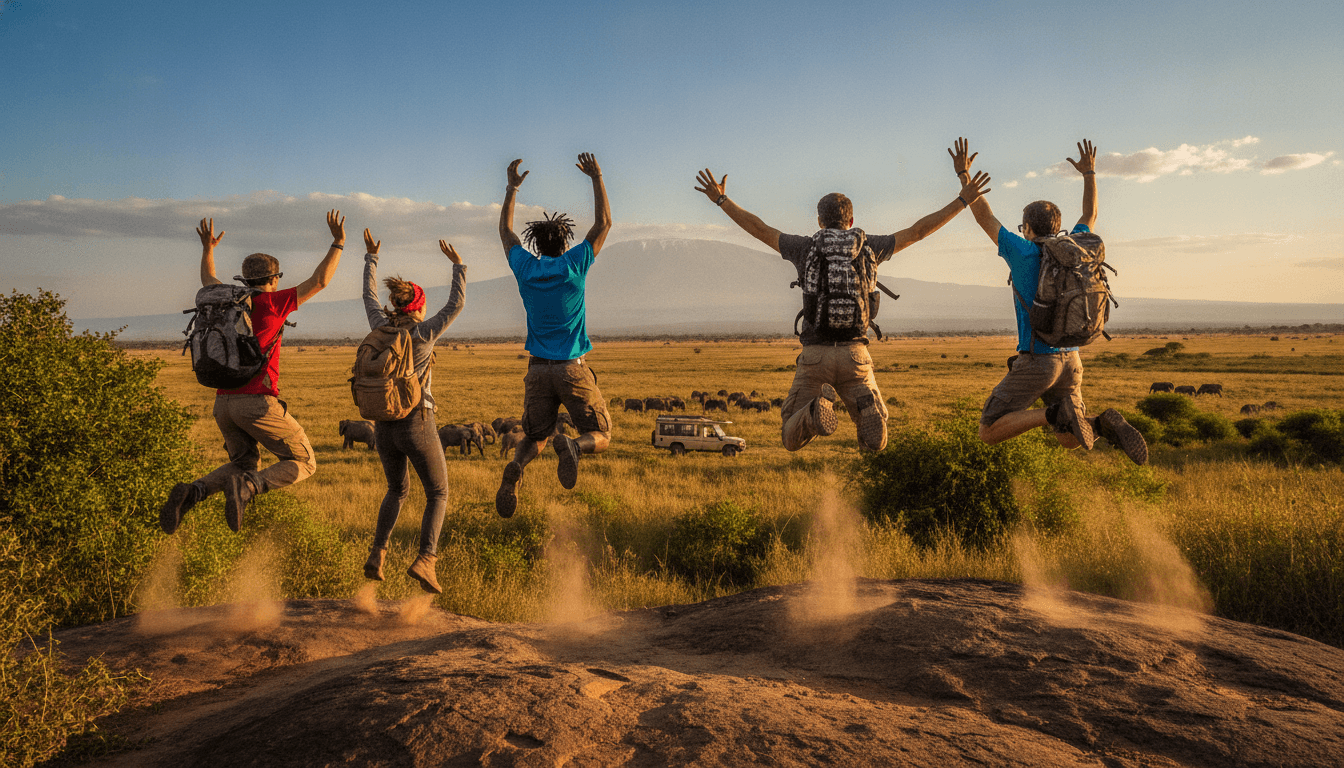
Kilimanjaro Northern Circuit — Self-Launched 8-Day Summit Trek
8 days · Kilimanjaro (Northern Circuit), Tanzania
Click Expeditions charges £2,320
No-markup version: ~£1,755 per person
Estimate only, not a guaranteed price. Always verify costs independently before booking.
A self-launched version of Click Expeditions' 8-day Northern Circuit climb: the same Londorossi Gate → Lemosho Glades → Shira Plateau → Moir Valley → Buffalo Camp → Third Cave → School Hut → Uhuru Peak (5,895m) → Mweka Gate route, booked directly with a licensed Moshi/Kilimanjaro operator rather than through a marketplace listing. Kilimanjaro National Park legally requires every climber to be accompanied by a licensed guide and porters, so this is not a fully independent trek — the savings come from booking direct, choosing a mid-range rather than premium outfitter, arranging your own flights/local transfers and Moshi guesthouse nights, and joining a group departure to share the fixed park and crew costs. Budget roughly £1,550–1,850 per person all-in from Kilimanjaro International Airport (JRO), versus ~£2,300+ for the marketplace package. Park fees alone (conservation, camping, rescue, crew permits) run to roughly $900–1,000 per person for this route and are non-negotiable — get them itemised in writing. All figures are approximate.
Day-by-day
Arrive Kilimanjaro Airport (JRO) → Moshi
Moshi
Fly into Kilimanjaro International (JRO) — return fares from the UK are usually £550–800 if booked 2–3 months out. Skip the operator's private airport transfer and take a pre-booked shared shuttle or local taxi from the airport to Moshi town, about 45–60 minutes (£15–25 for the car, cheaper shared). Overnight at a Moshi guesthouse (e.g. around Kaloleni or Rau) — the standard arrangement is a night before and a night after the climb included in most direct trek packages, or bookable separately from £20–35 for a double. Use the afternoon to meet your guide for the pre-climb briefing, hire any missing gear (sleeping bag, down jacket, poles — roughly £2–3 per item per day) and buy snacks and a 3-litre water bladder. Change money and buy a local SIM (Vodafone/Tigo, ~£5) — signal is patchy but useful on the lower mountain. Early night.
🚌JRO airport shared shuttle/taxi to Moshi, £10–20 per person
🛏Moshi guesthouse (budget double, £20–35/night)
- →Meet trek guide for briefing and gear check
- →Gear hire and snack shopping in Moshi
- →Buy local SIM card
Moshi → Londorossi Gate → Mti Mkubwa Camp (2,650m)
Londorossi Gate / Mti Mkubwa
The trek proper starts with the 4WD transfer from Moshi to Londorossi Park Gate (approx 3 hours) — this is included in virtually every direct-booked package as part of the crew and vehicle logistics. Complete park registration and permits at the gate (allow 1–2 hours; your outfitter handles the paperwork, but check the permit fees are included). Continue on the rough forest track to Lemosho Glades, then a gentle 2–3 hour, 6km forest trail through montane rainforest to Mti Mkubwa ('Big Tree') Camp. Prime colobus and blue monkey territory, and the last night of real warmth — enjoy it.
🚌4WD transfer Moshi → Londorossi Gate → Lemosho Glades (included in trek package)
🛏Camping (tent) at Mti Mkubwa — provided by operator
- →Londorossi Gate park registration
- →Rainforest hike to Mti Mkubwa Camp (6km, 2–3 hrs)
Mti Mkubwa → Shira 1 Camp (3,610m)
Shira Ridge / Shira 1
A longer day out of the forest: hike through heather moorland, cross several streams and climb over Shira Ridge before descending slightly to Shira 1 on the edge of the Shira Plateau. Around 8km and 4–5 hours. Slower is better — 'pole pole' (slowly slowly) is the whole game on Kilimanjaro and this is where acclimatisation starts to matter. Drink 3–4 litres, eat everything your cook puts in front of you, and get your twice-daily health check (oxygen saturation, pulse) done properly. Sunset over the plateau from Shira 1 is one of the best views of the trip.
🚌On foot
🛏Camping (tent) at Shira 1 Camp
- →Heather moorland hike across Shira Ridge (8km)
- →Stream crossings
- →Acclimatisation walk in the afternoon
Shira Plateau → Moir Camp (4,200m)
Shira Plateau / Moir Camp
Gentle morning across the Shira Plateau to Shira 2, then north-east through the 'Garden of the Senecios' (giant groundsel) into high alpine desert, and on to Moir Camp in the Moir Valley — the long day of the lower route at about 14km and 6–8 hours. This is the point where the Northern Circuit breaks away from the crowded Machame traffic and you'll suddenly be sharing the mountain with very few people. Cold nights now — expect below freezing, so a proper -10°C to -15°C bag matters.
🚌On foot
🛏Camping (tent) at Moir Camp
- →Cross Shira Plateau to Shira 2 Camp
- →Garden of the Senecios
- →Northern Circuit trek to Moir Camp (14km)
Moir Valley → Buffalo Camp (4,020m)
Moir Valley / Buffalo Camp
A moderately steep haul out of Moir Valley, then a traverse around the northern slopes of Kibo to Buffalo Camp — 12km, 5–6 hours, with the summit snows of Kibo directly ahead. Optional afternoon side-trip to the top of Little Lent Hill (4,375m) for extra acclimatisation if you're feeling good. Distances are shorter here but altitude makes them feel double; walk in the morning and rest in the afternoon.
🚌On foot
🛏Camping (tent) at Buffalo Camp
- →Climb out of Moir Valley
- →Northern Circuit traverse around Kibo to Buffalo Camp (12km)
- →Optional acclimatisation hike to Little Lent Hill (4,375m)
Buffalo Camp → Third Cave (3,800m)
Buffalo Ridge / Rongai Third Cave
Up over Buffalo Ridge, down to Porfu Camp, then around the northern slopes to Rongai Third Cave — 8km and 5–7 hours, entering the true wilderness zone with views towards the Kenyan plains. Third Cave is your base for a short night before School Hut. Sort and pack your summit kit tonight: layering system, headtorch with spare batteries, water bottle that won't freeze (a Nalgene in a sock), and snacks in an inside pocket so they stay soft.
🚌On foot
🛏Camping (tent) at Rongai Third Cave
- →Buffalo Ridge climb
- →Descend to Porfu Camp
- →Trek to Rongai Third Cave (8km)
Third Cave → School Hut (4,750m) — summit staging post
The Saddle / School Hut
A steady incline across the Saddle between Kibo and Mawenzi — the eerie, lunar-looking plain between the two peaks — then south-west to School Hut, 15km in 4–5 hours. Early dinner (usually 5–6pm) and an attempt to sleep before the midnight wake-up. Hot tea and biscuits at roughly 11:30pm, then off. Final check that your water hasn't frozen and your headtorch is on your head, not in your pack.
🚌On foot
🛏Camping (tent) at School Hut
- →Cross the Saddle between Kibo and Mawenzi (15km)
- →Reach School Hut (4,750m)
- →Early dinner and summit prep
Summit day: Uhuru Peak (5,895m) → Millennium Camp (3,950m)
School Hut / Uhuru Peak / Millennium Camp
Wake at 11pm, on the trail before midnight. Steep switchbacks up Kibo's scree slope in the dark, resting at Hans Meyer Cave, then on to Gilman's Point (5,681m) on the crater rim — usually 5–6 hours. Around the crater rim to Uhuru Peak (5,895m), Africa's highest point and the roof of the continent; time it (if you can) for sunrise. Then descend via Stella Point (5,739m) and the scree slopes down to Barafu Camp (4,680m) and on to Millennium Camp (3,950m). Summitting on a full-moon night is a genuinely spectacular option if your dates line up. It is a brutal 12–14 hours — put one foot in front of the other and listen to your guide.
🚌On foot
🛏Camping (tent) at Millennium Camp
- →Midnight summit ascent from School Hut
- →Gilman's Point (5,681m)
- →Uhuru Peak (5,895m) — summit of Kilimanjaro
- →Descend via Stella Point and Barafu Camp to Millennium Camp
Millennium Camp → Mweka Gate → Moshi
Mweka Gate / Moshi
Final descent to Mweka Park Gate — 10km, 3–4 hours, through cloud forest with your knees screaming. Collect your summit certificate at the gate (check your name and date are correct before you leave), then the vehicle transfer back to Moshi (about an hour). Tip your crew — the standard budget is roughly $15–20/day for the guide, $8–12/day for the assistant guide and cook, and $6–10/day per porter, which works out to about £90–130 per climber for this route; carry it in cash. Shower, eat a proper meal in Moshi town, and sleep in a real bed. Book your post-climb night in Moshi separately or as part of the package.
🚌On foot to Mweka Gate; vehicle transfer Mweka Gate → Moshi (included)
🛏Moshi guesthouse (budget double, £20–35/night)
- →Descent to Mweka Park Gate (10km)
- →Collect summit certificate
- →Crew tipping
Moshi → JRO / onward
Moshi / Kilimanjaro Airport
Buffer day — build this in, because if weather or altitude knocks your summit day back by 24 hours you don't want to miss your flight. Late flight? Spend the morning at a Moshi café, visit the Materuni Waterfalls and coffee farm independently (about £15–20 for a local guide from Moshi) or add a short day trip into Arusha National Park if you have energy left. Shared shuttle or taxi back to JRO for your flight home. Keep your trekking receipts and your Kilimanjaro certificate — some travel insurers ask for them.
🚌Shared shuttle/taxi Moshi → JRO, £10–20 per person
🛏None / departing (or Moshi guesthouse if flying next day, £20–35)
- →Optional independent Materuni Waterfalls and coffee tour
- →Departure from Kilimanjaro International Airport
Self-launched vs. Click Expeditions
| This itinerary (self-launched) | Click Expeditions | |
|---|---|---|
| Price per person | ~£1,755 | £2,320 |
| Duration | 8 days | 8 days |
| Who books it | You and your group, direct | Tour operator, guided group |
| Savings | £565 per person (24%) | |
Estimate only, not a guaranteed price. Always verify costs independently before booking.
Want to see more Click Expeditions-style trips? Check them out here.~£1,755
estimated per person
You never pay Travel Crew for this — you pay hostels, transport, and activity providers directly, the same as if you'd booked it all yourself.
This publishes your dates so other travellers can find and join you — no tour operator needed.
Customise with Tour BusterCreated by

Travel Crew
0 trips
Frequently asked questions
How much does Kilimanjaro Northern Circuit — Self-Launched 8-Day Summit Trek cost?+
Doing it yourself with this self-launched itinerary costs an estimated £1,755 per person for 8 days in Kilimanjaro (Northern Circuit), Tanzania. This is an AI-generated estimate based on typical budget-traveller prices — actual costs will vary by season and how you book.
Is this cheaper than booking with Click Expeditions?+
Yes — Click Expeditions charges around £2,320 per person for a similar tour. Doing the same route independently, using the same standard of accommodation and activities, costs an estimated £1,755 — a saving of roughly £565 (24%) per person.
How long is the Kilimanjaro (Northern Circuit), Tanzania trip?+
This itinerary runs 8 days, covering 10 day-by-day stops through Kilimanjaro (Northern Circuit), Tanzania.
How do I join this trip?+
You can join an existing open departure using this itinerary if one is scheduled, or launch your own departure with your own dates and invite other travellers to join you — no tour operator required.
Isn't it easier to just use a tour operator?+
Well, yes, a tour operator will book all the individual parts of your travel for you and provide a guide. That's obvious, but doing this has the potential to save the group thousands, which can in turn improve your itinerary substantially or save you huge amounts of money. Also, when you launch a departure, Travel Crew has tools in place to help you book the individual sections of the trip or make it easier for you to do this as a group. Really, you do not need a middle man. If you are more comfortable paying more and using a middle man, then you should certainly do this.
Is it safer to book through a tour operator?+
Arguably, there isn't much difference. A self-launched trip runs on the same principle as a group travel crew: collective responsibility, everyone looking out for each other, the same way it would if a group of friends organised the trip themselves — because that's exactly what's happening. You should always take out travel insurance before you go, self-launched or not; that doesn't change either way. Every open departure is published publicly with real dates and a real trip organiser, so it's never an anonymous arrangement, and our support team is reachable any time you need help, including in an emergency while you're away. Longer-term, we're building direct relationships with ground DMCs in popular destinations, offered as an optional paid add-on for extra on-the-ground support. Ultimately, though, the group is responsible for its own conduct and safety on a self-launched trip, same as on any trip you plan yourself.
What kind of trip is this?+
This is a adventure, hiking, backpacker trip through Kilimanjaro (Northern Circuit), Tanzania, self-launched rather than run by a tour operator — you organise it with a group you find or bring yourself.
Would you like to name the operator, name the trip, or have any suggestions about how to improve this itinerary?
Drop your comment below — if you've done a similar route, tell us what worked, what you'd add, or what you'd skip.
No comments yet — be the first to share your take.
Sign in to leave a comment.