
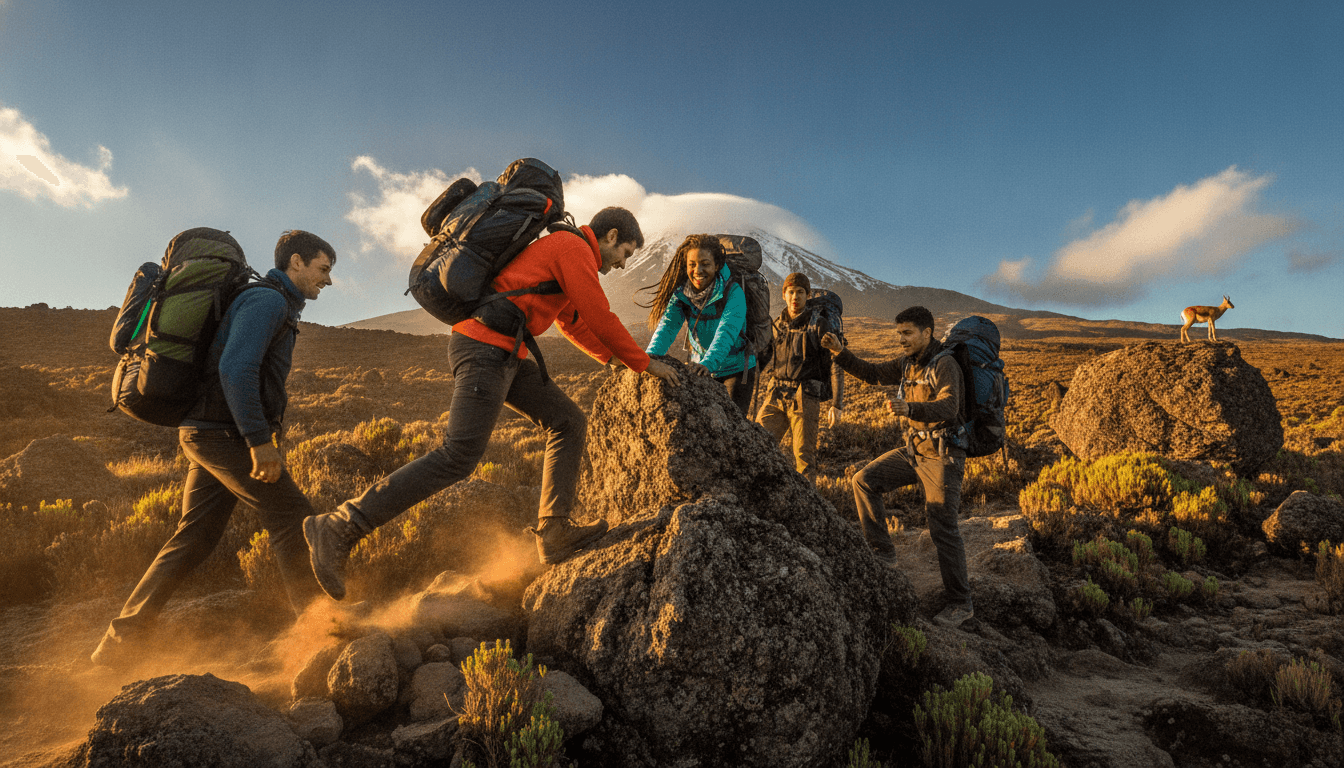
9-Day Self-Launched Kilimanjaro Climb: Lemosho Route
9 days · Kilimanjaro, Tanzania
Kiriwe Travel And Trekking Safaris Ltd charges £2,690
No-markup version: ~£1,240 per person
Estimate only, not a guaranteed price. Always verify costs independently before booking.
A self-launched version of the classic 9-day Lemosho Route on Kilimanjaro — the same scenic western approach, Shira Plateau crossing, Barranco Wall scramble and midnight summit push to Uhuru Peak (5,895m), arranged independently instead of through a packaged group tour. You book a licensed local operator's shared-group or open-crew trek directly (or assemble a small crew with other travellers via hostel noticeboards and Facebook trekking groups), pick a budget guesthouse in Moshi rather than a resort, and handle your own airport transfers with local taxis or dala-dalas. Key practical reality: Kilimanjaro National Park requires every climber to be accompanied by a licensed guide and porters, and permits are sold per person — so your savings come from choosing a fair-priced local outfitter, sharing a group, renting gear instead of buying it, and staying budget before/after the trek. Costs below are approximate backpacker rates in GBP.
Day-by-day
Arrive Kilimanjaro International Airport (JRO) → Moshi
Moshi
Fly into Kilimanjaro International Airport and make your own way to Moshi town rather than a resort. A pre-booked local taxi or shared shuttle costs roughly £15-20 for the 45-minute ride; public dala-dala buses from the airport road run for under £1 but are slow and awkward with a big pack. Check into a budget guesthouse or hostel in Moshi (around £15-20/night for a private room, less in a dorm). Spend the afternoon renting or checking gear — most local outfitters rent sleeping bags, down jackets, poles and boots for £3-5 per item per trek — and meet your guide for a briefing if you've already arranged a trek. Buy a Tanzanian SIM (Vodafone/Airtel, ~£4 with data) and stock up on snacks and water purification tablets in town. Eat dinner at a local 'hoteli' for £3-5.
🚌Local taxi/shuttle JRO to Moshi ~£15-20; dala-dala cheaper but slow
🛏Budget guesthouse in Moshi (e.g. simple private room, £15-20)
- →Airport arrival and taxi to Moshi
- →Gear rental and equipment check
- →SIM card and supplies shopping
Moshi → Londorossi Gate → Mti Mkubwa / Shira 1 Camp
Londorossi Gate / Shira Plateau
Early transfer from Moshi to Londorossi Gate (about 2-2.5 hours) — your licensed guide's outfitter normally provides this 4x4 transfer as part of the trek package. At the gate, park fees and permits are paid per person (roughly £60-70/day of park fee plus rescue fee and VAT, included in your trek cost if booked through an outfitter). Register with the search-and-rescue service and start the trek through the lush rainforest. A typical day-two route walks to Mti Mkubwa (Big Tree) camp at ~2,650m, or a longer day pushes up onto Shira 1 Camp at ~3,500m as in the original itinerary. Porters carry the bulk of the gear; you carry a daypack. Dinner cooked by the trek cook at camp.
🚌Outfitter 4x4 transfer Moshi to Londorossi Gate (included in trek cost)
🛏Trekking camp (tent) — Mti Mkubwa or Shira 1 Camp
- →Londorossi Gate permit registration
- →Rainforest hike to first camp
- →Camp dinner and acclimatisation briefing
Shira 1 Camp → Shira 2 Camp (Shira Plateau)
Shira Plateau
A gentle, beautiful day across the open Shira Plateau — roughly 5-7 hours of easy walking at 3,500-3,850m. Great views back to Mount Meru on clear mornings. Lunch at camp or en route, then an optional short acclimatisation walk in the afternoon. Altitude is now real: drink 3-4 litres, sleep low, and listen to your guide. Everything on the mountain — food, tents, cooking, toilet tent — is handled by the crew, which is why trekking independently on Kilimanjaro means contracting a licensed crew rather than going fully solo.
🚌On foot (porter-supported)
🛏Trekking camp — Shira 2 Camp (~3,850m)
- →Plateau hike to Shira 2 Camp
- →Optional acclimatisation walk
- →Mount Meru viewpoint
Shira 2 Camp → Lava Tower → Barranco Camp
Lava Tower / Barranco
The key acclimatisation day: climb to Lava Tower at 4,630m for lunch ('climb high, sleep low'), then descend steeply to Barranco Camp at ~3,950m. About 6-7 hours total. If altitude headaches or nausea kick in, tell your guide immediately — this is the day most people feel it. The reward is a first close look at the Barranco Wall you'll climb tomorrow and views of Kibo's glaciers.
🚌On foot (porter-supported)
🛏Trekking camp — Barranco Camp (~3,950m)
- →Lava Tower acclimatisation climb
- →Descent to Barranco Camp
- →Barranco Wall viewpoint
Barranco Camp → Barranco Wall → Karanga Camp
Karanga Camp
Scramble up the famous Barranco Wall — hands-on rock but not technical, about 1-1.5 hours, and a highlight of the route. Then undulating traverses to Karanga Camp at ~4,000m (4-5 hours). Hot lunch at camp, then a short optional acclimatisation walk towards Barafu. Karanga is a quiet, dramatic valley camp beneath the Kibo massif.
🚌On foot (porter-supported)
🛏Trekking camp — Karanga Camp (~4,000m)
- →Barranco Wall scramble
- →Karanga Valley traverse
- →Optional acclimatisation hike toward Barafu
Karanga Camp → Barafu Camp
Barafu Camp
A short 3-4 hour climb to Barafu Camp (base camp, ~4,670m). Rest, eat an early dinner and try to sleep from mid-afternoon — you'll be woken around 11pm for the summit push. Prepare layers: summit night is well below freezing with wind chill. Check your head torch batteries and keep water bottles in your sleeping bag so they don't freeze.
🚌On foot (porter-supported)
🛏Trekking camp — Barafu Camp (~4,670m)
- →Hike to Barafu base camp
- →Early dinner and rest
- →Summit-night gear prep
Summit night: Barafu → Uhuru Peak (5,895m) → Millennium Camp
Uhuru Peak / Millennium Camp
Wake around 11pm-12am and start the slow, cold, dark climb to Stella Point (~5,756m) on the crater rim, then the final traverse to Uhuru Peak at 5,895m — the roof of Africa — for sunrise. Expect 6-8 hours up and 3-4 hours down. Descend to Millennium Camp (~3,800m) for a well-earned sleep. Go slow, drink, and trust your guide's pace; the original tour pairs one guide per two climbers, which is worth insisting on if you book independently.
🚌On foot (porter-supported)
🛏Trekking camp — Millennium Camp (~3,800m)
- →Midnight summit attempt
- →Uhuru Peak sunrise (5,895m)
- →Descent to Millennium Camp
Millennium Camp → Mweka Gate → Moshi
Mweka Gate / Moshi
A 3-4 hour descent through rainforest to Mweka Gate, where you sign the register and collect your summit certificate. Tip your crew here — budget £60-100 total per climber for guides, cook and porters (this is a genuine cost, not optional in practice). Outfitter transfer back to Moshi. Swap to a budget guesthouse or hostel for the night (£15-20) and celebrate at a local restaurant with a cold Kilimanjaro beer for £5-8.
🚌Outfitter 4x4 Mweka Gate to Moshi (included); local taxi in town
🛏Budget guesthouse in Moshi (£15-20)
- →Descent to Mweka Gate
- →Summit certificate and crew tipping
- →Celebration dinner in Moshi
Moshi → Kilimanjaro International Airport
Moshi / JRO
Morning stroll around Moshi town — the market and a coffee stop are worth an hour — then a local taxi or shuttle to Kilimanjaro International Airport (roughly £15-20) for your flight out. If you're continuing in Tanzania, buses from Moshi to Arusha run frequently for a few pounds, and it's an easy connection to safari country or the coast.
🚌Local taxi/shuttle Moshi to JRO ~£15-20
🛏None (departure day)
- →Moshi town walk and market
- →Airport transfer
Self-launched vs. Kiriwe Travel And Trekking Safaris Ltd
| This itinerary (self-launched) | Kiriwe Travel And Trekking Safaris Ltd | |
|---|---|---|
| Price per person | ~£1,240 | £2,690 |
| Duration | 9 days | 9 days |
| Who books it | You and your group, direct | Tour operator, guided group |
| Savings | £1,450 per person (54%) | |
Estimate only, not a guaranteed price. Always verify costs independently before booking.
Want to see more Kiriwe Travel And Trekking Safaris Ltd-style trips? Check them out here.~£1,240
estimated per person
You never pay Travel Crew for this — you pay hostels, transport, and activity providers directly, the same as if you'd booked it all yourself.
This publishes your dates so other travellers can find and join you — no tour operator needed.
Customise with Tour BusterCreated by

Travel Crew
0 trips
Frequently asked questions
How much does 9-Day Self-Launched Kilimanjaro Climb: Lemosho Route cost?+
Doing it yourself with this self-launched itinerary costs an estimated £1,240 per person for 9 days in Kilimanjaro, Tanzania. This is an AI-generated estimate based on typical budget-traveller prices — actual costs will vary by season and how you book.
Is this cheaper than booking with Kiriwe Travel And Trekking Safaris Ltd?+
Yes — Kiriwe Travel And Trekking Safaris Ltd charges around £2,690 per person for a similar tour. Doing the same route independently, using the same standard of accommodation and activities, costs an estimated £1,240 — a saving of roughly £1,450 (54%) per person.
How long is the Kilimanjaro, Tanzania trip?+
This itinerary runs 9 days, covering 9 day-by-day stops through Kilimanjaro, Tanzania.
How do I join this trip?+
You can join an existing open departure using this itinerary if one is scheduled, or launch your own departure with your own dates and invite other travellers to join you — no tour operator required.
Isn't it easier to just use a tour operator?+
Well, yes, a tour operator will book all the individual parts of your travel for you and provide a guide. That's obvious, but doing this has the potential to save the group thousands, which can in turn improve your itinerary substantially or save you huge amounts of money. Also, when you launch a departure, Travel Crew has tools in place to help you book the individual sections of the trip or make it easier for you to do this as a group. Really, you do not need a middle man. If you are more comfortable paying more and using a middle man, then you should certainly do this.
Is it safer to book through a tour operator?+
Arguably, there isn't much difference. A self-launched trip runs on the same principle as a group travel crew: collective responsibility, everyone looking out for each other, the same way it would if a group of friends organised the trip themselves — because that's exactly what's happening. You should always take out travel insurance before you go, self-launched or not; that doesn't change either way. Every open departure is published publicly with real dates and a real trip organiser, so it's never an anonymous arrangement, and our support team is reachable any time you need help, including in an emergency while you're away. Longer-term, we're building direct relationships with ground DMCs in popular destinations, offered as an optional paid add-on for extra on-the-ground support. Ultimately, though, the group is responsible for its own conduct and safety on a self-launched trip, same as on any trip you plan yourself.
What kind of trip is this?+
This is a adventure, hiking, budget trip through Kilimanjaro, Tanzania, self-launched rather than run by a tour operator — you organise it with a group you find or bring yourself.
Would you like to name the operator, name the trip, or have any suggestions about how to improve this itinerary?
Drop your comment below — if you've done a similar route, tell us what worked, what you'd add, or what you'd skip.
No comments yet — be the first to share your take.
Sign in to leave a comment.