
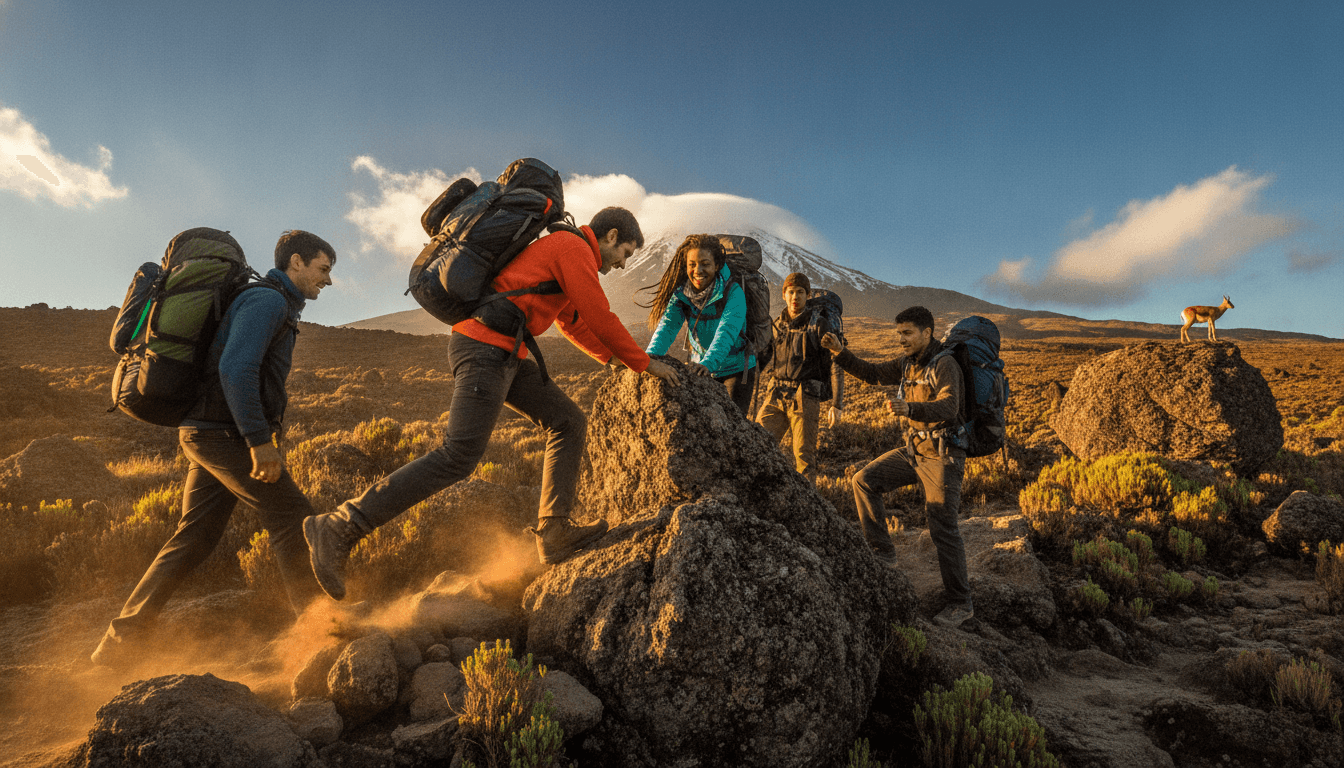
Self-Launched Kilimanjaro Rongai Route Climb
8 days · Kilimanjaro, Tanzania
Exodus charges £3,580
No-markup version: ~£1,650 per person
Estimate only, not a guaranteed price. Always verify costs independently before booking.
Trek Africa's highest peak via the quieter, more remote Rongai Route — self-launched, without the group tour price tag. This itinerary follows the same 8-day schedule as Exodus's guided climb, approaching Kilimanjaro from the east through forest, moorland and alpine desert to Uhuru Peak (5,895m). Kilimanjaro is one of the few high-altitude peaks in the world where you *must* use a licensed local operator for the climb itself (Tanzanian law requires a registered guide), so the savings here come from booking directly with a local Tanzanian climbing company rather than through a UK/US tour operator middleman. Expect to save roughly £2,000+ per person. All costs are approximate estimates.
Day-by-day
Arrive in Marangu — Trek Briefing & Gear Check
Marangu, Tanzania
Fly into Kilimanjaro International Airport (JRO), then take a shared taxi or pre-arranged transfer to Marangu (~£10–15 by negotiated taxi, or arrange with your local operator). Check into a budget guesthouse in Marangu — the village is the gateway to Kilimanjaro and has plenty of affordable accommodation. Meet your locally booked guide and crew in the evening for a full trek briefing, gear check, and distribution of hired equipment (poles, gaiters, sleeping bags available for hire locally at a fraction of UK prices). Enjoy dinner at the guesthouse or a local restaurant.
🚌Fly into Kilimanjaro International Airport (JRO). Shared taxi or minibus from airport to Marangu ~£10–15
🛏Kilimanjaro Mountain Resort or budget equivalent guesthouse in Marangu (e.g. Babylon Lodge, Keys Hotel budget rooms) — ~£20–30/night
- →Collect hired gear from local operator (poles, sleeping bag, gaiters — ~£30–50 total for the week)
- →Trek briefing with your licensed local guide
- →Explore Marangu village and stock up on snacks for the mountain
Rongai Gate to Rongai One Camp — Through the Forest
Rongai Gate to Rongai One Camp (2,600m)
Your local operator's vehicle transfers you from Marangu to the Rongai National Park Gate (2,100m) on the mountain's eastern side — a 2–3 hour drive. After completing park registration formalities (your operator handles this as part of the package), begin the climb on a winding path through pine forest. Wildlife spotters keep eyes peeled for Kilimanjaro colobus monkeys in the canopy. The trail climbs consistently but gently, and by late afternoon you reach Rongai One Camp (2,600m) at the moorland's edge with sweeping views over the Kenyan plains. Your crew will have camp set up and a hot meal waiting. Distance: 7km.
🚌Road transfer from Marangu to Rongai Gate included in local operator package (~2–3 hours)
🛏Full-service camping at Rongai One Camp — tents, meals and crew included in your local operator package
- →Transfer by vehicle to Rongai Gate (included in local operator package)
- →Trek through pine and podocarpus forest — 7km, ~4 hours
- →Wildlife spotting: Kilimanjaro colobus monkeys, buffalo, and birdlife
- →Arrive Rongai One Camp (2,600m) — full-service camping with crew
Rongai One to Kikelewa Caves Camp — Moorland Ascent
Kikelewa Caves Camp (3,600m)
A steady morning ascent brings you to Second Cave (3,450m), with superb views of Kibo's eastern icefields. After a packed lunch from your crew, leave the main Rongai trail on a smaller path striking out across open moorland towards the dramatic jagged spires of Mawenzi volcano. The campsite at Kikelewa Caves (3,600m) sits in a sheltered valley and is one of the most scenic on the route. A long but rewarding day. Distance: 15km.
🚌On foot
🛏Full-service camping at Kikelewa Caves — tents, meals and crew included in your local operator package
- →Trek to Second Cave (3,450m) — moorland ascent with Kibo icefield views
- →Cross-country moorland trail to Mawenzi massif
- →Arrive Kikelewa Caves Camp (3,600m) — camp set up by crew
Kikelewa to Mawenzi Tarn — Acclimatisation Day
Mawenzi Tarn Camp (4,330m)
A steep climb up grassy slopes rewards with panoramic views of the Kenyan plains stretching to the north. Vegetation thins rapidly as you approach Mawenzi Tarn (4,330m) — a dramatic glacial lake tucked beneath the towering cliffs of Mawenzi crater. The afternoon is free: rest in your tent, take a short acclimatisation walk to higher ground and descend (the classic 'climb high, sleep low' technique), or simply absorb the extraordinary lunar landscape. Hydration and rest are key tonight. Distance: 8km.
🚌On foot
🛏Full-service camping at Mawenzi Tarn — tents, meals and crew included in your local operator package
- →Steep ascent to Mawenzi Tarn (4,330m) — ~4 hours
- →Optional afternoon acclimatisation walk to higher ground
- →Rest and hydration in preparation for summit push — a critical day
Mawenzi Tarn to Kibo Camp — Crossing the Saddle
Kibo Camp (4,700m)
Leave the sheltered Mawenzi Tarn camp and cross the famous 'Saddle' — the high alpine desert plateau that connects Mawenzi and Kibo volcanoes. The landscape is surreal and exposed: barren, windswept volcanic gravel stretching between two of Africa's highest peaks. Reach Kibo Camp (4,700m) by early afternoon. Eat a substantial meal, drink plenty of fluids, and get to bed as early as possible — the alarm goes off around midnight for summit night. Distance: 10km.
🚌On foot
🛏Full-service camping at Kibo Camp — tents, meals and crew included in your local operator package
- →Trek across the lunar Saddle plateau — 10km, ~5 hours
- →Arrive Kibo Camp (4,700m) at the base of the summit cone
- →Rest, eat and sleep early — summit night begins around midnight
Summit Night & Descent to Horombo — Uhuru Peak (5,895m)
Uhuru Peak (5,895m) → Horombo Camp (3,720m)
The hardest day of the entire trek — expect 11–15 hours of walking. Start at around midnight by torchlight, climbing very slowly in bitter cold on a steep switchback trail through loose volcanic scree to Gillman's Point (5,685m) on the crater rim, arriving ideally in time for sunrise. Those with remaining energy push on for the 3-hour round trip along the snow-covered rim to Uhuru Peak (5,895m) — the highest point in Africa and the summit of Kilimanjaro. Take your photo at the famous sign. Descend back to Kibo Hut for rest and food, then continue a long descent to Horombo Camp (3,720m). The descent through the saddle and upper moorland feels endless but spirits will be high. Distance: ~10km (plus summit push ~3km each way on rim). Note: your licensed guide is essential for this summit push — they manage your safety, pace, and emergency procedures.
🚌On foot
🛏Full-service camping at Horombo Camp — tents, meals and crew included in your local operator package
- →Midnight summit push to Gillman's Point (5,685m) on crater rim — ~6 hours
- →Summit push to Uhuru Peak (5,895m) — highest point in Africa
- →Watch sunrise over Mawenzi and the East African plains
- →Descend to Kibo Hut for rest and hot food
- →Continue long descent to Horombo Camp (3,720m)
Horombo to Marangu Gate — Final Descent
Marangu Gate (1,830m) → Marangu
A long but celebratory final descent. The trail drops from Horombo (3,720m) through the open moorland, passing Mandara Hut (2,700m) in the forest zone before reaching the Marangu National Park Gate (1,830m) by mid-afternoon. Your local operator's vehicle meets you at the gate — collect your official summit certificate from the park office. Transfer back to your guesthouse in Marangu for a much-deserved hot shower and cold beer. The crew will be tipped at the gate — budget for this separately (see tip guidance below). Distance: 22km.
🚌Vehicle transfer from Marangu Gate back to guesthouse — included in local operator package
🛏Kilimanjaro Mountain Resort or equivalent budget guesthouse in Marangu — ~£20–30/night
- →Long descent from Horombo through moorland and forest — 22km, ~6–7 hours
- →Collect official Kilimanjaro summit certificate at Marangu Gate
- →Tip your crew at the gate (KPAP recommended rates: guide ~$20/day, assistant guides ~$15/day, cook ~$15/day, porters ~$10/day)
- →Transfer back to Marangu — hot shower and celebration dinner
Depart Marangu — Onward to Zanzibar or Safari
Marangu / Kilimanjaro Airport
A well-earned rest morning in Marangu. Browse the local village for Tanzanian souvenirs (Maasai crafts, coffee, spices). Head to Kilimanjaro International Airport for your onward flight, or extend your trip: take a dalla-dalla (local minibus) or shared taxi to Arusha (~£5–8) as a base for Serengeti or Ngorongoro safari, or head to Dar es Salaam for a ferry to Zanzibar (~£35 by fast ferry from Dar). Both extensions are easy to book independently and dramatically cheaper than operator-arranged packages.
🚌Taxi or dalla-dalla from Marangu to Kilimanjaro Airport (~£10–15). Onward independently as preferred.
🛏Airport hotel or depart — budget ~£25 if overnight needed
- →Rest, souvenir shopping in Marangu village
- →Optional: book a self-launched Zanzibar extension — dalla-dalla to Moshi, bus to Dar es Salaam (~£8), then Azam Marine fast ferry to Zanzibar (~£35)
- →Optional: book a budget Arusha-based safari directly with a local operator for Serengeti/Ngorongoro (~£150–250/day all-inclusive)
- →Transfer to Kilimanjaro International Airport (JRO)
Self-launched vs. Exodus
| This itinerary (self-launched) | Exodus | |
|---|---|---|
| Price per person | ~£1,650 | £3,580 |
| Duration | 8 days | 8 days |
| Who books it | You and your group, direct | Tour operator, guided group |
| Savings | £1,930 per person (54%) | |
Estimate only, not a guaranteed price. Always verify costs independently before booking.
Want to see more Exodus-style trips? Check them out here.~£1,650
estimated per person
You never pay Travel Crew for this — you pay hostels, transport, and activity providers directly, the same as if you'd booked it all yourself.
This publishes your dates so other travellers can find and join you — no tour operator needed.
Customise with Tour BusterCreated by

Travel Crew
0 trips
Frequently asked questions
How much does Self-Launched Kilimanjaro Rongai Route Climb cost?+
Doing it yourself with this self-launched itinerary costs an estimated £1,650 per person for 8 days in Kilimanjaro, Tanzania. This is an AI-generated estimate based on typical budget-traveller prices — actual costs will vary by season and how you book.
Is this cheaper than booking with Exodus?+
Yes — Exodus charges around £3,580 per person for a similar tour. Doing the same route independently, using the same standard of accommodation and activities, costs an estimated £1,650 — a saving of roughly £1,930 (54%) per person.
How long is the Kilimanjaro, Tanzania trip?+
This itinerary runs 8 days, covering 8 day-by-day stops through Kilimanjaro, Tanzania.
How do I join this trip?+
You can join an existing open departure using this itinerary if one is scheduled, or launch your own departure with your own dates and invite other travellers to join you — no tour operator required.
Isn't it easier to just use a tour operator?+
Well, yes, a tour operator will book all the individual parts of your travel for you and provide a guide. That's obvious, but doing this has the potential to save the group thousands, which can in turn improve your itinerary substantially or save you huge amounts of money. Also, when you launch a departure, Travel Crew has tools in place to help you book the individual sections of the trip or make it easier for you to do this as a group. Really, you do not need a middle man. If you are more comfortable paying more and using a middle man, then you should certainly do this.
Is it safer to book through a tour operator?+
Arguably, there isn't much difference. A self-launched trip runs on the same principle as a group travel crew: collective responsibility, everyone looking out for each other, the same way it would if a group of friends organised the trip themselves — because that's exactly what's happening. You should always take out travel insurance before you go, self-launched or not; that doesn't change either way. Every open departure is published publicly with real dates and a real trip organiser, so it's never an anonymous arrangement, and our support team is reachable any time you need help, including in an emergency while you're away. Longer-term, we're building direct relationships with ground DMCs in popular destinations, offered as an optional paid add-on for extra on-the-ground support. Ultimately, though, the group is responsible for its own conduct and safety on a self-launched trip, same as on any trip you plan yourself.
What kind of trip is this?+
This is a adventure, hiking, wildlife trip through Kilimanjaro, Tanzania, self-launched rather than run by a tour operator — you organise it with a group you find or bring yourself.
Would you like to name the operator, name the trip, or have any suggestions about how to improve this itinerary?
Drop your comment below — if you've done a similar route, tell us what worked, what you'd add, or what you'd skip.
No comments yet — be the first to share your take.
Sign in to leave a comment.