
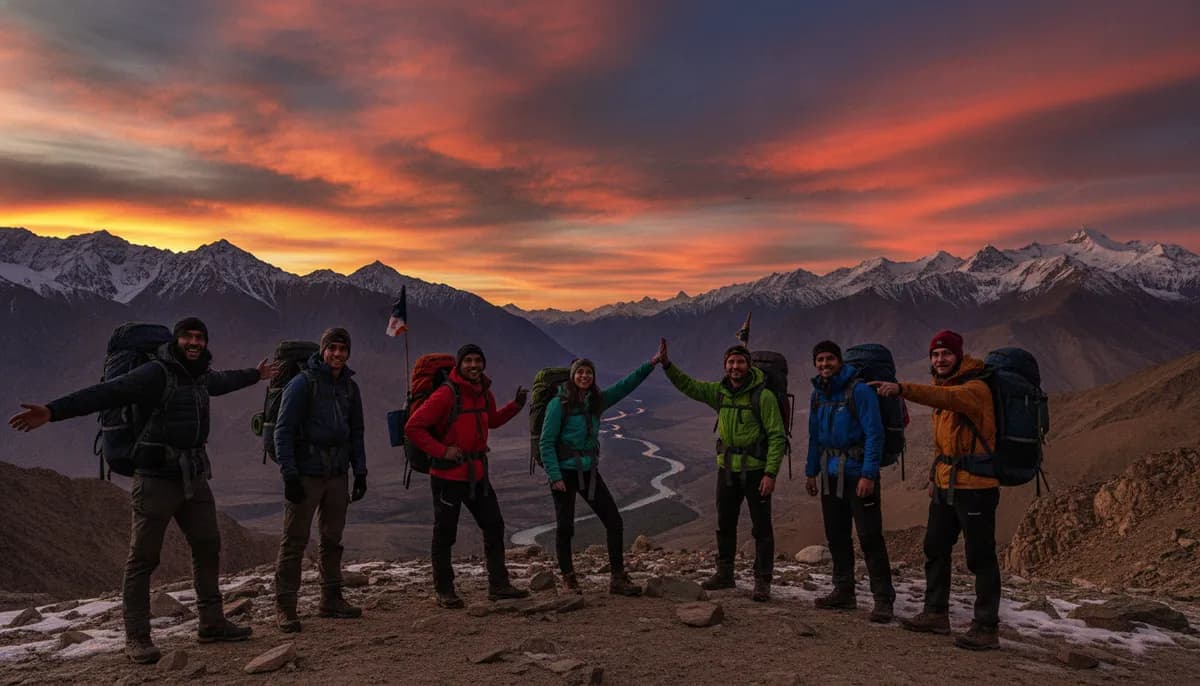
Trek India's Markha Valley to Summit UT Kangri (6070m) — Self-Launched
14 days · Ladakh, India
Much Better Adventures charges £3,295
No-markup version: ~£1,480 per person
Estimate only, not a guaranteed price. Always verify costs independently before booking.
A self-launched version of the classic Ladakh Markha Valley trek and UT Kangri (6070m) summit expedition, done independently by arranging your own guesthouses, local trekking agency support, pack horses, permits and a licensed Ladakhi climbing guide. You'll fly Delhi–Leh, acclimatise in Leh, trek the remote Markha Valley over Lalung La (5300m) and Chaksang La (5200m), then move onto the quieter Lato Valley for a 6000m trekking peak ascent, before returning via Hemis Monastery. Costs are approximate backpacker/budget rates in GBP and assume you share costs with other independent trekkers where possible. Note: a 6000m glaciated peak requires a certified guide, permits (IMF/ALTOA-registered agency) and proper insurance — do not attempt the summit unsupported.
Day-by-day
Arrive Delhi
Delhi
Land at Indira Gandhi International Airport and make your own way into the city — pre-book an airport taxi or take the Airport Express Metro to New Delhi station (~£2). Check into a budget guesthouse or hostel in Paharganj or Karol Bagh (dorms ~£6-10, private twin ~£18-25). Spend the afternoon wandering Connaught Place or, if energy allows, take the metro to the Red Fort and Chandni Chowk for street food. Sort your Indian e-Visa in advance online (approx. £30-40 for 30 days) and keep a printed copy for Leh checkpoints.
🚌Airport Express Metro or pre-paid taxi from DEL (~£2-5)
🛏Budget guesthouse/hostel in Paharganj (dorm ~£8, private ~£22)
- →Metro to Connaught Place
- →Chandni Chowk street food wander
- →Red Fort exterior walk
Fly Delhi to Leh, settle in and rest
Leh
Book a morning Delhi–Leh flight yourself in advance (IndiGo, SpiceJet or Air India, ~£55-90 one way if booked early). The 75-minute flight gives spectacular Himalayan views. On arrival take the fixed-rate pre-paid taxi or a shared taxi to your guesthouse in the Old Town near Changspa or Main Bazaar (~£4-7). Do almost nothing today: hydrate heavily, no strenuous activity, no alcohol. Leh sits at 3500m and altitude sickness is the main risk of the whole trip. Evening: simple thukpa (noodle soup) and momos in a local cafe (~£4).
🚌Delhi–Leh flight (~£55-90); airport pre-paid taxi (~£5)
🛏Family-run guesthouse in Leh Old Town (private twin ~£15-22, dorm ~£7)
- →Delhi–Leh flight with Himalayan views
- →Gentle Old Town orientation walk
- →Rest and hydration for acclimatisation
Acclimatisation in Leh + Thiksey Monastery
Leh / Thiksey
Second acclimatisation day. If you're trekking with an independent agency, use today for your high-altitude briefing, gear check and permit paperwork (Inner Line/ protected area permits and the IMF-registered expedition paperwork are usually handled by your Ladakhi agency). Take a shared taxi or local bus east along the Indus to Thiksey Monastery (~£2-3 each way), Ladakh's most iconic 12-storey complex. Pay the small entry (~£2) and walk up for valley views. Back in Leh, visit Leh Palace and Shanti Stupa at sunset. Climb to Namgyal Tsemo for a light 1-2hr walk — the best cheap acclimatisation.
🚌Shared taxi/bus to Thiksey (~£2-3 each way)
🛏Family-run guesthouse in Leh Old Town (private twin ~£15-22)
- →Thiksey Monastery visit (~£2 entry)
- →Leh Palace and Shanti Stupa
- →Namgyal Tsemo short acclimatisation hike
Drive to Sara/Chilling, trek into the Markha Valley
Thinles Pa (3700m)
Set off early in a shared jeep or local bus up the Indus Valley toward Chilling/Sara at the head of the Markha Valley (2-3hrs drive, ~£20-30 for a shared vehicle split between 4). Your hired pony/horse man and trek crew meet you at the trailhead — arrange pack horses in advance through your Ladakhi trekking agency (~£18-25 per horse per day, shared). Walk 2-3hrs (10km, 200m gain) on an easy trail through Chalak to camp at Thinles Pa (3700m). Camp under the stars — wild camping with a tent and mattress you brought or rented in Leh.
🚌Shared jeep/bus Leh to Chilling/Sara (~£20-30 per vehicle, split 4 ways)
🛏Wild camp — your own/rented tent at Thinles Pa
- →Scenic drive up the Indus Valley
- →First Markha Valley trekking stage
- →Pony-supported wild camping
Thinles Pa to Hankar (4250m)
Hankar
A long day: 5-6hrs, 15km, 550m gain. The trail crisscrosses the valley floor river — several crossings have no bridge, so wear sandals or accept wet boots. Pass miles of chortens and stop at the remote village of Markha, then climb to Tache Gompa perched on a cliff (steep but short). Continue up a side valley past Hankar Fort ruins to the stream-side camp in Upper Hankar (4250m). Cook your own meals or use the pony man's kitchen setup — buy fresh yoghurt and butter tea from villagers along the way.
🚌On foot
🛏Wild camp at Upper Hankar
- →Markha village visit
- →Tache Gompa cliff monastery climb
- →Hankar Fort ruins
Hankar to Nimaling (4854m)
Nimaling
Short but tough: 4-5hrs, 8km, 600m gain. Steep climb to a plateau where the valley opens with Kang Yatse (6400m) dominating the skyline. In summer, herders bring goats, sheep and dzos to graze Nimaling's pastures and often sell fresh yoghurt or local cheese — a cheap protein boost. Reach camp by lunchtime, set up, then take an afternoon walk toward the Kang Yatse side valley as extra acclimatisation. Exceptional stargazing — no light pollution up here.
🚌On foot
🛏Wild camp at Nimaling (4854m)
- →Kang Yatse viewpoint
- →Buying yoghurt/cheese from nomadic herders
- →High-altitude stargazing
Nimaling to Chak-tsang over Lalung La (5300m)
Chak-tsang
Big pass day: 4-5hrs, 13km, 470m up, 620m down. Climb to Lalung La at 5300m — the highest point of the Markha Valley section — with jaw-dropping views of Dzo Jongo and Kang Yatse. Watch for glaciers feeding the valley below. Descend past abandoned nomadic huts to camp at Chaktsang (4700m). Start early to cross the pass before afternoon weather rolls in; this is also a classic AMS checkpoint, so listen to your body.
🚌On foot
🛏Wild camp at Chak-tsang
- →Lalung La (5300m) crossing
- →Dzo Jongo & Kang Yatse views
- →Glacier lookout
Chak-tsang to Lato over Chaksang La (5200m)
Lato (4000m)
Tough day: 5-6hrs, 18km, 500m up, 1200m down. Steep descent into a rocky valley, then a stiff climb over Chaksang La (5200m) before dropping to the village of Lato — you've now left the main Markha trail and are on far quieter paths used only by herders and mountaineers. Camp on the Kyamur River on the quiet outskirts of Lato. Lato is road-connected, which matters: it's your evacuation and resupply point for the UT Kangri section.
🚌On foot
🛏Wild camp by the Kyamur River, Lato
- →Chaksang La (5200m) crossing
- →Remote Lato village camp
- →Nomadic herder encounters
Lato to Rumtse Phu (4854m)
Rumtse Phu
Ascend the Lato Valley on the UT Kangri approach: 5-6hrs, 17km, 850m gain. Follow old nomadic routes past farming villages, exploring traditional Ladakhi culture. Rumtse Phu locals are known for horse riding and the traditional Gya-Pa-Cho dance. Because both Lato and Rumtse Phu are road-connected, you keep easy descent and evacuation options right up to the UT Kangri base camp — a safety advantage over the standard Markha exit.
🚌On foot
🛏Wild camp at Rumtse Phu
- →Lato Valley nomadic trail
- →Traditional Ladakhi farming villages
- →Approach to UT Kangri
Trek to UT Kangri Base Camp (5300m) + skills training
UT Kangri Base Camp
Short, steep morning: 4hrs, 6km, 450m gain to base camp at 5300m, where you'll spend three nights. Move slowly at this altitude. After lunch your licensed Ladakhi climbing guide (required — budget £180-230 per person for the summit package on a 1:2 guide ratio, including equipment use, shared between two climbers) will run a snow skills session: roping up, crampon and ice-axe use. Evening golden-hour acclimatisation walk among the surrounding unclimbed peaks. This guide fee is the single biggest cost of the DIY trip and is non-negotiable for safety.
🚌On foot
🛏Wild camp at UT Kangri Base Camp (5300m)
- →Move to UT Kangri Base Camp
- →Mountaineering skills briefing
- →Golden-hour acclimatisation walk
Mountaineering practice and acclimatisation
UT Kangri Base Camp
2-3hrs of practical skills above base camp: walking on simple snow slopes, ice-axe self-arrest, moving on steep ground, rope technique and basic self-rescue. This session is what makes summit day realistic. Rent or hire crampons, harness and ice axe in Leh before departure (an introductory winter skills course in the UK beforehand is strongly recommended). Eat early, sleep early — summit start is pre-dawn tomorrow. Daily cost is mainly guide fees, food and camp supplies.
🚌On foot
🛏Wild camp at UT Kangri Base Camp (5300m)
- →Crampon and snow slope practice
- →Ice-axe self-arrest drills
- →Self-rescue and roped travel technique
Summit day — UT Kangri (6070m)
UT Kangri summit / Base Camp
The main event. Rope up before dawn with your guide at a 1:2 guide-to-climber ratio (the operator's own standard, and what any reputable independent arrangement should use). Climb steep scree and moraine, cross snow fields, then gain the summit at 6070m for views across Kang Yatse and the Ladakh ranges. 10-12hrs round trip, 800m up and 800m down. Carry 2L+ water, high-calorie snacks, sunglasses and full glacier kit. If weather or altitude says no, descend — contingency and evacuation plans are built around the Lato/Rumtse Phu road access.
🚌On foot
🛏Wild camp at UT Kangri Base Camp (5300m)
- →Roped ascent to UT Kangri summit (6070m)
- →Glacier snow-field crossing
- →Descent to base camp
Hike out to Rumtse Phu and return to Leh
Leh
2-3hrs, 6km, 450m descent back to Rumtse Phu, where you pay off and say goodbye to your trek crew and pony man. Collect your reserved shared jeep/taxi for the 2-3hr drive back to Leh (~£25-40 per vehicle split) and stop en route at Hemis Monastery (17th century, one of Ladakh's largest and richest, small entry ~£2). Check into a guesthouse in Leh for a hot shower and a well-earned meal on the Main Bazaar strip (Tibetan Kitchen or Bon Appetit, ~£8-12).
🚌Shared jeep Rumtse Phu to Leh (~£25-40 per vehicle split); Hemis Monastery stop
🛏Family-run guesthouse in Leh (private twin ~£15-22)
- →Final trek morning
- →Hemis Monastery visit (~£2 entry)
- →Farewell dinner in Leh
Fly Leh to Delhi and onward
Leh / Delhi
Transfer yourself to Leh Airport for the morning flight to Delhi (~£55-90 if booked in advance). Leh flights land in Delhi around midday, but weather and operational delays are common — do not book an onward international departure before 21:00. With time to spare, store bags at the airport or New Delhi station and see Humayun's Tomb or Qutub Minar (metro ~£1 each way, entries ~£4-5) before heading to the airport.
🚌Leh–Delhi flight (~£55-90); Airport Express Metro (~£2)
🛏Not included — onward travel or optional extra night in Delhi (~£20)
- →Leh–Delhi morning flight
- →Optional Delhi sightseeing
- →Onward international connection (after 21:00)
Self-launched vs. Much Better Adventures
| This itinerary (self-launched) | Much Better Adventures | |
|---|---|---|
| Price per person | ~£1,480 | £3,295 |
| Duration | 14 days | 14 days |
| Who books it | You and your group, direct | Tour operator, guided group |
| Savings | £1,815 per person (55%) | |
Estimate only, not a guaranteed price. Always verify costs independently before booking.
Want to see more Much Better Adventures-style trips? Check them out here.~£1,480
estimated per person
You never pay Travel Crew for this — you pay hostels, transport, and activity providers directly, the same as if you'd booked it all yourself.
This publishes your dates so other travellers can find and join you — no tour operator needed.
Customise with Tour BusterCreated by

Travel Crew
0 trips
Frequently asked questions
How much does Trek India's Markha Valley to Summit UT Kangri (6070m) — Self-Launched cost?+
Doing it yourself with this self-launched itinerary costs an estimated £1,480 per person for 14 days in Ladakh, India. This is an AI-generated estimate based on typical budget-traveller prices — actual costs will vary by season and how you book.
Is this cheaper than booking with Much Better Adventures?+
Yes — Much Better Adventures charges around £3,295 per person for a similar tour. Doing the same route independently, using the same standard of accommodation and activities, costs an estimated £1,480 — a saving of roughly £1,815 (55%) per person.
How long is the Ladakh, India trip?+
This itinerary runs 14 days, covering 14 day-by-day stops through Ladakh, India.
How do I join this trip?+
You can join an existing open departure using this itinerary if one is scheduled, or launch your own departure with your own dates and invite other travellers to join you — no tour operator required.
Isn't it easier to just use a tour operator?+
Well, yes, a tour operator will book all the individual parts of your travel for you and provide a guide. That's obvious, but doing this has the potential to save the group thousands, which can in turn improve your itinerary substantially or save you huge amounts of money. Also, when you launch a departure, Travel Crew has tools in place to help you book the individual sections of the trip or make it easier for you to do this as a group. Really, you do not need a middle man. If you are more comfortable paying more and using a middle man, then you should certainly do this.
Is it safer to book through a tour operator?+
Arguably, there isn't much difference. A self-launched trip runs on the same principle as a group travel crew: collective responsibility, everyone looking out for each other, the same way it would if a group of friends organised the trip themselves — because that's exactly what's happening. You should always take out travel insurance before you go, self-launched or not; that doesn't change either way. Every open departure is published publicly with real dates and a real trip organiser, so it's never an anonymous arrangement, and our support team is reachable any time you need help, including in an emergency while you're away. Longer-term, we're building direct relationships with ground DMCs in popular destinations, offered as an optional paid add-on for extra on-the-ground support. Ultimately, though, the group is responsible for its own conduct and safety on a self-launched trip, same as on any trip you plan yourself.
What kind of trip is this?+
This is a adventure, hiking, culture trip through Ladakh, India, self-launched rather than run by a tour operator — you organise it with a group you find or bring yourself.
Would you like to name the operator, name the trip, or have any suggestions about how to improve this itinerary?
Drop your comment below — if you've done a similar route, tell us what worked, what you'd add, or what you'd skip.
No comments yet — be the first to share your take.
Sign in to leave a comment.