
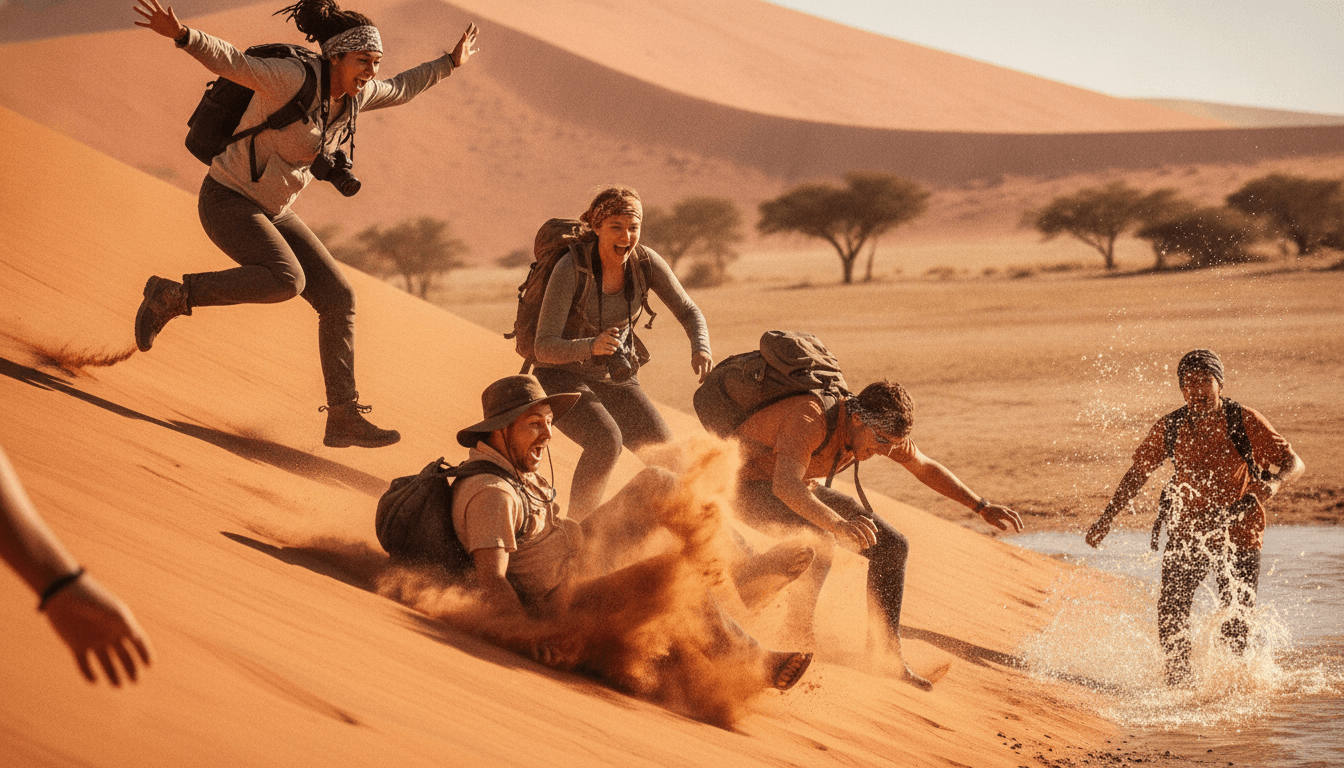
Discover Namibia Self-Launched: Dunes, Safari & Rhino Tracking
13 days · Namibia
Exodus charges £4,290
No-markup version: ~£1,450 per person
Estimate only, not a guaranteed price. Always verify costs independently before booking.
Namibia is one of Africa's most spectacular and underrated destinations — and you don't need a group tour operator to experience it. This self-launched itinerary follows the classic Namibia circuit: Windhoek, the Namib Desert dunes, Swakopmund, Damaraland, and Etosha National Park, finishing with rhino tracking near Otjiwa. The key to doing this independently is hiring a 4WD camper or budget rental car (most roads on this route are tar or well-graded gravel) and booking activities directly. Accommodation costs are estimated for mid-range guesthouses and lodge campsites rather than full lodge rooms. Expect to save significantly on the Exodus price — without sacrificing the experience.
Day-by-day
Arrive in Windhoek
Windhoek
Fly into Hosea Kutako International Airport (WDH), roughly 45km east of the city. Take the Intercape shuttle bus or a shared taxi into central Windhoek (~£5–8). Check into a central guesthouse or hostel and spend the afternoon exploring the city's German colonial architecture, the Christuskirche, and the lively Independence Avenue. Pick up supplies, a local SIM card, and sort your car hire for tomorrow if pre-booked. Head to Joe's Beerhouse in the evening for a classic Namibian welcome dinner — game meat, local beer, and a buzzing atmosphere.
🚌Intercape shuttle or shared taxi from airport to city centre (~£5–8)
🛏Cardboard Box Hostel or Chameleon Backpackers, Windhoek (~£18–25/night)
- →Explore Windhoek city centre and Christuskirche
- →Pick up supplies and local SIM card
- →Dinner at Joe's Beerhouse — try the game meat platter
Drive to Sesriem through Namib-Naukluft
Sesriem, Namib-Naukluft
Collect your pre-booked rental car (a 4WD is recommended; budget operators like Asco Car Hire or Odyssey Car Hire offer rates from ~£45/day including basic insurance). Head southwest on the B1 and C26 through the vast Namib-Naukluft National Park — one of the largest protected areas in the world. The drive is roughly 350km (5–6 hours) through surreal desert landscapes, rocky passes, and the occasional quiver tree. Stop at Solitaire for their famous apple pie and petrol. Arrive at Sesriem in the late afternoon. Book your entry permit to the dunes at the gate (opens at sunrise — you must be inside before sunrise). Settle into a guesthouse or campsite near Sesriem gate.
🚌Self-drive rental car from Windhoek, ~350km on B1/C26 (~£10 fuel)
🛏Sesriem Campsite (NWR-run, book ahead) or Desert Homestead Lodge (~£20–35/night)
- →Self-drive through Namib-Naukluft National Park
- →Stop at Solitaire for the legendary apple pie and fuel
- →Pre-book sunrise dune entry permit at Sesriem gate
Climb Dune 45 & Big Daddy • Deadvlei • Namib Carnivore Conservation Centre
Sossusvlei, Sesriem
Rise before dawn and drive through the park gate at sunrise. Head straight to Dune 45 for an early morning climb — one of the most photographed dunes in the world, and the views from the top are extraordinary. Continue to the Sossusvlei car park and walk (or take the 4WD shuttle, ~£5) to Deadvlei, the eerie white clay pan scattered with ancient dead camel thorn trees surrounded by towering orange dunes. Allow 2–3 hours exploring. In the afternoon, visit the Namib Desert Cheetah Conservation (also called AfriCat Namib or local cheetah sanctuaries near Sesriem) — book directly on arrival or via GetYourGuide. Return to your guesthouse for a stargazing evening; the Namib sky is exceptional.
🚌Self-drive within Sossusvlei National Park; 4WD shuttle to Deadvlei if needed (~£5)
🛏Sesriem Campsite or Desert Homestead Lodge (~£20–35/night)
- →Climb Dune 45 at sunrise
- →Walk to Deadvlei and explore the ghostly white clay pan
- →Visit Namib Carnivore Conservation Centre to see cheetahs (book direct, ~£15–20pp)
- →Stargazing from the campsite after dark
Drive to Swakopmund via Walvis Bay flamingos
Swakopmund
A long but spectacular drive northwest through the desert to the Atlantic coast — roughly 300km (4–5 hours). The road passes through ever-changing desert scenery before the landscape suddenly gives way to the cold Atlantic. Stop at Walvis Bay Lagoon en route: this is one of southern Africa's most important flamingo habitats and you can walk along the lagoon shore to see thousands of lesser and greater flamingos up close for free. Continue 30km north to Swakopmund, a charmingly odd German colonial beach resort town. Check into your guesthouse and explore the town's bakeries, craft shops, and beachfront promenade.
🚌Self-drive ~300km on C14/B2 via Walvis Bay (~£12 fuel)
🛏Swakopmund Backpackers or Alte Brücke Resort (~£20–35/night)
- →Stop at Walvis Bay Lagoon to see flamingo colonies (free, self-guided)
- →Explore Swakopmund's German colonial architecture and seafront
- →Browse local craft markets and try a Swakopmund bakery
Swakopmund: Free Day & Optional Activities
Swakopmund
Swakopmund is Namibia's adventure activity capital — take your pick. Sandboarding on the dunes is a must-do (half-day guided experience ~£30–40pp, bookable through operators like Alter Action on the high street). Quad biking, skydiving over the Skeleton Coast, sea kayaking with seals at Walvis Bay, and scenic flights are all bookable on arrival. Alternatively, simply enjoy the town: walk the beach, try the local seafood, and sample the excellent German-style cakes at Café Anton. The Living Desert Tour (a guided walk through the dunes to find desert-adapted creatures like sidewinder snakes and dancing white ladies) is bookable directly (~£30pp) and is a highlight.
🚌On foot or local taxi within Swakopmund
🛏Swakopmund Backpackers or Alte Brücke Resort (~£20–35/night)
- →Sandboarding on the dunes (half-day, ~£30–40pp via Alter Action or Outback Orange)
- →Living Desert Tour: spot sidewinder snakes, lizards, and chameleons (~£30pp)
- →Optional: sea kayaking with seals at Walvis Bay (~£35pp)
- →Explore Swakopmund's bakeries, museum, and seafront
Drive to Brandberg Mountain, Damaraland
Damaraland / Brandberg
Leave the coast behind and head north and inland through the dramatic Damaraland landscape — red rock mountains, sparse desert scrub, and enormous open skies. The drive is roughly 240km (3–4 hours) on a mix of tarred and gravel roads. Damaraland is famous for its free-roaming desert-adapted elephants that trek between the dry riverbeds. Keep an eye on the Ugab River as you approach Brandberg — elephant sightings are common. Arrive at Brandberg in the afternoon. In the evening, the night sky here is extraordinary; Brandberg sits far from any light pollution and the Milky Way is clearly visible to the naked eye.
🚌Self-drive ~240km from Swakopmund on B2/C35 (~£10 fuel)
🛏Brandberg White Lady Lodge (rooms or camping, ~£25–40/night)
- →Self-drive through Damaraland's red rock landscapes
- →Watch for free-roaming desert elephants in the Ugab River valley
- →Stargazing at Brandberg — one of Namibia's best dark sky sites
White Lady Rock Painting Hike • Drive to Khorixas Area
Brandberg / Damara Region
Hire a mandatory local San guide at the Brandberg trailhead (required by the Namibia Tourism Board, ~£5–8pp, paid directly on site) to lead you on the 90-minute hike through Valley 45 to the White Lady rock painting — a remarkable 2,000-year-old San rock art site featuring detailed human and animal figures. The granite formations along the way are beautiful, and birdlife is plentiful. Afterwards, drive east towards the Khorixas area (~250km, 4 hours). En route, look out for roadside Himba and Herero women selling handmade crafts — buy directly for the best prices and to support local communities. Check into your lodge guesthouse for the night.
🚌Self-drive ~250km from Brandberg towards Khorixas (~£10 fuel)
🛏Damara Mopane Lodge or similar guesthouse near Khorixas (~£25–40/night)
- →Guided hike to the White Lady rock painting (mandatory local guide ~£5–8pp)
- →Explore Valley 45 granite formations and birdlife
- →Stop at roadside Himba and Herero craft stalls to buy directly from artisans
Drive to Etosha National Park • Afternoon Game Drive
Etosha National Park
Head northeast to Etosha National Park — roughly 200km (3 hours). Enter via the Anderson Gate at Okaukuejo in the south. Pay your park entrance fee (~£7/person/day + £3/vehicle/day, payable at the gate). The park is self-drive, meaning you navigate between waterholes in your own vehicle at your own pace — no guide fees required. Arrive in time for the late afternoon, when animals are most active at the waterholes. Head to the Okaukuejo floodlit waterhole after dark — it runs all night and consistently attracts lion, elephant, rhino, and jackal. The night waterhole experience is genuinely unmissable.
🚌Self-drive ~200km from Khorixas area to Etosha (~£8 fuel)
🛏Okaukuejo NWR Camp (book well ahead via namibiawildlife.org, ~£25–40/night)
- →Enter Etosha at Anderson Gate — pay entry fee (~£7pp + £3/vehicle)
- →Self-drive afternoon game drive between waterholes
- →Okaukuejo floodlit waterhole night viewing — rhino, lion, and elephant regular sightings
Full Day Self-Drive Safari in Etosha
Etosha National Park
A full day inside Etosha — Africa's finest self-drive safari experience. Wildebeest, zebra, giraffe, elephant, lion, leopard, cheetah, black rhino, and hundreds of bird species all call this park home. The self-drive format means you choose where to go and how long to linger at a waterhole. Start at dawn and drive slowly between the named waterholes (Halali, Salvadora, Gemsbokvlaagte) as animals come to drink. Download the Tracks4Africa or Etosha app for offline maps and recent sighting notes. In the evening, consider booking an optional night drive with the NWR camp (~£20–25pp) for nocturnal predator sightings.
🚌Self-drive within Etosha National Park
🛏Halali NWR Camp (central Etosha, pool, waterhole — book ahead ~£25–40/night)
- →Full day self-drive safari between Etosha's famous waterholes
- →Spot elephant, giraffe, lion, rhino, zebra, and more
- →Optional NWR night drive from camp (~£20–25pp, book on arrival)
- →Use Tracks4Africa app for offline navigation and sighting tips
Second Full Day in Etosha
Etosha National Park
A second day in Etosha gives you the chance to explore the eastern reaches of the park around Namutoni camp, which have a different character — more dense woodland, and better for kudu, eland, and leopard. The Klein Namutoni and Fischer's Pan waterholes attract large concentrations of waterbirds when flooded. Wildlife movements change daily, so returning to favourite spots often yields completely different results. In the afternoon, begin the slow drive westward back towards Okaukuejo if continuing your loop, or position yourself near the exit for tomorrow's drive south.
🚌Self-drive within Etosha National Park
🛏Namutoni NWR Camp or Okaukuejo NWR Camp (~£25–40/night)
- →Morning drive to eastern Etosha around Namutoni and Fischer's Pan
- →Watch for kudu, eland, and leopard in denser woodland areas
- →Return to Okaukuejo waterhole for final night viewing
Drive to Otjiwa Area
Otjiwa / Otjozondjupa Region
Exit Etosha and drive south towards the Otjiwa area, roughly 330km (3.5 hours) on mostly tarred road. Otjiwa Safari Lodge and the surrounding private game reserves are the base for tomorrow's rhino tracking. Check in and spend the afternoon relaxing or joining optional lodge activities such as guided bush walks, cycling, or a sundowner game drive. The lodge typically sits on a private reserve where rhino, giraffe, and antelope roam — you may spot game from your chalet.
🚌Self-drive ~330km from Etosha south on B1 (~£12 fuel)
🛏Otjiwa Safari Lodge or Okonjima Bush Camp (~£35–55/night)
- →Scenic drive south from Etosha through Otjozondjupa cattle country
- →Optional afternoon game drive or guided bush walk at Otjiwa Lodge (~£20–30pp)
- →Sundowner on the lodge deck watching game at the waterhole
Rhino Tracking on Foot • Drive to Windhoek
Otjiwa → Windhoek
Rise early for rhino tracking — one of Namibia's most extraordinary wildlife experiences. Book the rhino tracking activity directly with Otjiwa Safari Lodge or nearby Okonjima Nature Reserve (operated by AfriCat Foundation, ~£50–70pp). A trained tracker first locates rhinos by vehicle, then the group approaches on foot to within a safe but remarkably close distance. This is a genuinely moving experience — white and black rhinos are critically endangered, and Namibia holds more than 90% of Africa's black rhino population. After tracking, drive the final 220km south to Windhoek (3 hours). Stop at the Okahandja craft market en route for woodcarvings and souvenirs — buy directly from the carvers.
🚌Self-drive ~220km from Otjiwa to Windhoek on B1 (~£8 fuel)
🛏Cardboard Box Hostel or Chameleon Backpackers, Windhoek (~£18–25/night)
- →Rhino tracking on foot with expert tracker (~£50–70pp, book direct with Otjiwa or Okonjima/AfriCat)
- →Stop at Okahandja craft market for wooden carvings direct from artisans
- →Return to Windhoek — last evening in the Namibian capital
Depart Windhoek
Windhoek
Your Namibia adventure ends this morning. Return your rental car at Hosea Kutako International Airport (allow extra time for the drop-off process). If your flight is late, spend the morning at the National Museum of Namibia or grab a final breakfast at one of Windhoek's excellent cafés. Alternatively, book a township tour of Katutura through a local guide — a powerful and insightful way to understand post-Apartheid Namibia before you fly home.
🚌Self-drive or taxi to airport (~£5–8)
🛏N/A — departure day
- →Return rental car at Hosea Kutako Airport
- →Optional: morning township tour of Katutura (~£15–20pp, book via local guides)
- →National Museum of Namibia (free) if time allows
Self-launched vs. Exodus
| This itinerary (self-launched) | Exodus | |
|---|---|---|
| Price per person | ~£1,450 | £4,290 |
| Duration | 13 days | 13 days |
| Who books it | You and your group, direct | Tour operator, guided group |
| Savings | £2,840 per person (66%) | |
Estimate only, not a guaranteed price. Always verify costs independently before booking.
Want to see more Exodus-style trips? Check them out here.~£1,450
estimated per person
You never pay Travel Crew for this — you pay hostels, transport, and activity providers directly, the same as if you'd booked it all yourself.
This publishes your dates so other travellers can find and join you — no tour operator needed.
Customise with Tour BusterCreated by

Travel Crew
0 trips
Frequently asked questions
How much does Discover Namibia Self-Launched: Dunes, Safari & Rhino Tracking cost?+
Doing it yourself with this self-launched itinerary costs an estimated £1,450 per person for 13 days in Namibia. This is an AI-generated estimate based on typical budget-traveller prices — actual costs will vary by season and how you book.
Is this cheaper than booking with Exodus?+
Yes — Exodus charges around £4,290 per person for a similar tour. Doing the same route independently, using the same standard of accommodation and activities, costs an estimated £1,450 — a saving of roughly £2,840 (66%) per person.
How long is the Namibia trip?+
This itinerary runs 13 days, covering 13 day-by-day stops through Namibia.
How do I join this trip?+
You can join an existing open departure using this itinerary if one is scheduled, or launch your own departure with your own dates and invite other travellers to join you — no tour operator required.
Isn't it easier to just use a tour operator?+
Well, yes, a tour operator will book all the individual parts of your travel for you and provide a guide. That's obvious, but doing this has the potential to save the group thousands, which can in turn improve your itinerary substantially or save you huge amounts of money. Also, when you launch a departure, Travel Crew has tools in place to help you book the individual sections of the trip or make it easier for you to do this as a group. Really, you do not need a middle man. If you are more comfortable paying more and using a middle man, then you should certainly do this.
Is it safer to book through a tour operator?+
Arguably, there isn't much difference. A self-launched trip runs on the same principle as a group travel crew: collective responsibility, everyone looking out for each other, the same way it would if a group of friends organised the trip themselves — because that's exactly what's happening. You should always take out travel insurance before you go, self-launched or not; that doesn't change either way. Every open departure is published publicly with real dates and a real trip organiser, so it's never an anonymous arrangement, and our support team is reachable any time you need help, including in an emergency while you're away. Longer-term, we're building direct relationships with ground DMCs in popular destinations, offered as an optional paid add-on for extra on-the-ground support. Ultimately, though, the group is responsible for its own conduct and safety on a self-launched trip, same as on any trip you plan yourself.
What kind of trip is this?+
This is a adventure, wildlife, culture trip through Namibia, self-launched rather than run by a tour operator — you organise it with a group you find or bring yourself.
Would you like to name the operator, name the trip, or have any suggestions about how to improve this itinerary?
Drop your comment below — if you've done a similar route, tell us what worked, what you'd add, or what you'd skip.
No comments yet — be the first to share your take.
Sign in to leave a comment.