
Everest Base Camp & Three Passes Trek — Self-Launched 16-Day Adventure
16 days · Nepal
Eco Holidays Nepal charges £1,220
No-markup version: ~£870 per person
Estimate only, not a guaranteed price. Always verify costs independently before booking.
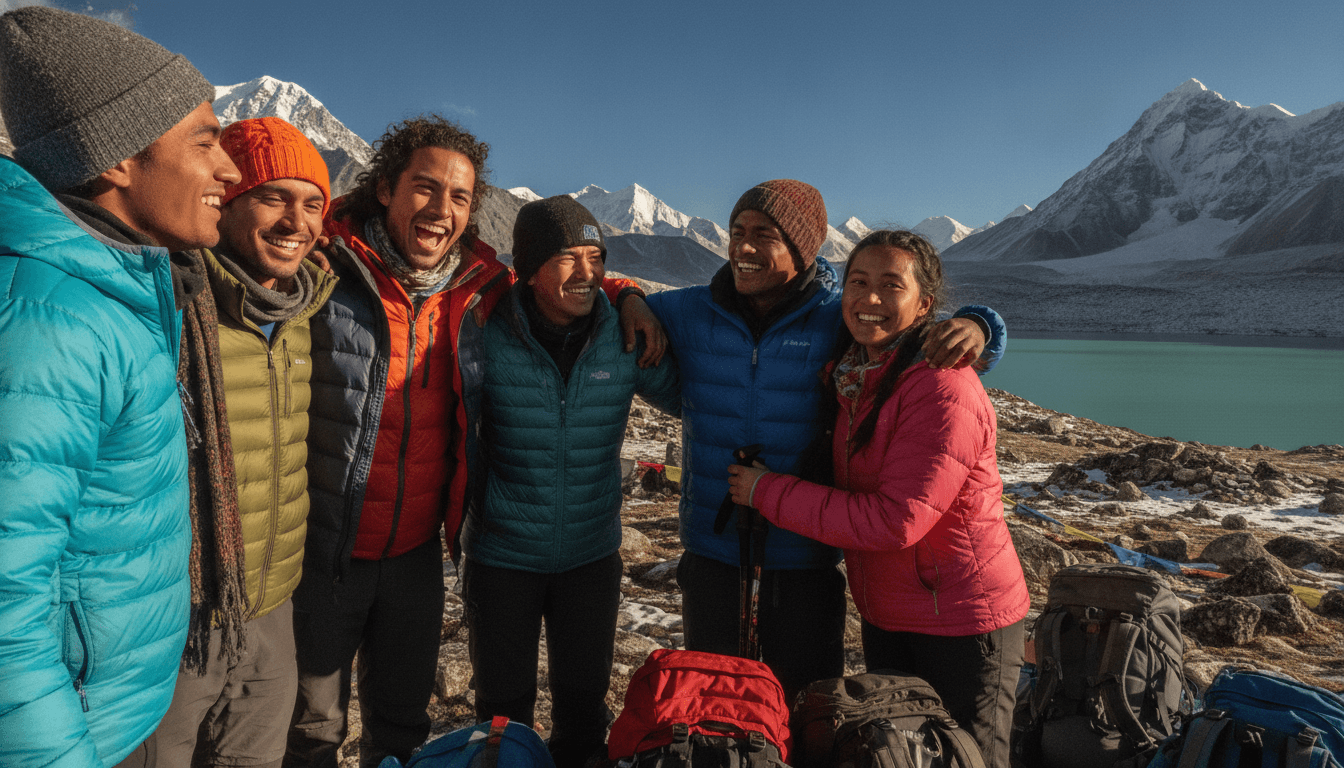
This self-launched version of the classic Everest Base Camp & Three Passes Trek lets you follow the same iconic route — Lukla to Everest Base Camp, Kalapathar, Cho La, Gokyo, Renjo La, and back — without a commercial operator's markup. You'll book your own licensed guide and porter directly (required by Nepal law in many zones and strongly recommended at altitude), arrange your own teahouse accommodation along the trail, and handle your own permits. The route covers some of the most dramatic high-altitude terrain on Earth, passing glaciers, sacred monasteries, Sherpa villages, and the world's highest peaks. Estimated costs below are per person and approximate — teahouse prices, domestic flights, and permit fees can fluctuate seasonally. Budget an additional buffer for contingencies such as flight delays at Lukla (weather cancellations are common) and altitude-related rest days.
Day-by-day
Fly Kathmandu to Lukla — Trek to Phakding
Kathmandu → Lukla → Phakding
Arrive at Tribhuvan International Airport and transfer independently to your Kathmandu guesthouse or proceed directly to the domestic terminal for your early-morning flight to Lukla. Book the Kathmandu–Lukla domestic flight directly with Tara Air or Summit Air (~£90–100 one way). Arrive at the dramatic Tenzing-Hillary Airport in Lukla (2,860m), meet your pre-arranged guide and porter, then begin the first day's trek through Choplung village and down into the Dudh-Kosi River valley to Phakding (2,610m). A gentle 3–4 hour walk — a good warm-up for what lies ahead. Stay in a basic but comfortable teahouse in Phakding.
🚌Taxi or hotel transfer to Kathmandu domestic airport (~£3). Tara Air/Summit Air flight to Lukla (~£95). All trekking on foot from Lukla.
🛏Teahouse in Phakding — e.g. Souvenir Lodge or Buddha Lodge (~£5–8 per person, meals extra)
- →Domestic flight Kathmandu to Lukla — book direct with Tara Air or Summit Air (~£90–100)
- →Trek Lukla to Phakding via Choplung village (~3–4 hrs)
- →Walk through Dudh-Kosi River valley
- →Spot views of Kongde Peak and Naulekh Himal
Phakding to Namche Bazaar
Phakding → Namche Bazaar
A classic and rewarding 5–6 hour trek ascending from Phakding (2,610m) to Namche Bazaar (3,440m) — the bustling trading hub of the Khumbu and the last place to stock up on supplies, change money, and use reliable internet. The route passes through Monjo and Jorsalle, crossing several suspension bridges over the Dudh-Kosi gorge. At Jorsalle you enter Sagarmatha National Park — have your TIMS card and park permit ready (arrange both in Kathmandu before departure). The steep final climb to Namche rewards you with your first glimpse of Everest. Stay in one of Namche's many well-established teahouses.
🚌All trekking on foot.
🛏Teahouse in Namche Bazaar — e.g. Khumbu Lodge or Panorama Lodge (~£6–10 per person)
- →Trek Phakding to Namche Bazaar via Monjo and Jorsalle (~5–6 hrs)
- →Cross dramatic suspension bridges over Dudh-Kosi gorge
- →Enter Sagarmatha National Park (permit required — buy in Kathmandu)
- →First views of Everest on the ascent to Namche
Acclimatisation Day in Namche Bazaar
Namche Bazaar
A mandatory acclimatisation rest day at 3,440m — this is not optional if you want to avoid altitude sickness higher up. Follow the golden rule: walk high, sleep low. Hike up to the famous Everest View Hotel ridge (3,880m) for panoramic views of Everest, Ama Dablam, Lhotse, and Nuptse — no need to enter the hotel itself. Visit the Sherpa Culture Museum (small entry fee ~£1–2) to learn about the history of Himalayan mountaineering and local Sherpa life. Browse Namche's Saturday market if timing aligns. Enjoy a rest afternoon, rehydrate well, and eat carbohydrate-rich meals.
🚌All on foot within Namche.
🛏Teahouse in Namche Bazaar (2nd night — same lodge)
- →Hike up to Everest View Hotel ridge viewpoint for Everest panorama (no entry fee for viewpoint)
- →Visit Namche Sherpa Culture Museum (~£1–2 entry)
- →Browse Namche Bazaar market — good for last-minute gear and snacks
- →Rest, hydrate, and monitor oxygen levels — your guide can assist with pulse oximeter readings
Namche Bazaar to Thyangboche
Namche Bazaar → Thyangboche
A stunning 5–6 hour trek from Namche (3,440m) to Thyangboche (3,867m), widely regarded as one of the most beautiful stages of the entire EBC route. The trail descends to cross the Imja Khola at Phunke Tenga before climbing steeply through rhododendron forest to the monastery ridge. Thyangboche Monastery is one of the most important Tibetan Buddhist sites in Nepal — visit the interior (small donation appreciated) and witness monks in the gompa if timing allows. The backdrop of Ama Dablam, Everest, Lhotse, and Nuptse at sunset from Thyangboche is unforgettable.
🚌All trekking on foot.
🛏Teahouse in Thyangboche — e.g. Rivendell Lodge or Thyangboche Guest House (~£5–8 per person)
- →Trek Namche to Thyangboche via Phunke Tenga (~5–6 hrs)
- →Interior visit to Thyangboche Buddhist Monastery (donation ~£1–2)
- →Sunset views of Ama Dablam, Everest, and Lhotse from monastery grounds
Thyangboche to Dingboche
Thyangboche → Dingboche
Continue ascending through the upper Khumbu valley on a 5–6 hour trek passing Deoboche and Pangboche — home to the oldest monastery in the Khumbu region (worth a short detour). The trail follows the Imja Khola river, with views of Ama Dablam, Island Peak, and Lhotse growing increasingly dramatic. Arrive in Dingboche (4,410m), a broad alpine valley of stone-walled fields and potato terraces. At this altitude, appetite may decrease — eat and drink regardless. Afternoon is a good time to rest and rest only.
🚌All trekking on foot.
🛏Teahouse in Dingboche — e.g. Himalayan Lodge or Peaceful Lodge (~£5–8 per person)
- →Trek Thyangboche to Dingboche via Deoboche and Pangboche (~5–6 hrs)
- →Short detour to Pangboche Monastery (oldest in Khumbu — small donation)
- →Views of Ama Dablam, Island Peak, and Lhotse throughout the day
Dingboche to Chukung
Dingboche → Chukung
A shorter day's walk of 2–3 hours up the Imja Khola valley to Chukung (4,730m) — a small cluster of teahouses surrounded by glaciers. This is an important acclimatisation push before the Khongma La crossing. The optional ascent of Chukung Ri (5,546m) is highly recommended if you have the energy — a strenuous 2–3 hour round trip from the village rewarded with extraordinary views of Island Peak, Baruntse, Lhotse, and the Nuptse wall. Return to Chukung for the night.
🚌All trekking on foot.
🛏Teahouse in Chukung — e.g. Island Peak Lodge or Chukung Ri Lodge (~£5–8 per person)
- →Trek Dingboche to Chukung via Imja Khola valley (~2–3 hrs)
- →Optional: Hike to Chukung Ri summit (5,546m) for panoramic high-altitude views (~2–3 hrs round trip)
- →Views of Island Peak, Baruntse, Lhotse South Face, and Nuptse
Chukung to Lobuche via Khongma La Pass (5,535m)
Chukung → Lobuche
One of the most challenging days of the trek — a 6–7 hour crossing of the Khongma La pass (5,535m), the first of the three high passes. The trail climbs steeply from Chukung through moraines, crosses the pass with sweeping views of the Khumbu glacier and surrounding 8,000m peaks, then descends to join the main EBC trail at Lobuche (4,940m). The trail along the Khumbu Glacier lateral moraine passes a series of memorial chortens to climbers lost on Everest — a moving and sobering sight. An early start is essential.
🚌All trekking on foot. Early 5–6am start recommended.
🛏Teahouse in Lobuche — e.g. Eco Lodge Lobuche or Lobuche Guest House (~£5–8 per person)
- →Trek Chukung to Khongma La pass (5,535m) — first of the three high passes (~3–4 hrs to pass)
- →Cross Khumbu Glacier lateral moraine with views of Nuptse, Pumori, and Pokalde
- →Pass memorial chortens dedicated to climbers lost on Everest
- →Descend to Lobuche (4,940m) (~2–3 hrs from pass)
Lobuche to Gorakshep — Trek to Everest Base Camp
Lobuche → Gorakshep → Everest Base Camp
The highlight of the entire journey. Trek from Lobuche (4,940m) to Gorakshep (5,164m) in approximately 2–3 hours across the rocky Khumbu Glacier moraine, then continue directly to Everest Base Camp (5,364m) — a further 2–3 hours return. The base camp itself is a sprawling glacial moraine with views of the Khumbu Icefall — the famous jumble of seracs and crevasses that expedition climbers must navigate. Return to Gorakshep for the night, exhausted but elated. The altitude here is serious — move slowly and drink plenty of water.
🚌All trekking on foot.
🛏Teahouse in Gorakshep — e.g. Everest Inn or Gorakshep Lodge (~£6–10 per person — limited options, book via your guide in advance)
- →Trek Lobuche to Gorakshep (5,164m) across Khumbu Glacier moraine (~2–3 hrs)
- →Trek to Everest Base Camp (5,364m) and back (~2–3 hrs return)
- →View the Khumbu Icefall and surrounding peaks — Everest, Lhotse, Nuptse
- →Return to Gorakshep for overnight stay
Climb Kalapathar (5,545m) — Trek to Dzongla
Gorakshep → Kalapathar → Dzongla
Rise before dawn for the pre-sunrise climb to Kalapathar (5,545m) — the iconic black rocky summit that provides the most celebrated close-up view of Everest's southwest face, as well as Lhotse, Nuptse, and Pumori. This is the highest point of the trek for most trekkers. Allow 1.5–2 hours to reach the summit from Gorakshep. Return to Gorakshep for breakfast, then begin the long traverse west towards Dzongla (4,830m), a remote hamlet that serves as the base for the Cho La pass crossing tomorrow. A tough 4–5 hour day after an early start.
🚌All trekking on foot. 3–4am start for Kalapathar recommended.
🛏Teahouse in Dzongla — limited options, basic but adequate (~£5–8 per person)
- →Pre-dawn climb to Kalapathar summit (5,545m) for sunrise Everest views (~1.5–2 hrs from Gorakshep)
- →Photograph Everest's southwest face from the closest accessible vantage point
- →Return to Gorakshep for breakfast, then trek to Dzongla (~4–5 hrs)
Dzongla to Thagnag via Cho La Pass (5,367m)
Dzongla → Cho La Pass → Thagnag
The second high pass of the trek — the Cho La (5,367m) — is a glacier crossing that requires care in icy conditions. An early start (4–5am) from Dzongla is essential. The ascent involves a rocky scramble to the pass, followed by a short glacier section (crampons are sometimes needed — ask your guide). On the far side, the Gokyo Valley opens up magnificently with views across the Ngozumba Glacier — Nepal's longest glacier. Descend to Thagnag (4,700m), a small collection of teahouses. This is a big, demanding day — 6–7 hours total.
🚌All trekking on foot. 4–5am start recommended.
🛏Teahouse in Thagnag — basic facilities (~£5–8 per person)
- →Early-morning trek and climb to Cho La pass (5,367m) — second of the three high passes (~3–4 hrs from Dzongla)
- →Glacier crossing at the pass (crampons may be needed — your guide will advise)
- →Descend into Gokyo Valley with views of Ngozumba Glacier (~2–3 hrs to Thagnag)
Thagnag to Gokyo — Lakes Walk
Thagnag → Gokyo
A shorter, more relaxed day walking from Thagnag to Gokyo (4,790m) alongside the stunning turquoise Gokyo lakes — a series of sacred high-altitude glacial lakes fed by the Ngozumba Glacier. Pass the first and second Gokyo lakes before reaching the third and most famous — Dudh Pokhari — beside which the main Gokyo village sits. Cho Oyu (8,201m), the world's sixth-highest mountain, dominates the skyline. Afternoon optional hike up Gokyo Ri (5,357m) is one of the finest viewpoints in the Himalayas — save this for tomorrow morning at sunrise if energy allows.
🚌All trekking on foot.
🛏Teahouse in Gokyo — e.g. Gokyo Resort or Namaste Gokyo Lodge (~£6–10 per person)
- →Trek Thagnag to Gokyo village alongside Ngozumba Glacier and first three Gokyo lakes (~3–4 hrs)
- →Walk to Dudh Pokhari (third Gokyo lake) — sacred glacial lake at 4,790m
- →Views of Cho Oyu (8,201m), Cholatse, and Taboche
- →Optional afternoon: begin ascent of Gokyo Ri (5,357m) for panoramic views
Gokyo to Lungden via Renjo La Pass (5,362m)
Gokyo → Renjo La Pass → Lungden
The third and final high pass of the trek — the Renjo La (5,362m) — offers arguably the most spectacular panorama of the entire route: Everest, Lhotse, Makalu, and Cho Oyu all visible simultaneously, plus the Gokyo lakes glittering below. Start early from Gokyo (4–5am), climb steeply to the pass, then descend the far side into a remote valley to the tiny settlement of Lungden (4,380m). Pass the sacred Renjo Pokhari lake on the descent. This is one of the least-trodden sections of the Three Passes route — a rewarding and wild end to the high-altitude portion of the trek.
🚌All trekking on foot. 4–5am start recommended.
🛏Teahouse in Lungden — very basic, remote (~£4–7 per person)
- →Early-morning climb to Renjo La pass (5,362m) — third of the three high passes (~3–4 hrs from Gokyo)
- →360° Himalayan panorama from the pass — Everest, Lhotse, Makalu, Cho Oyu visible simultaneously
- →Descend past Renjo Pokhari sacred lake to Lungden (~2–3 hrs)
Lungden to Thame via Marlung
Lungden → Marlung → Thame
A descent day following the Bhote Kosi river valley through the remote upper Rolwaling corridor, passing the tiny stone village of Marlung before reaching Thame (3,800m) — a beautiful traditional Sherpa village and a place of great cultural significance. Thame Monastery, perched above the village, is one of the most rewarding monastery visits on the entire trek — the setting is dramatic and the site is far less visited than Thyangboche. Explore the monastery and village in the afternoon. A 5–6 hour walking day.
🚌All trekking on foot.
🛏Teahouse in Thame — e.g. Khumbu Guest House or local teahouses (~£5–8 per person)
- →Trek Lungden to Marlung village along Bhote Kosi valley (~2–3 hrs)
- →Continue to Thame (3,800m) (~2–3 hrs)
- →Visit Thame Monastery — perched on the hillside above the village (small donation)
Thame to Namche Bazaar
Thame → Thamo → Namche Bazaar
A gentle descent back to the comforts of Namche Bazaar (3,440m) via the village of Thamo, passing mani walls and chortens along the Bhote Kosi. A relatively easy 3–4 hour walk that feels like a victory lap after the demands of the high passes. Arrive in Namche to celebrate with a warm shower (pay extra at teahouse, typically ~£2–3), hot food, and perhaps a well-earned slice of apple cake at one of Namche's bakeries. The altitude drop will immediately make you feel stronger — enjoy the sensation. Use the afternoon to wash clothes and restock on snacks for the final two days.
🚌All trekking on foot.
🛏Teahouse in Namche Bazaar — upgrade to a slightly better room if you wish (~£8–12 per person)
- →Trek Thame to Namche Bazaar via Thamo (~3–4 hrs)
- →Pass mani walls, chortens, and views of Kongde Ridge on descent
- →Celebrate arrival back in Namche — hot shower, bakery cake, and rest
- →Restock snacks and dry clothes for final descent days
Namche Bazaar to Lukla
Namche Bazaar → Monjo → Phakding → Lukla
A long but enjoyable descent back to Lukla (2,860m) retracing the outward route through Sagarmatha National Park, past Monjo, along the Dudh Kosi river, and through Phakding. The descent takes approximately 6–7 hours — the knees will feel it, but the lush lower-altitude forest is a delight after weeks above the treeline. Arrive in Lukla in the afternoon. Celebrate the completion of the trek with your guide and porter — a customary tip is greatly appreciated and an important part of local livelihoods (guide ~£8–12/day, porter ~£5–8/day for the full trip is the standard recommendation). Book your Lukla–Kathmandu flight seat for tomorrow morning if not already confirmed.
🚌All trekking on foot.
🛏Teahouse in Lukla — e.g. Lukla Lodge or Sherpa Guest House (~£5–8 per person)
- →Trek Namche to Lukla via Monjo, Jorsalle, and Phakding (~6–7 hrs)
- →Exit Sagarmatha National Park at Monjo checkpoint
- →Celebrate trek completion with guide and porter in Lukla — tip generously
- →Confirm morning Lukla–Kathmandu flight
Fly Lukla to Kathmandu
Lukla → Kathmandu
The final leg home — weather permitting (Lukla flights are frequently delayed or cancelled due to cloud and wind, so never book onward international flights on this same day). The dramatic 30-minute flight back to Kathmandu offers a final aerial view of the Himalayan range. On arrival in Kathmandu, transfer to your hotel or guesthouse in Thamel — treat yourself to a hot shower, a real meal, and a beer. If time allows, visit Boudhanath Stupa or Pashupatinath Temple for a memorable final afternoon. International transfer to airport is by pre-booked taxi (~£3–5).
🚌Tara Air/Summit Air flight Lukla to Kathmandu (~£95). Taxi Kathmandu domestic airport to Thamel hotel (~£3–5).
🛏Guesthouse or budget hotel in Thamel, Kathmandu — e.g. Hotel Potala Guest House or Holy Himalaya Hotel (~£10–18 per person)
- →Morning domestic flight Lukla to Kathmandu (~30 mins) — confirm day before (~£95)
- →Transfer from domestic terminal to hotel in Thamel (~£3–5 taxi)
- →Optional: Visit Boudhanath Stupa (UNESCO World Heritage Site, ~£3 entry) or Pashupatinath Temple
- →Celebratory dinner in Thamel — Nepalese dal bhat ~£3–5, or splurge at a restaurant
Self-launched vs. Eco Holidays Nepal
| This itinerary (self-launched) | Eco Holidays Nepal | |
|---|---|---|
| Price per person | ~£870 | £1,220 |
| Duration | 16 days | 16 days |
| Who books it | You and your group, direct | Tour operator, guided group |
| Savings | £350 per person (29%) | |
Estimate only, not a guaranteed price. Always verify costs independently before booking.
Want to see more Eco Holidays Nepal-style trips? Check them out here.~£870
estimated per person
You never pay Travel Crew for this — you pay hostels, transport, and activity providers directly, the same as if you'd booked it all yourself.
This publishes your dates so other travellers can find and join you — no tour operator needed.
Customise with Tour BusterCreated by

Travel Crew
0 trips
Frequently asked questions
How much does Everest Base Camp & Three Passes Trek — Self-Launched 16-Day Adventure cost?+
Doing it yourself with this self-launched itinerary costs an estimated £870 per person for 16 days in Nepal. This is an AI-generated estimate based on typical budget-traveller prices — actual costs will vary by season and how you book.
Is this cheaper than booking with Eco Holidays Nepal?+
Yes — Eco Holidays Nepal charges around £1,220 per person for a similar tour. Doing the same route independently, using the same standard of accommodation and activities, costs an estimated £870 — a saving of roughly £350 (29%) per person.
How long is the Nepal trip?+
This itinerary runs 16 days, covering 16 day-by-day stops through Nepal.
How do I join this trip?+
You can join an existing open departure using this itinerary if one is scheduled, or launch your own departure with your own dates and invite other travellers to join you — no tour operator required.
Isn't it easier to just use a tour operator?+
Well, yes, a tour operator will book all the individual parts of your travel for you and provide a guide. That's obvious, but doing this has the potential to save the group thousands, which can in turn improve your itinerary substantially or save you huge amounts of money. Also, when you launch a departure, Travel Crew has tools in place to help you book the individual sections of the trip or make it easier for you to do this as a group. Really, you do not need a middle man. If you are more comfortable paying more and using a middle man, then you should certainly do this.
Is it safer to book through a tour operator?+
Arguably, there isn't much difference. A self-launched trip runs on the same principle as a group travel crew: collective responsibility, everyone looking out for each other, the same way it would if a group of friends organised the trip themselves — because that's exactly what's happening. You should always take out travel insurance before you go, self-launched or not; that doesn't change either way. Every open departure is published publicly with real dates and a real trip organiser, so it's never an anonymous arrangement, and our support team is reachable any time you need help, including in an emergency while you're away. Longer-term, we're building direct relationships with ground DMCs in popular destinations, offered as an optional paid add-on for extra on-the-ground support. Ultimately, though, the group is responsible for its own conduct and safety on a self-launched trip, same as on any trip you plan yourself.
What kind of trip is this?+
This is a hiking, adventure, culture trip through Nepal, self-launched rather than run by a tour operator — you organise it with a group you find or bring yourself.
Would you like to name the operator, name the trip, or have any suggestions about how to improve this itinerary?
Drop your comment below — if you've done a similar route, tell us what worked, what you'd add, or what you'd skip.
No comments yet — be the first to share your take.
Sign in to leave a comment.