
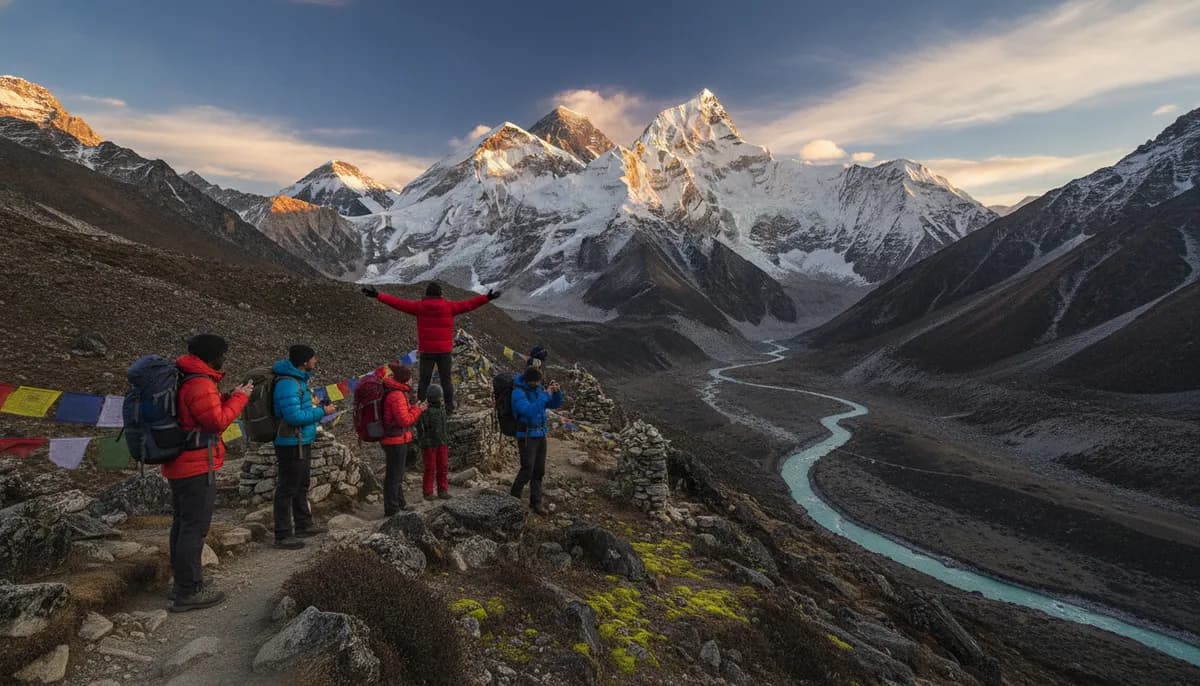
Self-Launched Everest Base Camp Trek — 15 Days
15 days · Nepal (Kathmandu & Khumbu / Everest Region)
Himalayan Scenery Treks And Expedition charges £1,750
No-markup version: ~£1,085 per person
Estimate only, not a guaranteed price. Always verify costs independently before booking.
A self-launched version of the classic 15-day Everest Base Camp trek from Kathmandu. Instead of paying for a fully guided group tour, you organise the same route yourself: book your own Kathmandu guesthouse, arrange the Lukla flights (or the shared jeep alternative), pick up your Khumbu Pasanglhamu Rural Municipality permit and Sagarmatha National Park entry in Monjo, and hire a local guide and/or porter directly in Lukla or Namche at standard rates. Tea houses along the trail are plentiful and can be booked on the spot or a day ahead in peak season. The rhythm of the trek — acclimatisation days at Namche and Dingboche, the push to Base Camp, the sunrise at Kala Patthar — is unchanged. Costs are rough backpacker estimates in GBP and assume you'll share guide/porter costs; solo travellers pay more for the guide/porter unless they hire just a porter-guide. Book a guide for safety at altitude — this is not a route to attempt entirely unsupported if it's your first Himalayan trek.
Day-by-day
Arrive Kathmandu — Thamel base camp
Kathmandu
Fly into Tribhuvan International Airport. Skip the pre-arranged hotel transfer: pre-book an airport pickup through your guesthouse (usually NPR 800–1,200 / ~£5–7) or grab a metered taxi from the official desk outside arrivals (~NPR 700 / ~£4 to Thamel). Check into a Thamel or Paknajang guesthouse. Spend the afternoon gently: sort a Nepali SIM/eSIM (Ncell or NTC counter at the airport, ~£4 for data), draw cash from an ATM (take out more than you think — ATMs above Namche are unreliable), and buy or rent gear on Thamel's trekking shops (down jacket and sleeping bag rental ~£1.50–2.50/day each). Early night — you fly out in two days.
🚌Airport taxi ~£4; walking in Thamel
🛏Thamel guesthouse, private room with hot shower (~£12)
- →Airport transfer to Thamel
- →Buy Nepali SIM/eSIM
- →Rent down jacket and sleeping bag in Thamel
- →Trip admin and cash run
Kathmandu Valley sightseeing (self-guided)
Kathmandu
Do the same four UNESCO sites the tour visits, but on your own schedule. Buy the Kathmandu Durbar Square ticket (~NPR 1,000 / ~£6) and walk to Swayambhunath (Monkey Temple, ~NPR 200 / ~£1.20) — it's 30–40 minutes on foot from Thamel. In the afternoon take a metered taxi or Pathao ride to Pashupatinath (~£3) and then Boudhanath (~£3); Boudhanath's stupa kora at dusk is the highlight. Entry to Pashupatinath is ~NPR 1,000 (~£6). Alternatively book a half-day Kathmandu Valley tour on GetYourGuide or Klook (~£25–35) if you'd rather have commentary. Sort your TIMS/permits situation this evening and confirm your Lukla flight with the airline.
🚌Walking plus 2–3 short taxis/Pathao rides (~£8 total)
🛏Thamel guesthouse (~£12)
- →Kathmandu Durbar Square
- →Swayambhunath
- →Pashupatinath
- →Boudhanath at dusk
Fly Kathmandu → Lukla, trek to Phakding
Lukla / Phakding
The Lukla flight is the one thing you should book well ahead — book direct with Tara Air, Summit Air or Yeti Airlines (~£150–190 return, weather dependent, hand luggage 10kg + 5kg). Flights leave from the domestic terminal at 6–7am; be there by 5am. From Lukla (2,860m) walk the gentle 3–4 hour trail down to Phakding (2,610m). In Lukla or Phakding, hire a licensed guide and/or porter directly — standard rates are roughly £20–25/day for a guide and £13–17/day for a porter, and you should also cover their food and lodging. Agree the number of days and the payment schedule in writing. Overnight in a Phakding tea house.
🚌Domestic flight KTM–Lukla (included in the ~£170 return airfare)
🛏Phakding tea house, twin room (~£4–6; meals bought separately)
- →Kathmandu–Lukla flight
- →Trek Lukla to Phakding, 3–4 hrs
- →Hire local guide/porter in Lukla
Phakding → Namche Bazaar
Namche Bazaar
A long but beautiful day: 6–7 hours up through Jorsale, across the high suspension bridges, and up the notorious Namche hill. At Monjo you register your Khumbu Pasanglhamu Rural Municipality permit (NPR 3,000 / ~£18, buy at the Monjo or Lukla counter) and your Sagarmatha National Park entry (NPR 3,000 / ~£18). Namche (3,440m) is the last place with decent ATMs, bakeries and gear shops. Tea house in Namche, ideally near the main square.
🚌On foot, 6–7 hrs
🛏Namche tea house, twin room (~£6–8)
- →Sagarmatha National Park entry and Khumbu permit at Monjo
- →Suspension bridge crossings
- →Namche Bazaar evening
Namche acclimatisation — Everest View Hotel hike
Namche Bazaar
Standard acclimatisation day. Walk up to the Everest View Hotel at Syangboche (3,880m) for your first sight of Everest, Nuptse and Ama Dablam — 2 hours up, 1 hour back. Entry to the Syangboche viewpoint area / hotel grounds is small or free. Spend the afternoon exploring the Saturday market area (if your timing works), the Sherpa museum and the bakeries. Do not push higher — this day is what keeps you well at Base Camp.
🚌On foot, 3–4 hrs round trip
🛏Namche tea house (~£6–8)
- →Hike to Everest View Hotel / Syangboche
- →Namche village and Sherpa museum
- →Acclimatisation rest
Namche → Tengboche
Tengboche
4–5 hours along a spectacular high traverse above the Dudh Koshi, then down to Phunki Tenga and up through pine forest to Tengboche (3,860m). Tengboche Monastery is the largest in the Khumbu — entry is about NPR 300 (~£1.80) and afternoon prayer ceremonies are usually open to visitors (check times at the gate). Stay in a tea house in Tengboche or the slightly warmer Deboche 20 minutes below.
🚌On foot, 4–5 hrs
🛏Tengboche/Deboche tea house (~£6–8)
- →Tengboche Monastery visit and prayer ceremony
- →Dudh Koshi valley views
Tengboche → Dingboche
Dingboche
5–6 hours through Pangboche village (one of the oldest in the Khumbu) and past the mountain river crossing, then gently up onto the open Imja Valley to Dingboche (4,410m). Dingboche is cold and exposed — expect to pay a little more for rooms and food here (tea houses often charge for charging devices, ~NPR 200–500). Hydrate, nap, and prepare for the acclimatisation day tomorrow.
🚌On foot, 5–6 hrs
🛏Dingboche tea house (~£7–9)
- →Pangboche village
- →Imja Valley views of Ama Dablam
Dingboche acclimatisation — Nangkartshang hike
Dingboche
Hike up Nangkartshang Hill (5,083m) — 3–4 hours round trip with huge views of Makalu, Island Peak and Ama Dablam. It's the best-value acclimatisation hike on the route and free to do. Come down for lunch and rest. If you're feeling the altitude, this is the day to speak up to your guide about slowing down.
🚌On foot, 3–4 hrs round trip
🛏Dingboche tea house (~£7–9)
- →Nangkartshang Hill hike (5,083m)
- →Rest and hydration
Dingboche → Lobuche
Lobuche
4–5 hours over the Thukla Pass moraine, passing the memorial chortens for climbers lost on Everest, then on to Lobuche (4,940m). Short day by distance but cold and slow at this altitude. Lobuche tea houses are basic and expensive — bring cash (NPR), expect ~£10–12 for a room and simple meals at 5,000m.
🚌On foot, 4–5 hrs
🛏Lobuche tea house (~£9–12)
- →Thukla memorial chortens
- →Khumbu Glacier views
Lobuche → Gorak Shep → Everest Base Camp
Gorak Shep / Everest Base Camp
The big day. Walk 2–3 hours to Gorak Shep (5,164m), drop bags, then continue 3 hours each way along the Khumbu Glacier to Everest Base Camp (5,364m). Take a photo at the marker and the icefall viewpoint — you can't step onto the glacier itself. This is a 7–8 hour day; start early, go slowly. Stay in Gorak Shep (very basic, ~£12–15 for a room). Bring a headtorch and your warmest layers.
🚌On foot, 7–8 hrs total
🛏Gorak Shep tea house (~£12–15)
- →Trek to Everest Base Camp (5,364m)
- →Khumbu Icefall viewpoint
- →Photo at the EBC marker
Kala Patthar sunrise → Pheriche
Kala Patthar / Pheriche
Up at 4am for the 2-hour climb to Kala Patthar (5,545m) for sunrise over Everest — the single best view of the trek, and free. Back to Gorak Shep for breakfast, then descend 4–5 hours to Pheriche (4,270m). The descent feels euphoric; watch your footing on the moraine. Pheriche has a small Himalayan Rescue Association clinic if you have any altitude concerns.
🚌On foot, 6–7 hrs total
🛏Pheriche tea house (~£6–8)
- →Kala Patthar sunrise (5,545m)
- →Descend to Pheriche
Pheriche → Namche via Khumjung
Namche Bazaar
A long descent 6–7 hours via the alternative high route through Khumjung village, home of the Hillary School and the Khumjung Monastery (which claims a yeti scalp — small donation entry). Continue down to Namche for a hot shower, a proper meal and maybe a celebratory beer. Rooms in Namche often drop in price once you're heading down.
🚌On foot, 6–7 hrs
🛏Namche tea house (~£6–8)
- →Khumjung village and monastery
- →Descent to Namche Bazaar
Namche → Lukla
Lukla
The last long walking day: 7–8 hours back down via Monjo and Phakding to Lukla (2,860m). Cash out your guide and porter here — budget tip money on top of wages (10–15% is customary). Celebrate over dal bhat and a beer in Lukla's Irish pub, and confirm tomorrow's flight. Note: flights are frequently delayed or cancelled, so keep a spare day in your Kathmandu plan.
🚌On foot, 7–8 hrs
🛏Lukla guesthouse (~£6–8)
- →Descend to Lukla
- →Tip guide and porter
- →Confirm return flight
Fly Lukla → Kathmandu
Kathmandu
Early morning flight back to Kathmandu (weather permitting). Afternoon free: a massage in Thamel (~£12–18 for an hour), souvenir shopping in Patan or Thamel, and a proper dinner. If your flight is cancelled, the usual fallback is a shared jeep Lukla–Salleri or Lukla–Jiri then a bus to Kathmandu — slow and bumpy, but it works.
🚌Lukla–Kathmandu flight (in return airfare); taxi from domestic terminal (~£4)
🛏Thamel guesthouse (~£12)
- →Return flight to Kathmandu
- →Thamel shopping
- →Massage/spa
Depart Kathmandu
Kathmandu
Transfer to Tribhuvan International Airport for your international flight. Pre-book a guesthouse taxi (~£4) or use Pathao. Allow 3 hours before departure. If you have extra time, Bhaktapur Durbar Square or Patan are excellent half-day add-ons.
🚌Airport taxi ~£4
🛏—
- →Airport transfer
- →Optional Bhaktapur or Patan day trip if time allows
Self-launched vs. Himalayan Scenery Treks And Expedition
| This itinerary (self-launched) | Himalayan Scenery Treks And Expedition | |
|---|---|---|
| Price per person | ~£1,085 | £1,750 |
| Duration | 15 days | 15 days |
| Who books it | You and your group, direct | Tour operator, guided group |
| Savings | £665 per person (38%) | |
Estimate only, not a guaranteed price. Always verify costs independently before booking.
Want to see more Himalayan Scenery Treks And Expedition-style trips? Check them out here.~£1,085
estimated per person
You never pay Travel Crew for this — you pay hostels, transport, and activity providers directly, the same as if you'd booked it all yourself.
This publishes your dates so other travellers can find and join you — no tour operator needed.
Customise with Tour BusterCreated by

Travel Crew
0 trips
Frequently asked questions
How much does Self-Launched Everest Base Camp Trek — 15 Days cost?+
Doing it yourself with this self-launched itinerary costs an estimated £1,085 per person for 15 days in Nepal (Kathmandu & Khumbu / Everest Region). This is an AI-generated estimate based on typical budget-traveller prices — actual costs will vary by season and how you book.
Is this cheaper than booking with Himalayan Scenery Treks And Expedition?+
Yes — Himalayan Scenery Treks And Expedition charges around £1,750 per person for a similar tour. Doing the same route independently, using the same standard of accommodation and activities, costs an estimated £1,085 — a saving of roughly £665 (38%) per person.
How long is the Nepal (Kathmandu & Khumbu / Everest Region) trip?+
This itinerary runs 15 days, covering 15 day-by-day stops through Nepal (Kathmandu & Khumbu / Everest Region).
How do I join this trip?+
You can join an existing open departure using this itinerary if one is scheduled, or launch your own departure with your own dates and invite other travellers to join you — no tour operator required.
Isn't it easier to just use a tour operator?+
Well, yes, a tour operator will book all the individual parts of your travel for you and provide a guide. That's obvious, but doing this has the potential to save the group thousands, which can in turn improve your itinerary substantially or save you huge amounts of money. Also, when you launch a departure, Travel Crew has tools in place to help you book the individual sections of the trip or make it easier for you to do this as a group. Really, you do not need a middle man. If you are more comfortable paying more and using a middle man, then you should certainly do this.
Is it safer to book through a tour operator?+
Arguably, there isn't much difference. A self-launched trip runs on the same principle as a group travel crew: collective responsibility, everyone looking out for each other, the same way it would if a group of friends organised the trip themselves — because that's exactly what's happening. You should always take out travel insurance before you go, self-launched or not; that doesn't change either way. Every open departure is published publicly with real dates and a real trip organiser, so it's never an anonymous arrangement, and our support team is reachable any time you need help, including in an emergency while you're away. Longer-term, we're building direct relationships with ground DMCs in popular destinations, offered as an optional paid add-on for extra on-the-ground support. Ultimately, though, the group is responsible for its own conduct and safety on a self-launched trip, same as on any trip you plan yourself.
What kind of trip is this?+
This is a adventure, hiking, backpacker trip through Nepal (Kathmandu & Khumbu / Everest Region), self-launched rather than run by a tour operator — you organise it with a group you find or bring yourself.
Would you like to name the operator, name the trip, or have any suggestions about how to improve this itinerary?
Drop your comment below — if you've done a similar route, tell us what worked, what you'd add, or what you'd skip.
No comments yet — be the first to share your take.
Sign in to leave a comment.