
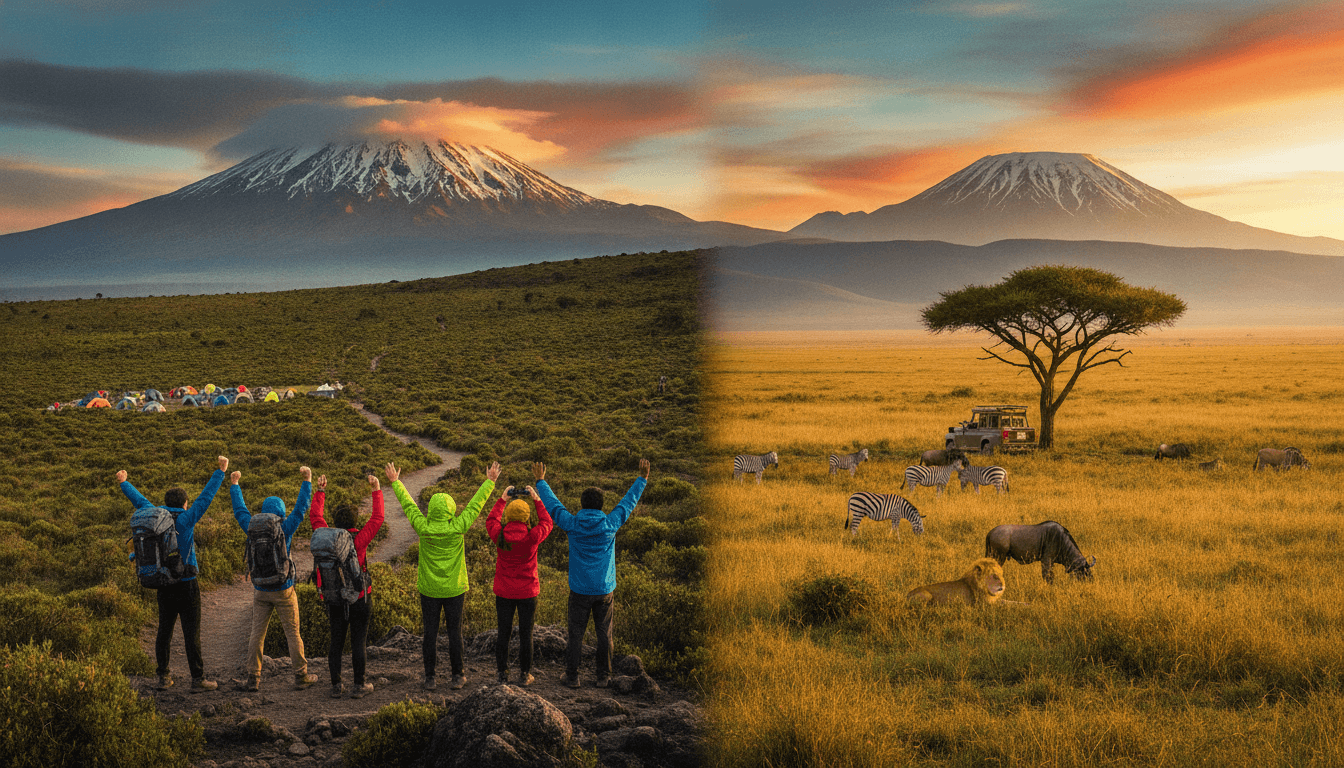
Kilimanjaro Machame Route & Serengeti Safari — Self-Launched
13 days · Tanzania (Kilimanjaro & Northern Safari Circuit)
G Adventures charges £3,400
No-markup version: ~£2,055 per person
Estimate only, not a guaranteed price. Always verify costs independently before booking.
A self-launched 13-day Tanzania adventure combining the classic Machame Route climb to Uhuru Peak (5,895m) with a camping safari through Lake Manyara, the Serengeti and the Ngorongoro Crater. Instead of a fully guided group tour, you book your Kilimanjaro trek direct with a licensed local outfitter (which is how almost everyone climbs Kili — the mountain requires registered guides and porters), then join a shared small-group camping safari out of Arusha. You save by booking direct, choosing budget lodges/hostels in Moshi and Arusha, and using local buses and shared 4x4 safari departures instead of a private tour vehicle. Note: Kilimanjaro is one of the few places where you genuinely cannot go fully independent — Tanzanian law requires a licensed guide and permit — so the self-launched saving comes from cutting out the Western tour operator's markup, not from skipping support. Costs are approximate, per person, in GBP.
Day-by-day
Arrive Moshi — trip briefing & gear check
Moshi
Fly into Kilimanjaro International Airport (JRO) and take a pre-booked shuttle or taxi (~£12) 45 minutes to Moshi town. Check into a budget guesthouse near the clock tower. Spend the afternoon renting kit if needed — sleeping bag, down jacket, trekking poles and a 4-season mat can be rented in town for around £35-50 for the whole climb rather than buying. Meet your trekking outfitter in the evening for the Machame Route briefing, permit check and gear inspection. Eat a big carb-heavy dinner and get an early night. Note: if you prefer a more relaxed acclimatisation you can add an extra rest day in Moshi for ~£15.
🚌Airport shuttle/taxi JRO → Moshi ~£12 (shareable)
🛏Budget guesthouse/hostel in Moshi town (e.g. dorm or private room near the clock tower) — ~£12/night
- →Arrive JRO, transfer to Moshi
- →Rent trekking gear in Moshi
- →Trek briefing and permit/document check with outfitter
Machame Gate (1,640m) → Machame Camp (2,850m)
Kilimanjaro — Machame Camp
Drive 45 minutes to Machame Gate, complete park registration and start the rainforest section of the climb — roughly 5-6 hours of walking through lush forest to Machame Camp. Porters carry your main pack; you carry a daypack with water, layers and snacks. The altitude gain is real, so walk pole pole (slowly). Dinner in a mess tent and an early night. All meals on the mountain are included in your trek price.
🚌Outfitter transfer Moshi → Machame Gate (~45 min) — included in trek
🛏Mountain tented camp (Machame Camp) — included in trek package
- →Machame Gate registration
- →Trek rainforest zone to Machame Camp
Machame Camp → Shira 2 Camp (3,850m)
Kilimanjaro — Shira 2 Camp
A shorter but steeper day climbing out of the forest into the moorland zone, with the first big views of Kibo Peak. Around 4-5 hours walking to Shira 2 Camp on the open Shira Plateau. Afternoon rest, hydrate heavily, and expect the first mild altitude symptoms — headache and appetite loss are normal. Your guide will do a health check with a pulse oximeter.
🚌On foot — included in trek
🛏Mountain tented camp (Shira 2 Camp) — included in trek package
- →Trek forest to moorland transition
- →First views of Kibo Peak
Shira 2 Camp → Lava Tower (4,600m) → Barranco Camp (3,950m)
Kilimanjaro — Barranco Camp
The key acclimatisation day: climb high to Lava Tower for lunch, then descend into the Barranco Valley — 'climb high, sleep low'. Around 6-7 hours walking total. This descent day is what gives most climbers their best shot at the summit, so don't rush it. Barranco Camp sits below the looming Barranco Wall and the Helm Glacier.
🚌On foot — included in trek
🛏Mountain tented camp (Barranco Camp) — included in trek package
- →Lava Tower acclimatisation climb
- →Descend to Barranco Camp
Barranco Camp → Barafu Camp (4,673m)
Kilimanjaro — Barafu Camp
Scramble up the Great Barranco Wall (not technical, but hands-on and exposed in places), then traverse the ridge and cross the Karanga Valley to Barafu Camp — roughly 6-7 hours. Eat and sleep early: summit night starts around midnight. Charge devices now and lay out your summit layers, headtorch and water so you can dress in the dark.
🚌On foot — included in trek
🛏Mountain tented camp (Barafu Camp) — included in trek package
- →Climb the Great Barranco Wall
- →Cross Karanga Valley to Barafu Camp
- →Summit-night preparation
Summit night: Barafu → Stella Point → Uhuru Peak (5,895m) → Mweka Camp
Kilimanjaro — Uhuru Peak & Mweka Camp
The big one. Start around midnight and climb 6-8 hours in the dark and cold (down to -15°C with windchill) to Stella Point on the crater rim, then an hour more along the rim to Uhuru Peak, the roof of Africa. Short celebration, then descend 3-4 hours to Mweka Camp — the descent is brutal on the knees, so poles help. This is the toughest day of the trip; drink and eat even when you don't feel like it.
🚌On foot — included in trek
🛏Mountain tented camp (Mweka Camp) — included in trek package
- →Midnight summit ascent
- →Stella Point (5,756m)
- →Uhuru Peak summit (5,895m)
- →Descent to Mweka Camp
Mweka Gate → Moshi — summit certificates & hot shower
Moshi
A 3-4 hour descent through forest to Mweka Gate, where you sign out and collect your summit certificate over a packed lunch. Transfer back to Moshi for a very welcome hot shower and a celebration meal. This is also tipping day — budget around £60-100 for the guide, assistant guide, cook and porters (a shared tip pot works well). Optional aromatherapy massage in town, or just collapse.
🚌Outfitter transfer Mweka Gate → Moshi — included in trek
🛏Budget guesthouse/hostel in Moshi — ~£12/night
- →Descend to Mweka Gate
- →Collect summit certificate
- →Trek tipping ceremony
- →Optional massage in Moshi (~£15)
Moshi → Arusha — coffee tour & town time
Arusha
Sleep in, then take a local bus or shared shuttle from Moshi to Arusha (~2 hours, £3-6). Check into a budget lodge or hostel in Arusha. Spend the afternoon on a self-booked Materuni-area coffee tour or the Moshi/Arusha women's cooperative craft markets to buy directly from makers. Evening: pre-safari briefing with your safari operator and pack a small day bag for the game drives.
🚌Local bus/shared shuttle Moshi → Arusha ~£4
🛏Budget lodge/hostel in Arusha (e.g. The Outpost-style mid-range lodge or a cheaper guesthouse) — ~£20/night
- →Moshi→Arusha transfer
- →Coffee/craft cooperative visit (direct booking, ~£15)
- →Safari briefing
Arusha → Mto wa Mbu → Lake Manyara National Park
Mto wa Mbu / Lake Manyara
Join your shared small-group camping safari (booked direct with an Arusha operator). Drive to Mto wa Mbu for a village walk and a traditional lunch with a local family — this market town is also the best place on the route for souvenir shopping direct from makers. Afternoon game drive in Lake Manyara National Park, famous for tree-climbing lions, elephants and huge flamingo flocks along the soda lake. Overnight camping at a lodge campsite near Mto wa Mbu.
🚌Shared safari 4x4 with pop-up roof — Arusha → Mto wa Mbu → Lake Manyara — included in safari
🛏Camping at a lodge campsite near Mto wa Mbu (tent + basic facilities) — included in safari package
- →Mto wa Mbu village walk and local lunch
- →Lake Manyara National Park afternoon game drive
- →Bush-camp evening
Mto wa Mbu → Serengeti National Park (Seronera)
Serengeti National Park
A long, dusty but spectacular drive through the Ngorongoro Conservation Area and up onto the Serengeti plains, with game viewing en route. Arrive at Seronera campsite in the central Serengeti — if you camp here, expect wildlife (including hyenas and the odd elephant) right at the fence line. Afternoon game drive hunting the Big Five. Stay quiet at night and listen.
🚌Shared safari 4x4 — Mto wa Mbu → Serengeti — included in safari
🛏Camping at Seronera Campsite, central Serengeti — included in safari package
- →Drive through Ngorongoro Conservation Area
- →Serengeti afternoon game drive
- →Camp under the stars in Seronera
Full day in the Serengeti — picnic lunch in the bush
Serengeti National Park
A full day of game drives across the Seronera Valley, with a picnic lunch in the bush. Time your visit right (roughly late June to October) and you may see the Great Migration herds in the northern Serengeti or western corridor. Optional extra: a hot-air balloon safari at dawn — gorgeous but pricey, around £450-550 per person booked directly with the balloon company. Second night at Seronera.
🚌Shared safari 4x4 — included in safari
🛏Camping at Seronera Campsite, central Serengeti — included in safari package
- →Full-day Serengeti game drive
- →Bush picnic lunch
- →Optional hot-air balloon safari (~£450-550, book direct)
Serengeti → Ngorongoro Crater rim
Ngorongoro Crater
Morning game drive as you exit the Serengeti, then travel to the Ngorongoro Conservation Area. Drop into the crater floor in the afternoon for one of the densest wildlife concentrations on earth — black rhino, lions, hippos, flamingos and huge elephant bulls. Climb back up to camp on the crater rim at Simba Campsite. Bring warm layers — the rim sits at about 2,300m and gets cold at night. Stop at a Maasai village or the clean-cookstove community project on the way, and buy directly from the community.
🚌Shared safari 4x4 — Serengeti → Ngorongoro — included in safari
🛏Camping at Simba Campsite, Ngorongoro rim — included in safari package
- →Morning Serengeti game drive
- →Ngorongoro Crater floor wildlife drive
- →Community/Maasai village visit
Ngorongoro → Arusha — trip ends
Arusha
Final morning drive back to Arusha, with a stop at a community cookstove project en route. Arrive in Arusha by early afternoon — your trip officially ends here. If you're continuing onward, you can catch a shuttle to Kilimanjaro Airport (~£35) or a local bus onward to Dar es Salaam or Nairobi. If you have a spare day, the Arusha National Park day trip or a night at a cheap hostel before flying out works well.
🚌Shared safari 4x4 back to Arusha — included in safari; onward airport shuttle ~£35 if needed
🛏Not included — onward travel or optional Arusha hostel (~£20/night if you stay over)
- →Community cookstove project visit
- →Return to Arusha — trip ends
Self-launched vs. G Adventures
| This itinerary (self-launched) | G Adventures | |
|---|---|---|
| Price per person | ~£2,055 | £3,400 |
| Duration | 13 days | 13 days |
| Who books it | You and your group, direct | Tour operator, guided group |
| Savings | £1,345 per person (40%) | |
Estimate only, not a guaranteed price. Always verify costs independently before booking.
Want to see more G Adventures-style trips? Check them out here.~£2,055
estimated per person
You never pay Travel Crew for this — you pay hostels, transport, and activity providers directly, the same as if you'd booked it all yourself.
This publishes your dates so other travellers can find and join you — no tour operator needed.
Customise with Tour BusterCreated by

Travel Crew
0 trips
Frequently asked questions
How much does Kilimanjaro Machame Route & Serengeti Safari — Self-Launched cost?+
Doing it yourself with this self-launched itinerary costs an estimated £2,055 per person for 13 days in Tanzania (Kilimanjaro & Northern Safari Circuit). This is an AI-generated estimate based on typical budget-traveller prices — actual costs will vary by season and how you book.
Is this cheaper than booking with G Adventures?+
Yes — G Adventures charges around £3,400 per person for a similar tour. Doing the same route independently, using the same standard of accommodation and activities, costs an estimated £2,055 — a saving of roughly £1,345 (40%) per person.
How long is the Tanzania (Kilimanjaro & Northern Safari Circuit) trip?+
This itinerary runs 13 days, covering 13 day-by-day stops through Tanzania (Kilimanjaro & Northern Safari Circuit).
How do I join this trip?+
You can join an existing open departure using this itinerary if one is scheduled, or launch your own departure with your own dates and invite other travellers to join you — no tour operator required.
Isn't it easier to just use a tour operator?+
Well, yes, a tour operator will book all the individual parts of your travel for you and provide a guide. That's obvious, but doing this has the potential to save the group thousands, which can in turn improve your itinerary substantially or save you huge amounts of money. Also, when you launch a departure, Travel Crew has tools in place to help you book the individual sections of the trip or make it easier for you to do this as a group. Really, you do not need a middle man. If you are more comfortable paying more and using a middle man, then you should certainly do this.
Is it safer to book through a tour operator?+
Arguably, there isn't much difference. A self-launched trip runs on the same principle as a group travel crew: collective responsibility, everyone looking out for each other, the same way it would if a group of friends organised the trip themselves — because that's exactly what's happening. You should always take out travel insurance before you go, self-launched or not; that doesn't change either way. Every open departure is published publicly with real dates and a real trip organiser, so it's never an anonymous arrangement, and our support team is reachable any time you need help, including in an emergency while you're away. Longer-term, we're building direct relationships with ground DMCs in popular destinations, offered as an optional paid add-on for extra on-the-ground support. Ultimately, though, the group is responsible for its own conduct and safety on a self-launched trip, same as on any trip you plan yourself.
What kind of trip is this?+
This is a adventure, hiking, wildlife trip through Tanzania (Kilimanjaro & Northern Safari Circuit), self-launched rather than run by a tour operator — you organise it with a group you find or bring yourself.
Would you like to name the operator, name the trip, or have any suggestions about how to improve this itinerary?
Drop your comment below — if you've done a similar route, tell us what worked, what you'd add, or what you'd skip.
No comments yet — be the first to share your take.
Sign in to leave a comment.