
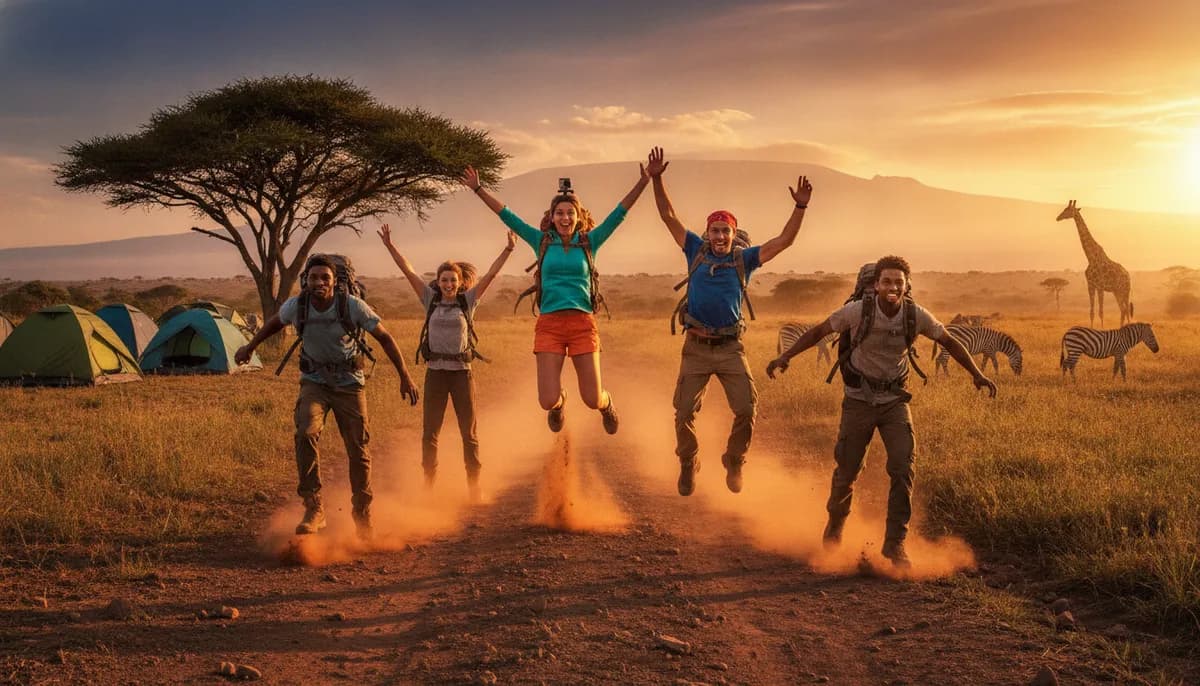
Self-Launched Kilimanjaro Marangu Route & Serengeti Adventure
12 days · Tanzania
G Adventures charges £3,100
No-markup version: ~£1,620 per person
Estimate only, not a guaranteed price. Always verify costs independently before booking.
A self-launched, independently booked version of G Adventures' 12-day Marangu Route summit and camping safari. You'll book your own Machame/Marangu trek operator (porters, guide and cook included by park law), stay in budget guesthouses and public campsites, and join a shared 4x4 safari for Serengeti and Ngorongoro. Same mountain, same wildlife, no group-tour markup — expect to pay well under half the original price.
Day-by-day
Arrive Moshi
Moshi
Land at Kilimanjaro International Airport (JRO) and take a taxi or shared shuttle ~45 minutes into Moshi town (~£12-18). Check into a budget guesthouse, buy a local SIM with data at the airport or in town, and pick up bottled water and any last-minute trek gear from Moshi's climbing shops (rental gear is far cheaper here than through a tour operator). Meet your trek operator this evening to confirm the briefing, gear check, duffle weigh-in and permit paperwork.
🚌Airport taxi or shared shuttle JRO to Moshi (~£12-18)
🛏Budget guesthouse in Moshi (dorm or private twin)
- →Gear check with independent trek operator
- →SIM card and supplies run in Moshi town
Marangu Gate to Mandara Huts
Kilimanjaro - Mandara Huts
Transfer to Marangu Gate with your guide team, complete park registration and permit checks, then hike the forested lower slopes to Mandara Huts (2,720m), roughly 4-5 hours through rainforest with colobus monkeys. Marangu is the 'Coca-Cola route' with dorm-style A-frame huts, so no tent needed — bring a warm sleeping bag (rentable in Moshi for ~£25). Purified mountain water is provided from here onwards.
🚌Shared minibus Moshi to Marangu Gate (~45 min)
🛏Mandara Huts (shared A-frame dorm hut)
- →Marangu Route day 1 trek
- →Rainforest hike to Mandara escarpment
Mandara Huts to Horombo Huts
Kilimanjaro - Horombo Huts
Climb out of the forest into heather and moorland to Horombo Huts (3,720m), about 6 hours. Go slowly, drink 3+ litres of water and watch for altitude symptoms. Optional acclimatisation side-hike to Zebra Rocks in the afternoon. This is where the temperature really drops at night.
🚌On foot
🛏Horombo Huts (shared A-frame dorm hut)
- →Moorland zone trek
- →Optional Zebra Rocks acclimatisation hike
Horombo Huts to Kibo Huts
Kilimanjaro - Kibo Huts
Cross the alpine desert of the Kilimanjaro Saddle to Kibo Hut (4,703m), around 5-6 hours. Eat and sleep early in the afternoon — you'll be woken around midnight for the summit push. You can also split this into an extra acclimatisation day at Horombo if you'd like a safer 6-day ascent; budget an extra ~£95 for the extra park day and crew.
🚌On foot
🛏Kibo Huts (large shared bunk dorm, unheated)
- →Alpine desert hike across the Saddle
Summit day — Uhuru Peak and descend to Horombo
Kilimanjaro - Uhuru Peak / Horombo Huts
Start just after midnight on the frozen scree to Gilman's Point (5,681m) in time for sunrise, then continue around the crater rim to Uhuru Peak (5,895m) — the roof of Africa. Descend to Kibo for lunch, then walk down to Horombo Huts for a well-earned rest. Expect 12-14 hours of walking: poles, headtorch and warm extremities are essential.
🚌On foot
🛏Horombo Huts (shared A-frame dorm hut)
- →Night summit ascent via Gilman's Point
- →Uhuru Peak sunrise
- →Long descent to Horombo
Descend to Moshi
Moshi
Walk out through the moorland, plantations and villages to Marangu Gate, collect your summit certificate, then take your shared transfer back to Moshi. Shower, hand in laundry at your guesthouse and have a proper meal in town. Tip your guide, cook and porters on the mountain before departing — 8-12% of your trek cost split across the crew is standard practice (roughly £55-90pp).
🚌Shared minibus Marangu Gate to Moshi (~45 min)
🛏Budget guesthouse in Moshi
- →Final descent and certificate collection
- →Optional aromatherapy massage in Moshi (~£15)
Moshi to Arusha via the Moshi Women's Cooperative
Arusha
Take a local bus or shared shuttle from Moshi to Arusha (~2 hours, ~£4-6). Before leaving Moshi, visit the Moshi Women's Cooperative — an independently run project supported by Planeterra where women and girls excluded from formal education learn sewing and craft skills. Buy something directly and the money goes straight to the cooperative. In Arusha, stock up on safari snacks, a wide-brim hat and binoculars if you don't have them.
🚌Local bus or shared shuttle Moshi to Arusha (~£5)
🛏Budget guesthouse or hostel in Arusha
- →Moshi Women's Cooperative visit and workshop tour
- →Arusha supplies and safari briefing
Mto wa Mbu cultural walk and Lake Manyara safari
Mto wa Mbu
Join a shared 4x4 safari vehicle (most budget operators consolidate solo travellers) or take a local dalla-dalla from Arusha bus stand to Mto wa Mbu (~2 hours, ~£3). Do a community-led cultural walk with Mto wa Mbu's village tourism office: banana plantations, rice paddies, market and a traditional lunch cooked by a local family (~£12-18). In the afternoon head into Lake Manyara National Park for tree-climbing lions and flamingo-lined shores (~£60 park fees and vehicle share). Camp at a public campsite near the park with warm showers and a small bar.
🚌Dalla-dalla Arusha to Mto wa Mbu (~£3); shared 4x4 in the park
🛏Public campsite near Lake Manyara (own rented tent)
- →Mto wa Mbu cultural walk with local guide
- →Traditional family lunch
- →Lake Manyara wildlife drive
Safari drive to Serengeti National Park
Serengeti National Park
Game drive en route through the Ngorongoro Conservation Area and out onto the Serengeti plains, arriving at a central Serengeti public campsite near Seronera. Park fees for Serengeti are steep (~£50pp per 24 hours on top of the conservation fee) so most budget travellers join a 2-3 day shared camping safari package, which works out far cheaper than doing it solo. Pitch tents before dark, put a torch by the zip — wildlife wanders through these camps.
🚌Shared 4x4 safari vehicle
🛏Public campsite in central Serengeti (own rented tent)
- →Game drive through Ngorongoro Conservation Area
- →Evening at Seronera campsite
Full-day Serengeti game drive
Serengeti National Park
Out at dawn for a full day's wildlife viewing with a picnic lunch in the bush. Lions, elephants, buffalo, giraffe, hippo and — depending on the season — huge wildebeest herds working through the Seronera plains. Optional hot-air balloon safari booked directly with a Serengeti balloon operator is roughly £400-480pp; it's spectacular but it's the single biggest optional splurge on this route.
🚌Shared 4x4 safari vehicle
🛏Public campsite in central Serengeti (own rented tent)
- →Full-day Serengeti game drive
- →Picnic lunch in the bush
- →Optional Serengeti balloon safari (direct booking, ~£420)
Serengeti to Ngorongoro Crater rim
Ngorongoro Conservation Area
Morning game drive as you leave the Serengeti, then descend into the Ngorongoro Crater — the world's largest intact volcanic caldera and your best shot at black rhino, plus huge lion prides and flamingo lakes. Camp on the crater rim for the view and the coldest night of the safari (it's over 2,300m); facilities here are long-drop latrines and basic cold showers.
🚌Shared 4x4 safari vehicle
🛏Ngorongoro Crater rim public campsite (own rented tent)
- →Morning Serengeti game drive
- →Ngorongoro Crater wildlife drive
Maasai village and cookstove project, return to Arusha
Arusha
Book a village visit through a community tourism association in the Monduli District rather than a hotel desk — a Maasai-run conservation project plus a look at the fuel-efficient clean cookstove initiative that cuts wood use and indoor smoke (a small fee, typically £15-25, goes to the village). Then drive back to Arusha where the trip ends; onward flights should be booked from 6pm, or stay an extra night. The daily shuttle to Nairobi leaves Arusha around 8am (~6-8 hours with border formalities).
🚌Shared 4x4 to Arusha; optional shuttle Arusha to Nairobi
🛏Not included — optional extra night in Arusha
- →Maasai village visit in Monduli District
- →Clean cookstove project visit
Self-launched vs. G Adventures
| This itinerary (self-launched) | G Adventures | |
|---|---|---|
| Price per person | ~£1,620 | £3,100 |
| Duration | 12 days | 12 days |
| Who books it | You and your group, direct | Tour operator, guided group |
| Savings | £1,480 per person (48%) | |
Estimate only, not a guaranteed price. Always verify costs independently before booking.
Want to see more G Adventures-style trips? Check them out here.~£1,620
estimated per person
You never pay Travel Crew for this — you pay hostels, transport, and activity providers directly, the same as if you'd booked it all yourself.
This publishes your dates so other travellers can find and join you — no tour operator needed.
Customise with Tour BusterCreated by

Travel Crew
0 trips
Frequently asked questions
How much does Self-Launched Kilimanjaro Marangu Route & Serengeti Adventure cost?+
Doing it yourself with this self-launched itinerary costs an estimated £1,620 per person for 12 days in Tanzania. This is an AI-generated estimate based on typical budget-traveller prices — actual costs will vary by season and how you book.
Is this cheaper than booking with G Adventures?+
Yes — G Adventures charges around £3,100 per person for a similar tour. Doing the same route independently, using the same standard of accommodation and activities, costs an estimated £1,620 — a saving of roughly £1,480 (48%) per person.
How long is the Tanzania trip?+
This itinerary runs 12 days, covering 12 day-by-day stops through Tanzania.
How do I join this trip?+
You can join an existing open departure using this itinerary if one is scheduled, or launch your own departure with your own dates and invite other travellers to join you — no tour operator required.
Isn't it easier to just use a tour operator?+
Well, yes, a tour operator will book all the individual parts of your travel for you and provide a guide. That's obvious, but doing this has the potential to save the group thousands, which can in turn improve your itinerary substantially or save you huge amounts of money. Also, when you launch a departure, Travel Crew has tools in place to help you book the individual sections of the trip or make it easier for you to do this as a group. Really, you do not need a middle man. If you are more comfortable paying more and using a middle man, then you should certainly do this.
Is it safer to book through a tour operator?+
Arguably, there isn't much difference. A self-launched trip runs on the same principle as a group travel crew: collective responsibility, everyone looking out for each other, the same way it would if a group of friends organised the trip themselves — because that's exactly what's happening. You should always take out travel insurance before you go, self-launched or not; that doesn't change either way. Every open departure is published publicly with real dates and a real trip organiser, so it's never an anonymous arrangement, and our support team is reachable any time you need help, including in an emergency while you're away. Longer-term, we're building direct relationships with ground DMCs in popular destinations, offered as an optional paid add-on for extra on-the-ground support. Ultimately, though, the group is responsible for its own conduct and safety on a self-launched trip, same as on any trip you plan yourself.
What kind of trip is this?+
This is a adventure, hiking, wildlife trip through Tanzania, self-launched rather than run by a tour operator — you organise it with a group you find or bring yourself.
Would you like to name the operator, name the trip, or have any suggestions about how to improve this itinerary?
Drop your comment below — if you've done a similar route, tell us what worked, what you'd add, or what you'd skip.
No comments yet — be the first to share your take.
Sign in to leave a comment.