
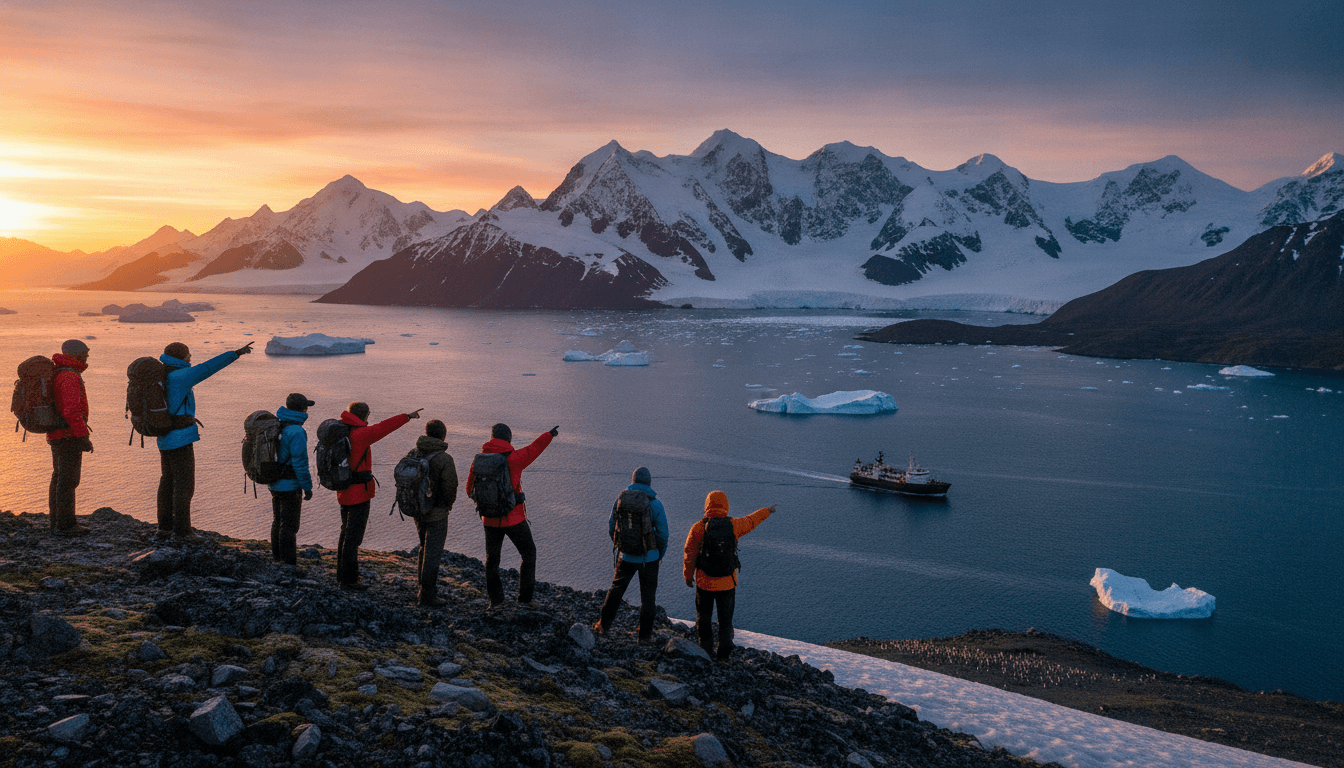
Spirit of Shackleton: Self-Launched Antarctic Expedition (Ushuaia → Antarctica → South Georgia → Falklands → Ushuaia)
21 days · Ushuaia, Antarctica, South Georgia & Falkland Islands
G Adventures charges £13,700
No-markup version: ~£10,200 per person
Estimate only, not a guaranteed price. Always verify costs independently before booking.
This is the self-launched equivalent of G Adventures' iconic Spirit of Shackleton polar expedition — one of the most remote and awe-inspiring journeys on Earth. The route takes you from Ushuaia across the Drake Passage to the Antarctic Peninsula, then northeast to Elephant Island and South Georgia (resting place of Ernest Shackleton himself), before finishing in the Falkland Islands and returning to Ushuaia. Because the bulk of this trip is an ocean expedition by necessity, the core vessel cost cannot be replaced with local transport — but by booking independently through specialist polar expedition operators rather than via a group tour markup, and choosing the most budget-conscious cabin categories, you can save significantly. Pre- and post-cruise nights in Ushuaia are booked independently at local guesthouses. Note: all cost estimates are approximate. Antarctic expeditions carry inherent fixed costs; savings here come from cutting the operator premium, booking directly, and choosing shared cabins on independent expedition vessels.
Day-by-day
Arrive Ushuaia — The End of the World
Ushuaia, Argentina
Fly into Malvinas Argentinas International Airport (USH). Ushuaia is the world's southernmost city and your gateway to Antarctica. Check into a budget hostel or guesthouse in the town centre — options like Freestyle Hostel or Los Cormoranes offer dorm and private rooms from ~£18-30/night. Spend the afternoon exploring the waterfront Beagle Channel, stroll Avenida San Martín, and grab dinner at one of the local parrillas. If time allows, take the local bus or taxi (~£4) to Tierra del Fuego National Park for a self-guided hike (~£15 entry fee) — this is an optional activity on the G Adventures tour too. Tomorrow you embark, so pack your kit and get an early night.
🚌Fly into Ushuaia (USH) — book independently. From airport, take a remis (shared taxi) to town centre ~£5-8.
🛏Freestyle Hostel or Los Cormoranes Guesthouse, Ushuaia — dorm ~£18/night, private ~£30/night
- →Self-guided walk along the Beagle Channel waterfront
- →Explore Avenida San Martín and Ushuaia town centre
- →Optional: Tierra del Fuego National Park self-entry visit (~£15, local bus/remis ~£4 each way)
- →Optional: Martial Glacier hike (accessible via chairlift or trail — lift ~£8)
- →Book polar/cold weather gear rental locally if needed (~£20-40 for the trip)
Embarkation Day — Set Sail from Ushuaia
Ushuaia → Beagle Channel → Drake Passage
Check out of your hostel and make your way to the Ushuaia port for embarkation (usually early afternoon). When booking independently, look for expedition vessels operated by companies like Quark Expeditions, Poseidon Expeditions, Oceanwide Expeditions, or Aurora Expeditions — all offer 'Spirit of Shackleton' style full circuit itineraries (Antarctica + South Georgia + Falklands) with shared cabin options. Book the lowest cabin category (triple or quad share) for maximum savings. The ship departs through the Beagle Channel — an extraordinarily scenic passage flanked by mountains. Dinner and safety briefings are included on board from this point.
🚌Walk or short taxi to Ushuaia pier. All subsequent transport is aboard the expedition vessel (included in expedition cost).
🛏Expedition vessel shared cabin (included in expedition booking cost)
- →Embark expedition vessel at Ushuaia port
- →Safety and zodiac briefing with expedition team
- →Scenic transit through the Beagle Channel
- →Attend first on-board lecture from expedition naturalists
Drake Passage — Crossing the Roughest Sea on Earth
Drake Passage
Day one of crossing the notorious Drake Passage — the body of water between Cape Horn and the South Shetland Islands. Conditions can range from the fabled 'Drake Lake' (calm) to 'Drake Shake' (very rough). Most independent expedition ships offer a full on-board lecture programme by expert naturalists, ornithologists, and glaciologists — take full advantage. Watch for albatrosses, petrels, and cape pigeons following the ship. Sea sickness tablets are wise (buy before departure in Ushuaia chemists, ~£3). All meals included on board.
🚌Aboard expedition vessel
🛏Expedition vessel shared cabin
- →Attend naturalist lectures on Antarctic wildlife, geology, and Shackleton's history
- →Seabird watching from the deck — albatrosses, petrels, storm petrels
- →Join the ship's library and read up on Shackleton's Endurance expedition
- →Rest and acclimatise — sea legs required!
Drake Passage — Final Approach to Antarctica
Drake Passage → South Shetland Islands approach
The second day crossing the Drake. By late afternoon or evening, if conditions allow, you may spot your first icebergs — a genuinely jaw-dropping moment. The crew will continue the educational programme. Keep an eye on the expedition notice board for tomorrow's planned zodiac landing schedule — these are briefed the evening before and depend on weather and ice conditions. Dress in layers: the ship is warm but zodiac landings require serious cold-weather gear.
🚌Aboard expedition vessel
🛏Expedition vessel shared cabin
- →Continue naturalist lecture programme
- →First iceberg sightings — watch from the bow
- →Evening briefing on Day 5 landing plans
- →Zodiac safety and boarding practice
South Shetland Islands — First Landings in Antarctica
South Shetland Islands, Antarctica
Welcome to Antarctica! The South Shetland Islands — typically King George Island, Deception Island, or Half Moon Island — offer your first zodiac landings on Antarctic soil. Expect enormous penguin colonies (chinstrap, gentoo, and macaroni), fur seals, and breathtaking volcanic scenery. Zodiac cruising in calm bays with icebergs is included in your expedition package. The optional 'Polar Plunge' — jumping into Antarctic waters — is a rite of passage and typically free on board. All zodiac operations and landings are led by the ship's expedition team.
🚌Zodiac tenders from ship to shore (included)
🛏Expedition vessel shared cabin
- →Zodiac landing at South Shetland Islands (included in expedition)
- →Penguin colony visits — chinstrap and gentoo penguins
- →Zodiac cruising among icebergs
- →Optional: Polar Plunge into Antarctic waters (free, on board)
- →Evening recap lecture and wildlife log
Antarctic Peninsula — Into the Ice
Antarctic Peninsula
The ship pushes deeper into the Antarctic Peninsula — one of the most dramatic landscapes on Earth. Expect multiple zodiac landings or cruises today, depending on ice and weather. Classic Peninsula sites include Paradise Bay, Neko Harbour, and Cuverville Island. These locations offer enormous gentoo penguin rookeries, calving glaciers, and the eerie silence of a world of white. Photography opportunities are extraordinary. Remember: no touching wildlife, no removing anything, stay 5m from penguins (though they may approach you!).
🚌Zodiac tenders (included)
🛏Expedition vessel shared cabin
- →Zodiac landing at Paradise Bay or Neko Harbour (included)
- →Gentoo penguin rookery visit
- →Glacier watching — listen for calving ice
- →Zodiac cruising in ice-filled bays
- →Evening lecture: Antarctic ecology and climate change
Antarctic Peninsula — Weddell Sea & Wildlife
Antarctic Peninsula / Bransfield Strait
Deeper exploration of the Peninsula, potentially crossing into the Weddell Sea — home to vast sea ice, tabular icebergs, and Weddell seals hauled out on ice floes. Look for humpback and minke whales — sightings in this region are common. The expedition team will adjust the route based on ice conditions and wildlife. Optional kayaking (pre-booked add-on with some operators, typically ~£150-200 for the full trip) gives a low-to-the-water perspective among the icebergs that is simply unforgettable.
🚌Zodiac tenders (included)
🛏Expedition vessel shared cabin
- →Weddell Sea zodiac cruise — tabular icebergs and sea ice
- →Weddell seal spotting from zodiacs
- →Whale watching — humpback and minke whales
- →Optional: Kayaking among icebergs (pre-booked add-on, ~£150-200 for trip)
- →Learn about Antarctic exploration history with expedition team
Antarctic Peninsula — Lemaire Channel
Antarctic Peninsula — Lemaire Channel
The Lemaire Channel — nicknamed 'Kodak Gap' — is one of Antarctica's most photographed passages: a narrow 11km channel flanked by sheer cliff faces rising 750m from the water. The ship navigates slowly through, and the silence is profound. If ice permits, zodiacs will operate. Look for crabeater seals resting on pan ice and leopard seals lurking below. This is peak photography day — have your camera ready from first light.
🚌Ship navigation + zodiac tenders (included)
🛏Expedition vessel shared cabin
- →Ship navigation of the Lemaire Channel
- →Zodiac cruise if ice permits (included)
- →Crabeater and leopard seal spotting
- →Photography workshop with ship's naturalist
- →Optional: Antarctica overnight camping (pre-booked add-on with select operators)
Antarctic Peninsula — Final Landings
Antarctic Peninsula
Final day of Peninsula exploration before the ship turns northeast toward Elephant Island and South Georgia. Make the most of today's zodiac landings — every site is different. The expedition team will hold a 'wrap-up' of the Peninsula leg in the evening. Exchange photos with fellow travellers, write your expedition journal, and prepare for two days of open ocean crossing ahead.
🚌Zodiac tenders (included), ship departs northeast
🛏Expedition vessel shared cabin
- →Final Peninsula zodiac landings (included)
- →Attend expedition wrap-up lecture on Peninsula leg
- →Share and discuss wildlife sightings with fellow passengers
- →Evening: prepare for Scotia Sea crossing
Scotia Sea Crossing — Toward Elephant Island
Scotia Sea / Bransfield Strait
Two days of open ocean sailing across the Scotia Sea, heading toward Elephant Island — the spot where Shackleton's crew waited 4.5 months in 1916 while he sailed to South Georgia for rescue. Conditions can be rough. Lectures continue: today focus on Shackleton's extraordinary Endurance story, as you'll soon visit the very places he sailed. Seabird spotting remains excellent — southern giant petrels, skuas, and possibly wandering albatross.
🚌Aboard expedition vessel
🛏Expedition vessel shared cabin
- →Lecture series on Shackleton's Endurance expedition
- →Seabird watching — wandering albatross, giant petrels
- →Film screening: documentary on Shackleton or polar exploration
- →Rest and journalling
Elephant Island — Where Shackleton's Men Waited
Elephant Island, Scotia Sea
Elephant Island is a dramatic, glacier-fringed rock that looms out of the Southern Ocean. Landing is rarely possible due to surf and weather, but a zodiac cruise close to shore — particularly Point Wild, where the 22 men sheltered under upturned lifeboats — is deeply moving. Your expedition naturalists will bring Shackleton's story to life on location. Look for chinstrap penguins nesting on the sheer cliffs and elephant seals on the beaches.
🚌Zodiac tenders (included)
🛏Expedition vessel shared cabin
- →Zodiac cruise to Point Wild, Elephant Island (included)
- →Visit the site where Shackleton's 22 crew sheltered for 4.5 months
- →Chinstrap penguin cliff colonies viewed from zodiacs
- →Elephant seal spotting
- →On-deck Shackleton lecture at Point Wild
Crossing to South Georgia — Shackleton's Route
Scotia Sea → South Georgia approach
The ship now sails the same route Shackleton navigated in the James Caird — a 22-foot lifeboat — in some of the world's worst seas. It took him 17 days. You'll cover it in roughly 36-48 hours on a modern expedition vessel. Lectures today focus on South Georgia's extraordinary wildlife, whaling history, and the geography of the island. By late afternoon or evening you may spot the first snow-capped peaks of South Georgia rising from the ocean.
🚌Aboard expedition vessel
🛏Expedition vessel shared cabin
- →Lecture: South Georgia wildlife — king penguins, elephant seals, albatrosses
- →Lecture: South Georgia whaling history
- →First sightings of South Georgia's mountains
- →Seabird watching — approach to island brings more species
South Georgia — Gold Harbour & Salisbury Plain
South Georgia
South Georgia is arguably the wildlife highlight of the entire expedition. Gold Harbour and Salisbury Plain host some of the largest king penguin colonies on Earth — hundreds of thousands of birds in a single bay, backed by glaciers. Elephant seals the size of cars loll on the beaches; reindeer (introduced) roam the hills. The scale and the noise are overwhelming. Zodiac landings here are the expedition's most memorable. No entry fee — your expedition landing fees are included in the vessel cost.
🚌Zodiac tenders (included)
🛏Expedition vessel shared cabin
- →Zodiac landing at Gold Harbour or Salisbury Plain (included)
- →King penguin 'supercolony' — hundreds of thousands of birds
- →Southern elephant seal harem observation
- →Gentoo and macaroni penguin sub-colonies
- →Glacier photography backdrop
- →Wandering albatross nesting sites
South Georgia — Grytviken & Shackleton's Grave
Grytviken, South Georgia
Grytviken is the historic whaling station and the emotional heart of this journey. Here you'll visit Ernest Shackleton's grave in the whalers' cemetery — a moment of great poignancy for anyone who has followed his story. The South Georgia Museum (small donation appreciated) tells the full history of whaling and exploration. Fur seals are everywhere in and around the old station — watch your step! A toast to Shackleton at his graveside with a dram of whisky is a ship tradition. The South Georgia Heritage Trust works to restore the whaling station — you can learn about their conservation work here.
🚌Zodiac tenders (included)
🛏Expedition vessel shared cabin
- →Visit Shackleton's grave, Grytviken Cemetery (included)
- →South Georgia Museum visit (donation ~£3-5)
- →Explore the restored whaling station at Grytviken
- →South Georgia Heritage Trust conservation exhibit
- →Fur seal colony — take care navigating ashore
- →Traditional whisky toast to Shackleton at graveside
South Georgia — Prion Island & St Andrews Bay
South Georgia
Final day on South Georgia. St Andrews Bay is home to the largest king penguin colony on the island — an estimated 150,000+ birds. The bay is backed by the Cook Glacier and framed by mountains — truly one of the great wildlife spectacles on the planet. Prion Island is a protected wandering albatross nesting site — access is strictly managed and a privilege to visit. This is your last chance to absorb South Georgia before the ship heads northwest toward the Falklands.
🚌Zodiac tenders (included), ship departs toward Falklands
🛏Expedition vessel shared cabin
- →Zodiac landing at St Andrews Bay (included) — largest king penguin colony
- →Prion Island — wandering albatross nesting sites (permitted landing, included)
- →Final South Georgia wildlife photography
- →Evening farewell to South Georgia on deck
Southern Ocean — Sailing to the Falklands
Southern Ocean
Two days of sailing the Southern Ocean between South Georgia and the Falkland Islands. Conditions are typically calmer than the Drake Passage. The lecture programme continues with a focus on Falklands natural history, the 1982 conflict, and the islands' unique culture. This is a good time to write up your wildlife log, sort and back up your photos, and swap stories with fellow expeditioners.
🚌Aboard expedition vessel
🛏Expedition vessel shared cabin
- →Lecture: Falkland Islands — history, wildlife, and the 1982 conflict
- →Seabird watching — black-browed albatross numbers increase
- →Photo editing and backup session
- →Wildlife log write-up with naturalist guidance
Southern Ocean — Approach to the Falklands
Southern Ocean → Falkland Islands approach
Final at-sea day before reaching the Falklands. By late afternoon, the moorland and cliffs of the Falkland Islands may be visible on the horizon. The crew will brief for tomorrow's landings. The Falklands operate on GBP — your UK bank card will work without issue. The islands are genuinely remote, windswept, and extraordinarily beautiful. Stock up on any remaining ship amenity purchases before disembarkation approaches.
🚌Aboard expedition vessel
🛏Expedition vessel shared cabin
- →Final at-sea lecture programme
- →First sightings of Falkland Islands coastline
- →Ship's farewell preparations and expedition recap
- →Currency note: Falkland Islands Pound (1:1 with GBP)
Falkland Islands — Sea Lion Island & Wildlife
Falkland Islands (Outer Islands)
The outer islands of the Falklands offer extraordinary wildlife: massive black-browed albatross colonies at Steeple Jason and West Point Island, rockhopper and Magellanic penguins, southern sea lions, and southern elephant seals. Sea Lion Island in the south is famous for orca hunting sea lions in the shallows — a rare natural spectacle. Zodiac landings on the outer islands are included in the expedition. The landscapes feel like a sub-Antarctic version of the Scottish Outer Hebrides.
🚌Zodiac tenders (included)
🛏Expedition vessel shared cabin
- →Zodiac landing on outer Falkland islands (included)
- →Black-browed albatross colony — nesting pairs at close range
- →Rockhopper penguin colony
- →Southern sea lion beach
- →Optional: Orca (killer whale) hunting behaviour at Sea Lion Island
Falkland Islands — Stanley, the Capital
Stanley, Falkland Islands
Stanley is one of the world's most remote capitals — a colourful, windswept settlement of ~2,500 people with a distinctly British feel. The ship docks or tenders into Stanley Harbour. Walk the town independently: visit the 1982 War Memorial, the Whalebone Arch, and the historic wrecked sailing ships in the harbour. The museum on John Street covers both natural history and the 1982 conflict. Pop into the Falkland Islands Company Store or the Pink Shop for local gifts. Chat with Stanley locals — a unique cross-cultural interaction that the G Adventures tour also highlights.
🚌Zodiac tenders from ship to Stanley (included). Walking in Stanley is free — it's compact.
🛏Expedition vessel shared cabin
- →Self-guided walking tour of Stanley (free)
- →Falkland Islands Museum, John Street (~£5 entry)
- →1982 Liberation Monument and War Memorial
- →Historic shipwrecks in Stanley Harbour
- →Whalebone Arch on Ross Road
- →Chat with Stanley locals — pub lunch at the Globe Tavern (~£12)
- →Optional: 4WD self-drive or taxi tour to Volunteer Point penguin colony (~£80-100 per vehicle)
Falkland Islands to Ushuaia — Final Crossing
Falkland Islands → Drake Passage → Ushuaia
The ship departs Stanley and begins the final leg — sailing southwest back to Ushuaia, crossing through the Le Maire Strait and into the Beagle Channel. The expedition team will hold a final recap presentation, certificate ceremony, and farewell dinner on board. Exchange contacts with fellow expeditioners — these are lifelong friendships forged in one of Earth's most extreme environments. Pack carefully: disembarkation is tomorrow morning.
🚌Aboard expedition vessel, returning to Ushuaia
🛏Expedition vessel shared cabin (final night)
- →Final lecture recap and expedition highlights presentation
- →Expedition certificate ceremony on board
- →Farewell group dinner on board
- →Pack and prepare for Ushuaia disembarkation
Disembarkation in Ushuaia — Journey's End
Ushuaia, Argentina
Disembark in Ushuaia in the morning. The city feels different now — warmer, busier, more colourful — after three weeks in the white world. If your flight home is not until tomorrow, rebook a night at your original hostel (prices ~£18-30/night). Celebrate with a proper Patagonian lamb meal at one of Ushuaia's excellent restaurants — you've earned it. Transfer to Ushuaia Airport (USH) independently by remis (~£5-8) for your onward flight. Note: book a flexible onward flight from Ushuaia — expedition return dates can shift by up to 24 hours due to weather.
🚌Remis (shared taxi) from Ushuaia port to town or airport ~£5-8. Book flexible outbound flights from USH.
🛏Freestyle Hostel or Los Cormoranes (if overnight needed) — dorm ~£18, private ~£30
- →Disembark expedition vessel at Ushuaia port
- →Optional: extra night in Ushuaia if needed (book flexible accommodation)
- →Celebratory Patagonian lamb dinner (~£18-25)
- →Transfer to Ushuaia Airport for onward flight
Self-launched vs. G Adventures
| This itinerary (self-launched) | G Adventures | |
|---|---|---|
| Price per person | ~£10,200 | £13,700 |
| Duration | 21 days | 21 days |
| Who books it | You and your group, direct | Tour operator, guided group |
| Savings | £3,500 per person (26%) | |
Estimate only, not a guaranteed price. Always verify costs independently before booking.
Want to see more G Adventures-style trips? Check them out here.~£10,200
estimated per person
You never pay Travel Crew for this — you pay hostels, transport, and activity providers directly, the same as if you'd booked it all yourself.
This publishes your dates so other travellers can find and join you — no tour operator needed.
Customise with Tour BusterCreated by

Travel Crew
0 trips
Frequently asked questions
How much does Spirit of Shackleton: Self-Launched Antarctic Expedition (Ushuaia → Antarctica → South Georgia → Falklands → Ushuaia) cost?+
Doing it yourself with this self-launched itinerary costs an estimated £10,200 per person for 21 days in Ushuaia, Antarctica, South Georgia & Falkland Islands. This is an AI-generated estimate based on typical budget-traveller prices — actual costs will vary by season and how you book.
Is this cheaper than booking with G Adventures?+
Yes — G Adventures charges around £13,700 per person for a similar tour. Doing the same route independently, using the same standard of accommodation and activities, costs an estimated £10,200 — a saving of roughly £3,500 (26%) per person.
How long is the Ushuaia, Antarctica, South Georgia & Falkland Islands trip?+
This itinerary runs 21 days, covering 21 day-by-day stops through Ushuaia, Antarctica, South Georgia & Falkland Islands.
How do I join this trip?+
You can join an existing open departure using this itinerary if one is scheduled, or launch your own departure with your own dates and invite other travellers to join you — no tour operator required.
Isn't it easier to just use a tour operator?+
Well, yes, a tour operator will book all the individual parts of your travel for you and provide a guide. That's obvious, but doing this has the potential to save the group thousands, which can in turn improve your itinerary substantially or save you huge amounts of money. Also, when you launch a departure, Travel Crew has tools in place to help you book the individual sections of the trip or make it easier for you to do this as a group. Really, you do not need a middle man. If you are more comfortable paying more and using a middle man, then you should certainly do this.
Is it safer to book through a tour operator?+
Arguably, there isn't much difference. A self-launched trip runs on the same principle as a group travel crew: collective responsibility, everyone looking out for each other, the same way it would if a group of friends organised the trip themselves — because that's exactly what's happening. You should always take out travel insurance before you go, self-launched or not; that doesn't change either way. Every open departure is published publicly with real dates and a real trip organiser, so it's never an anonymous arrangement, and our support team is reachable any time you need help, including in an emergency while you're away. Longer-term, we're building direct relationships with ground DMCs in popular destinations, offered as an optional paid add-on for extra on-the-ground support. Ultimately, though, the group is responsible for its own conduct and safety on a self-launched trip, same as on any trip you plan yourself.
What kind of trip is this?+
This is a adventure, wildlife, culture trip through Ushuaia, Antarctica, South Georgia & Falkland Islands, self-launched rather than run by a tour operator — you organise it with a group you find or bring yourself.
Would you like to name the operator, name the trip, or have any suggestions about how to improve this itinerary?
Drop your comment below — if you've done a similar route, tell us what worked, what you'd add, or what you'd skip.
No comments yet — be the first to share your take.
Sign in to leave a comment.