
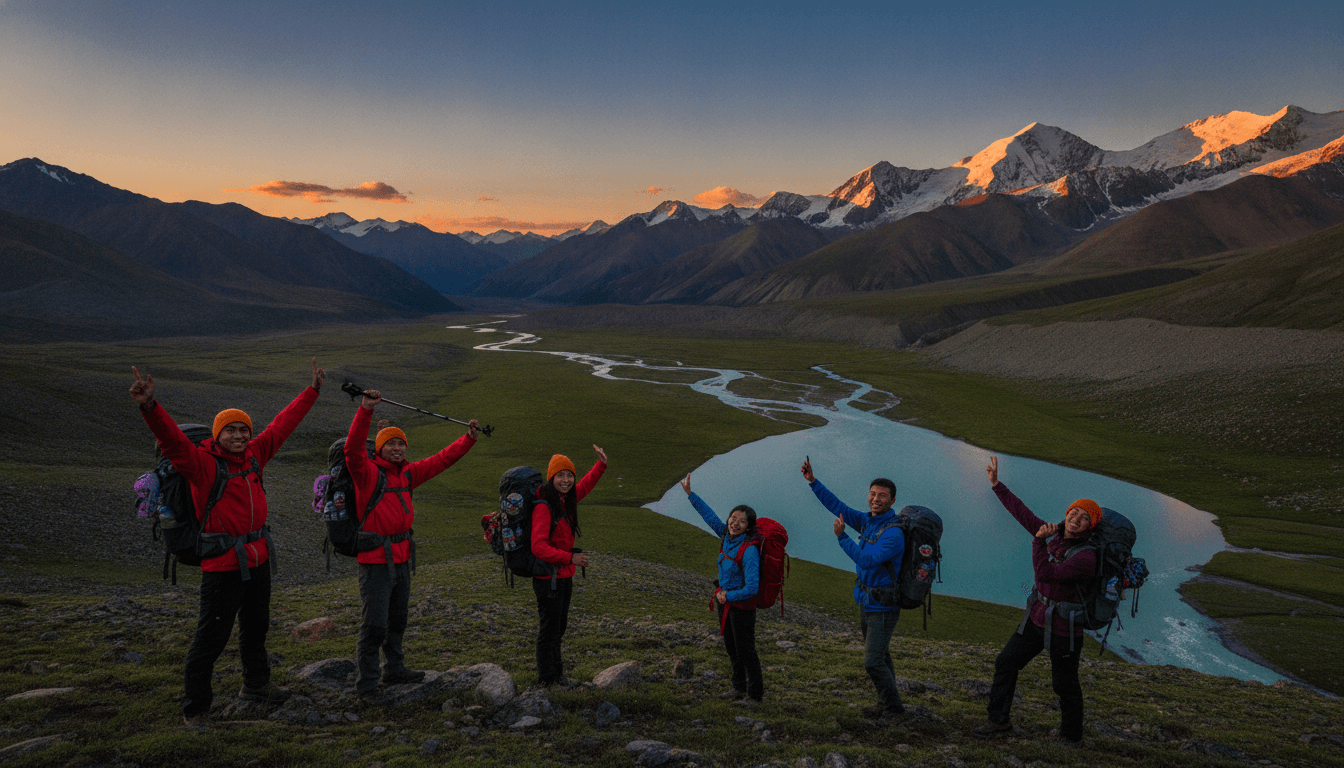
Self-Launched Silk Road Wusun Trail: 8-Day Trekking Expedition in the Tianshan Mountains
8 days · Xinjiang, China
Doufeng Adventure charges £990
No-markup version: ~£650 per person
Estimate only, not a guaranteed price. Always verify costs independently before booking.
The Ancient Wusun Trail is one of China's most spectacular and remote multi-day treks — cutting through the Tianshan Mountains from Yining to Kuqa via high alpine passes, glacial valleys, and nomadic Kazakh landscapes. This self-launched version follows the exact same route as Doufeng Adventure's guided expedition, replacing the group tour package with independent planning: local shared transport to the trailhead, a locally hired guide or porter arranged on arrival in Yining (mandatory for foreign trekkers in Xinjiang), wild camping and guesthouse stays in Qiongkushitai village, and self-prepared or locally sourced meals on trail. Estimated cost is approximately £600–£700 per person vs. ~£990 on the commercial tour — saving you around £300 while giving you full flexibility on pacing and group size. Note: trekking in Xinjiang requires advance permits and it is strongly advised to hire a local guide; budget accordingly. Best season is June to early October.
Day-by-day
Arrival in Yining — Explore & Prepare
Yining (Gulja), Xinjiang
Fly or take the overnight train into Yining (Gulja), the gateway city to the Wusun Trail. Check into a budget guesthouse in the city centre. Spend the afternoon exploring Liuxing Street (Six-Star Street) — a photogenic Uyghur and Kazakh neighbourhood — and take a walk along the Ili River at sunset. In the evening, sort your trail logistics: arrange your local guide (required for foreigners trekking in Xinjiang — budget around £60–£90 for the full trek), confirm any permits needed, and pick up trail snacks and supplies from the local market. Eat dinner at a local Uyghur restaurant — lamb skewers, naan bread, and laghman noodles are excellent and very cheap.
🚌Fly to Yining Airport (GHZ) from Urumqi (~£40–£70 one-way) or take a shared taxi/sleeper bus from Urumqi (~£15–£25, ~10 hrs). Urumqi is reached via international or domestic flights.
🛏Budget guesthouse or hostel in Yining city centre (e.g. around Jiefang Road area) — approx. £10–£15/night
- →Walk Liuxing Street (Six-Star Street) — free
- →Stroll along the Ili River — free
- →Arrange local guide for the trek at Yining guesthouses or via local trekking contacts (~£60–£90 total for the trek)
- →Stock up on trail food at the local bazaar
- →Dinner at a local Uyghur restaurant (~£5–£8)
Yining to Qiongkushitai Village — Trail Begins
Qiongkushitai Village, Tekes County
Take a hired minivan or shared vehicle from Yining to Tekes County (Bagua City — a town famously laid out in the shape of a Bagua diagram, worth a quick detour) and then onward to Qiongkushitai Village, the traditional starting point of the Wusun Trail. The drive takes approximately 3–4 hours. Once at the village, check into a Kazakh family homestay (yurt accommodation is available for very reasonable rates). In the afternoon, begin your first hike: a 10km warm-up walk along the Qiongkushitai River through stunning meadows. Dinner and breakfast are typically included at the homestay.
🚌Hire a minivan from Yining to Qiongkushitai Village (shared between group, ~£15–£25pp depending on group size, ~3–4 hrs). Arrange via your guesthouse in Yining the night before.
🛏Kazakh family yurt homestay in Qiongkushitai Village — approx. £12–£18/night including meals
- →Detour through Tekes Bagua City — free to walk
- →Hike 10km along Qiongkushitai River through meadows and forest (4–5 hours) — free
- →Stay in a Kazakh family yurt homestay (~£12–£18 including dinner and breakfast)
Qiongkushitai to Kunuosai Valley — High Pass Crossing
Kunuosai Valley, Tianshan Mountains
Today is the most demanding day so far: a full 20km trek (approximately 8 hours) through rocky terrain, vast alpine meadows, and wildflower-covered slopes, culminating in the crossing of Qiongdaban Pass at 3,744m. The views from the pass are extraordinary — a 360-degree panorama of the Tianshan range. Descend into the lush Kunuosai Valley and make camp. This is wild camping territory — bring a quality tent, sleeping bag rated to -10°C, and a camp stove. Water is available from glacial streams (treat or filter it).
🚌On foot — self-sufficient trekking day
🛏Wild camping in Kunuosai Valley — free (bring your own tent and sleeping bag)
- →Full-day 20km mountain trek crossing Qiongdaban Pass (3,744m) — free
- →Wild camping in Kunuosai Valley — free (carry tent)
- →Wildlife spotting: ibex, eagles, marmots common in this area
Kunuosai Valley to Kokesu River — V-Valleys & Zip-line
Kokesu River, Tianshan Mountains
Trek down through dramatic V-shaped valleys carved by glacial rivers, passing through ancient spruce and fir forests. The highlight of the day is crossing the Kokesu River via a traditional manual zip-line — one of the most thrilling and memorable moments on the trail. The crossing is managed by local Kazakh families who run it as a small business (small fee payable on site, usually a few yuan). Make camp on the riverbank. Evening is ideal for washing in the river and watching the stars in this utterly remote wilderness.
🚌On foot — self-sufficient trekking day
🛏Wild camping on Kokesu River — free
- →Trek through V-shaped valleys and old-growth forest — free
- →Cross Kokesu River via traditional manual zip-line (~£1–£2)
- →Wild camping on the Kokesu riverbank — free
Kokesu River to Heaven Lake (Akekule Lake) — Seven Crossings & Summit
Heaven Lake (Akekule Lake), Tianshan Mountains
A long and rewarding day: hike downstream along the Kokesu River, crossing it on foot seven times (waterproof boots or trekking sandals strongly recommended). The river crossings are thigh-deep in places — use trekking poles for balance. After the crossings, begin a steep ascent to a 3,400m pass before descending to Heaven Lake (Akekule Lake) — a pristine, turquoise alpine lake surrounded by snow-capped peaks. Wild camp on the lakeshore. This is one of the most iconic wild camping spots in all of China.
🚌On foot — self-sufficient trekking day
🛏Wild camping at Heaven Lake (Akekule Lake) — free
- →Trek downstream with seven river crossings along Kokesu River — free
- →Ascend 3,400m pass — free
- →Arrive at Heaven Lake (Akekule Lake) and wild camp on the lakeshore — free
- →Photography of glacial lake at sunset
Heaven Lake to Bozikeerg Valley — Icy Passes & Glacial Descents
Bozikeerg Valley, Tianshan Mountains
Today involves the most technical section of the trek: hike past the dramatic Tiger's Mouth cliff formation at Heaven Lake, then make a careful ascent of Akebulak Pass at 3,900m — the highest point on the trail. The upper slopes can be icy even in summer; trekking poles and microspikes are strongly recommended. The reward is a breathtaking 20km descent into the vast Bozikeerg Valley, with sweeping views over the Xinjiang plains in the distance. Wild camp in the valley.
🚌On foot — self-sufficient trekking day
🛏Wild camping in Bozikeerg Valley — free
- →Trek past Tiger's Mouth cliff at Heaven Lake — free
- →Ascend Akebulak Pass (3,900m) with possible icy conditions — free
- →20km descent into Bozikeerg Valley — free
- →Wild camping in Bozikeerg Valley — free
Bozikeerg Valley to Kuqa — 40 Crossings & Farewell
Kuqa (Kuche), Xinjiang
The final trekking day is legendary: traverse the full length of Bozikeerg Valley with approximately 40 river crossings — a relentless but exhilarating finale. Optional horseback riding is available from Kazakh herder families for some of the crossings (negotiate on the spot, typically £5–£15 for a section). A 4WD vehicle should be pre-arranged to meet you at Heiyingshan at the valley exit and drive you the remaining distance to Kuqa. In Kuqa, check into a budget hotel, clean up, and celebrate with a feast at a local Uyghur restaurant — try the Kuqa-style lamb rice and pomegranate juice. You've earned it.
🚌On foot for the valley crossing, then pre-arranged 4WD from Heiyingshan valley exit to Kuqa (~£15–£25pp). Arrange this in advance via your guide in Yining.
🛏Budget hotel in Kuqa city centre — approx. £12–£18/night
- →Traverse Bozikeerg Valley with ~40 river crossings — free
- →Optional horseback riding during crossings (~£5–£15, negotiate with local Kazakh herders)
- →4WD pickup from valley exit to Kuqa (pre-arrange via Yining guide, ~£15–£25pp)
- →Farewell dinner in Kuqa at a local Uyghur restaurant (~£6–£10)
Departure from Kuqa — or Extend to Kashgar/Duku Highway
Kuqa (Kuche), Xinjiang
Fly out of Kuqa Airport (KCA) to Urumqi and connect onward. Alternatively, this is a fantastic springboard for two unmissable extensions: the ancient Silk Road city of Kashgar (fly or take a bus/train, ~£20–£40) with its spectacular Sunday livestock market and Id Kah Mosque; or drive the legendary Duku Highway — one of the world's most dramatic mountain roads — via shared hire car or public bus toward Urumqi. Both extensions add 2–4 days and are highly recommended.
🚌Fly from Kuqa Airport (KCA) to Urumqi (~£40–£70). Kashgar extension: fly or sleeper bus from Kuqa (~£20–£40). Duku Highway: shared taxi or local bus (~£20–£35pp).
🛏Departure day — or budget guesthouse in Kashgar if extending (~£10–£15/night)
- →Fly Kuqa (KCA) to Urumqi then connect home (~£40–£70 domestic)
- →Optional: Extend to Kashgar via flight or train (~£20–£40) — explore Id Kah Mosque, Sunday Livestock Market, Old Town
- →Optional: Drive the Duku Highway toward Urumqi — one of China's most scenic mountain roads (hire car or shared taxi ~£20–£35pp)
Self-launched vs. Doufeng Adventure
| This itinerary (self-launched) | Doufeng Adventure | |
|---|---|---|
| Price per person | ~£650 | £990 |
| Duration | 8 days | 8 days |
| Who books it | You and your group, direct | Tour operator, guided group |
| Savings | £340 per person (34%) | |
Estimate only, not a guaranteed price. Always verify costs independently before booking.
Want to see more Doufeng Adventure-style trips? Check them out here.~£650
estimated per person
You never pay Travel Crew for this — you pay hostels, transport, and activity providers directly, the same as if you'd booked it all yourself.
This publishes your dates so other travellers can find and join you — no tour operator needed.
Customise with Tour BusterCreated by

Travel Crew
0 trips
Frequently asked questions
How much does Self-Launched Silk Road Wusun Trail: 8-Day Trekking Expedition in the Tianshan Mountains cost?+
Doing it yourself with this self-launched itinerary costs an estimated £650 per person for 8 days in Xinjiang, China. This is an AI-generated estimate based on typical budget-traveller prices — actual costs will vary by season and how you book.
Is this cheaper than booking with Doufeng Adventure?+
Yes — Doufeng Adventure charges around £990 per person for a similar tour. Doing the same route independently, using the same standard of accommodation and activities, costs an estimated £650 — a saving of roughly £340 (34%) per person.
How long is the Xinjiang, China trip?+
This itinerary runs 8 days, covering 8 day-by-day stops through Xinjiang, China.
How do I join this trip?+
You can join an existing open departure using this itinerary if one is scheduled, or launch your own departure with your own dates and invite other travellers to join you — no tour operator required.
Isn't it easier to just use a tour operator?+
Well, yes, a tour operator will book all the individual parts of your travel for you and provide a guide. That's obvious, but doing this has the potential to save the group thousands, which can in turn improve your itinerary substantially or save you huge amounts of money. Also, when you launch a departure, Travel Crew has tools in place to help you book the individual sections of the trip or make it easier for you to do this as a group. Really, you do not need a middle man. If you are more comfortable paying more and using a middle man, then you should certainly do this.
Is it safer to book through a tour operator?+
Arguably, there isn't much difference. A self-launched trip runs on the same principle as a group travel crew: collective responsibility, everyone looking out for each other, the same way it would if a group of friends organised the trip themselves — because that's exactly what's happening. You should always take out travel insurance before you go, self-launched or not; that doesn't change either way. Every open departure is published publicly with real dates and a real trip organiser, so it's never an anonymous arrangement, and our support team is reachable any time you need help, including in an emergency while you're away. Longer-term, we're building direct relationships with ground DMCs in popular destinations, offered as an optional paid add-on for extra on-the-ground support. Ultimately, though, the group is responsible for its own conduct and safety on a self-launched trip, same as on any trip you plan yourself.
What kind of trip is this?+
This is a adventure, hiking, culture trip through Xinjiang, China, self-launched rather than run by a tour operator — you organise it with a group you find or bring yourself.
Would you like to name the operator, name the trip, or have any suggestions about how to improve this itinerary?
Drop your comment below — if you've done a similar route, tell us what worked, what you'd add, or what you'd skip.
No comments yet — be the first to share your take.
Sign in to leave a comment.